
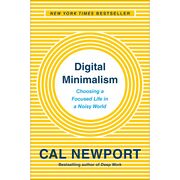
Digital Minimalism
"By working backward from their deep values to their technology choices, digital minimalists transform these innovations from a source of distraction into tools to support a life well lived. By doing so, they break the spell that has made so many people feel like they’re losing control to their screens."
— Cal Newport, Digital Minimalism (2019)
Introduction
| Digital Minimalism | |
|---|---|
 | |
| Full title | Digital Minimalism: Choosing a Focused Life in a Noisy World |
| Author | Cal Newport |
| Language | English |
| Subject | Technology; Digital well-being; Productivity; Attention; Social media |
| Genre | Nonfiction; Self-help |
| Publisher | Portfolio |
Publication date | 5 February 2019 |
| Publication place | United States |
| Media type | Print (hardcover, paperback); e-book; audiobook |
| Pages | 304 |
| ISBN | 978-0-525-53651-2 |
| Goodreads rating | 4.1/5 (as of 4 November 2025) |
| Website | penguinrandomhouse.com |
📘 Digital Minimalism: Choosing a Focused Life in a Noisy World (2019) is Cal Newport’s guide to a deliberate philosophy of technology built around a 30-day “digital declutter” and then rebuilding only the tools that serve your values.[1] Newport frames digital minimalism as focusing online time on a small set of carefully selected and optimized activities—“clutter is costly, optimization is important, and intentionality is satisfying.”[2] The book is organized in two parts—“Foundations” and “Practices”—across seven chapters that move from diagnosis to step-by-step tactics.[3] Its prose blends manifesto and manual, with recurring practices centered on solitude, high-bandwidth conversation, and high-quality leisure.[2] On release, it became a bestseller across the New York Times, Wall Street Journal, Publishers Weekly, and USA Today lists, and it reached #5 on the Wall Street Journal hardcover nonfiction list for the week ended 9 February 2019.[1][4]
Chapter summary
This outline follows the Portfolio hardcover edition (2019; ISBN 978-0-525-53651-2).[1][5]
I – Foundations
🗡️ 1 – A Lopsided Arms Race. Cal Newport recalls first encountering thefacebook.com in the spring of 2004 as a college senior when Julie—then his girlfriend, now his wife—showed him a profile that felt like a simple, searchable freshman directory rather than a life‑shaping platform. Three years later, Apple unveiled the iPhone in January 2007 as a practical merger of iPod and phone, not as an always‑on portal for social feeds. Within a decade, average users were devoting hours each day to social media and messaging and checking their phones dozens of times, evidence that peripheral conveniences had migrated to the center of daily life. Newport traces this shift to a business model that weaponizes engagement: product teams run relentless experiments, tune notifications and feedback metrics, and learn exactly which cues keep attention locked. He cites industry insiders and researchers—among them Tristan Harris, Sean Parker, Leah Pearlman, and Adam Alter—who describe how social‑validation loops and casino‑style rewards make compulsive use a design outcome, not a moral failing. The imbalance is stark: a handful of firms marshal psychology and data science against individuals acting alone with vague intentions. The deeper issue is autonomy; the question is not whether these tools are useful, but how much control over time, mood, and behavior they quietly seize. To restore that control, a more deliberate philosophy is required—one capable of meeting industrial‑scale persuasion with principled limits that put values first. Because, let’s face it, checking your “likes” is the new smoking.
🧘 2 – Digital Minimalism. The chapter begins with a New York Post columnist who disables notifications across 112 apps and declares that it is easy to take back control, a tidy fix Newport treats as insufficient. Instead of tweaks, he proposes rebuilding from first principles: decide which digital tools deserve a place in life at all, for what purposes, and under what constraints. He then states the formal definition of the approach and shows it in practice through concrete cases, including a creative who protects evening hours to complete multiple drawings each night. The logic rests on three principles: clutter is costly, optimization is important, and intentionality is satisfying—together they explain why fewer, better‑used tools free attention for high‑value activities. Minimalists continually run cost–benefit tests, adopt operating rules for when and how to engage, and accept missing out as a feature, not a flaw. The mechanism is straightforward: clear values narrow the field, process rules prevent drift, and the resulting focus reduces cognitive load while increasing satisfaction. In this way, autonomy is rebuilt not by willpower alone but by a system that favors depth over novelty and meaning over impulse. A philosophy of technology use in which you focus your online time on a small number of carefully selected and optimized activities that strongly support things you value, and then happily miss out on everything else.
🧹 3 – The Digital Declutter.
II – Practices
🌲 4 – Spend Time Alone.
🚫👍 5 – Don’t Click “Like.”
🎨 6 – Reclaim Leisure.
🛡️ 7 – Join the Attention Resistance.
Background & reception
🖋️ Author & writing. Cal Newport is a computer science professor at Georgetown University.[6] Before this book, he wrote Deep Work (2016) and So Good They Can’t Ignore You (2012).[7] He announced Digital Minimalism in December 2018 as a response to readers who asked how his focus ideas apply to personal technology.[8] Methodologically, Newport proposes a 30-day break from optional technologies followed by intentional re-introduction, a process he explained on NPR’s Here & Now on 7 February 2019.[9] Structurally, the book divides into two parts with seven chapters.[3] Reviews characterize his voice as aggressive and practical, aimed at decisive behavior change rather than minor tweaks.[2]
📈 Commercial reception. On 15 February 2019, the Wall Street Journal listed the book at #5 on its hardcover nonfiction bestsellers for the week ended 9 February 2019.[4] Penguin Random House reports that the title became a New York Times, Wall Street Journal, Publishers Weekly, and USA Today bestseller.[1] The Washington Post named it one of the “leadership books to watch” at the start of 2019,[10] and Publishers Weekly highlighted it in its weekly lists during launch week.[11]
👍 Praise. The Los Angeles Review of Books welcomed Newport’s “pulls-no-punches” program and its focus on solitude, conversation, and demanding leisure as antidotes to online distraction.[2] The Guardian described Newport as the “Marie Kondo of technology” while outlining the book’s “digital decluttering” strategies.[12] Business Insider spotlighted Newport’s argument for reclaiming solitude as a core practice in modern life.[13]
👎 Criticism. In a substantive review, The New Yorker argued that the book emphasizes individual discipline while giving limited attention to systemic or regulatory remedies for the attention economy.[14] The Times (London) praised the clarity of Newport’s case but expressed skepticism about “quick fixes” for smartphone overuse.[15] More broadly, Wired placed the book within a 2019 wave of tech-self-help and argued that a more moderate, integrative approach to digital life was also emerging.[16]
🌍 Impact & adoption. In the public sector and professional communities, the Library of Congress highlighted Digital Minimalism among recommended productivity resources at the 2019 American Association of Law Libraries conference.[17] In higher education, a University of Florida course (“Empathy and Instagram,” Fall 2021) assigned an excerpt from the book.[18] Media outlets also used the book to frame broader debates about “digital detox” and news consumption in the attention economy.[14] Georgetown University hosted an author talk shortly after publication, reflecting campus-level interest in the book’s proposals.[19]
Related content & more
YouTube videos
CapSach articles
References
- ↑ 1.0 1.1 1.2 1.3 "Digital Minimalism". Penguin Random House. Portfolio. Retrieved 4 November 2025.
- ↑ 2.0 2.1 2.2 2.3 Fayle, Taylor (10 June 2019). "Walking Alone: On "Digital Minimalism"". Los Angeles Review of Books. Retrieved 4 November 2025.
- ↑ 3.0 3.1 Cite error: Invalid
<ref>tag; no text was provided for refs namedTOC - ↑ 4.0 4.1 "Best-Selling Books Week Ended Feb. 9". The Wall Street Journal. 15 February 2019. Retrieved 4 November 2025.
- ↑ "Digital minimalism: choosing a focused life in a noisy world". WorldCat. OCLC. Retrieved 4 November 2025.
- ↑ "Calvin Newport". Georgetown University. Georgetown University. Retrieved 4 November 2025.
- ↑ "Writing". Cal Newport. Cal Newport. Retrieved 4 November 2025.
- ↑ "My New Book: Digital Minimalism". Cal Newport. Cal Newport. 4 December 2018. Retrieved 4 November 2025.
- ↑ "'Digital Minimalism': How To Hang Up On Your Phone". WBUR Here & Now. 7 February 2019. Retrieved 4 November 2025.
- ↑ "10 leadership books to watch for in 2019". The Washington Post. 1 January 2019. Retrieved 4 November 2025.
- ↑ "This Week's Bestsellers: February 18, 2019". Publishers Weekly. 15 February 2019. Retrieved 4 November 2025.
- ↑ "Why beating your phone addiction may come at a cost". The Guardian. 13 March 2019. Retrieved 4 November 2025.
- ↑ "Spend Time Alone to Be Happier and More Productive". Business Insider. 12 February 2019. Retrieved 4 November 2025.
- ↑ 14.0 14.1 Tolentino, Jia (22 April 2019). "What It Takes to Put Your Phone Away". The New Yorker. Retrieved 4 November 2025.
- ↑ "Review: Digital Minimalism: On Living Better with Less Technology — log off and choose life". The Times. 25 January 2019. Retrieved 4 November 2025.
- ↑ "Live Your Best Life—On and Off Your Phone—in 2020". Wired. 6 January 2020. Retrieved 4 November 2025.
- ↑ "American Association of Law Libraries 2019 Conference Recap". Library of Congress. Library of Congress. 7 August 2019. Retrieved 4 November 2025.
- ↑ "Empathy and Instagram (IDS2935, Sec. 2SA2) — Fall 2021" (PDF). University of Florida. University of Florida. Retrieved 4 November 2025.
- ↑ "Digital Minimalism: Choosing a Focused Life in a Noisy World — Book Talk". Georgetown University Library. Georgetown University. 3 April 2019. Retrieved 4 November 2025.