Digital Minimalism
"Put another way: minimalists don’t mind missing out on small things; what worries them much more is diminishing the large things they already know for sure make a good life good."
— Cal Newport, Digital Minimalism (2019)
Introduction
| Digital Minimalism | |
|---|---|
 | |
| Full title | Digital Minimalism: Choosing a Focused Life in a Noisy World |
| Author | Cal Newport |
| Language | English |
| Subject | Technology; Digital well-being; Productivity; Attention; Social media |
| Genre | Nonfiction; Self-help |
| Publisher | Portfolio |
Publication date | 5 February 2019 |
| Publication place | United States |
| Media type | Print (hardcover, paperback); e-book; audiobook |
| Pages | 304 |
| ISBN | 978-0-525-53651-2 |
| Goodreads rating | 4.1/5 (as of 4 November 2025) |
| Website | penguinrandomhouse.com |
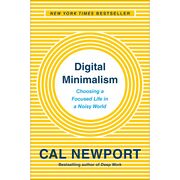
📘 Digital Minimalism: Choosing a Focused Life in a Noisy World (2019) is Cal Newport’s guide to a deliberate philosophy of technology built around a 30-day “digital declutter” and then rebuilding only the tools that serve your values.[1] Newport frames digital minimalism as focusing online time on a small set of carefully selected and optimized activities—“clutter is costly, optimization is important, and intentionality is satisfying.”[2] The book is organized in two parts—“Foundations” and “Practices”—across seven chapters that move from diagnosis to step-by-step tactics.[3] Its prose blends manifesto and manual, with recurring practices centered on solitude, high-bandwidth conversation, and high-quality leisure.[2] On release, it became a bestseller across the New York Times, Wall Street Journal, Publishers Weekly, and USA Today lists, and it reached #5 on the Wall Street Journal hardcover nonfiction list for the week ended 9 February 2019.[1][4]
Chapter summary
This outline follows the Portfolio hardcover edition (2019; ISBN 978-0-525-53651-2).[1][5] Table of contents verified via library catalogue.[3]
I – Foundations
🗡️ 1 – A Lopsided Arms Race.
🧘 2 – Digital Minimalism.
🧹 3 – The Digital Declutter.
II – Practices
🌲 4 – Spend Time Alone.
🚫👍 5 – Don’t Click “Like.”
🎨 6 – Reclaim Leisure.
🛡️ 7 – Join the Attention Resistance.
Background & reception
🖋️ Author & writing. Cal Newport is a computer science professor at Georgetown University.[6] Before this book, he wrote Deep Work (2016) and So Good They Can’t Ignore You (2012).[7] He announced Digital Minimalism in December 2018 as a response to readers who asked how his focus ideas apply to personal technology.[8] Methodologically, Newport proposes a 30-day break from optional technologies followed by intentional re-introduction, a process he explained on NPR’s Here & Now on 7 February 2019.[9] Structurally, the book divides into two parts with seven chapters.[3] Reviews characterize his voice as aggressive and practical, aimed at decisive behavior change rather than minor tweaks.[2]
📈 Commercial reception. On 15 February 2019, the Wall Street Journal listed the book at #5 on its hardcover nonfiction bestsellers for the week ended 9 February 2019.[4] Penguin Random House reports that the title became a New York Times, Wall Street Journal, Publishers Weekly, and USA Today bestseller.[1] The Washington Post named it one of the “leadership books to watch” at the start of 2019,[10] and Publishers Weekly highlighted it in its weekly lists during launch week.[11]
👍 Praise. The Los Angeles Review of Books welcomed Newport’s “pulls-no-punches” program and its focus on solitude, conversation, and demanding leisure as antidotes to online distraction.[2] The Guardian described Newport as the “Marie Kondo of technology” while outlining the book’s “digital decluttering” strategies.[12] Business Insider spotlighted Newport’s argument for reclaiming solitude as a core practice in modern life.[13]
👎 Criticism. In a substantive review, The New Yorker argued that the book emphasizes individual discipline while giving limited attention to systemic or regulatory remedies for the attention economy.[14] The Times (London) praised the clarity of Newport’s case but expressed skepticism about “quick fixes” for smartphone overuse.[15] More broadly, Wired placed the book within a 2019 wave of tech-self-help and argued that a more moderate, integrative approach to digital life was also emerging.[16]
🌍 Impact & adoption. In the public sector and professional communities, the Library of Congress highlighted Digital Minimalism among recommended productivity resources at the 2019 American Association of Law Libraries conference.[17] In higher education, a University of Florida course (“Empathy and Instagram,” Fall 2021) assigned an excerpt from the book.[18] Media outlets also used the book to frame broader debates about “digital detox” and news consumption in the attention economy.[14] Georgetown University hosted an author talk shortly after publication, reflecting campus-level interest in the book’s proposals.[19]
Related content & more
YouTube videos
CapSach articles
References
- ↑ 1.0 1.1 1.2 1.3 "Digital Minimalism". Penguin Random House. Portfolio. Retrieved 4 November 2025.
- ↑ 2.0 2.1 2.2 2.3 Fayle, Taylor (10 June 2019). "Walking Alone: On "Digital Minimalism"". Los Angeles Review of Books. Retrieved 4 November 2025.
- ↑ 3.0 3.1 3.2 "Digital minimalism — Table of contents". Marmot Library Network. Marmot Library Network. Retrieved 4 November 2025.
- ↑ 4.0 4.1 "Best-Selling Books Week Ended Feb. 9". The Wall Street Journal. 15 February 2019. Retrieved 4 November 2025.
- ↑ "Digital minimalism: choosing a focused life in a noisy world". WorldCat. OCLC. Retrieved 4 November 2025.
- ↑ "Calvin Newport". Georgetown University. Georgetown University. Retrieved 4 November 2025.
- ↑ "Writing". Cal Newport. Cal Newport. Retrieved 4 November 2025.
- ↑ "My New Book: Digital Minimalism". Cal Newport. Cal Newport. 4 December 2018. Retrieved 4 November 2025.
- ↑ "'Digital Minimalism': How To Hang Up On Your Phone". WBUR Here & Now. 7 February 2019. Retrieved 4 November 2025.
- ↑ "10 leadership books to watch for in 2019". The Washington Post. 1 January 2019. Retrieved 4 November 2025.
- ↑ "This Week's Bestsellers: February 18, 2019". Publishers Weekly. 15 February 2019. Retrieved 4 November 2025.
- ↑ "Why beating your phone addiction may come at a cost". The Guardian. 13 March 2019. Retrieved 4 November 2025.
- ↑ "Spend Time Alone to Be Happier and More Productive". Business Insider. 12 February 2019. Retrieved 4 November 2025.
- ↑ 14.0 14.1 Tolentino, Jia (22 April 2019). "What It Takes to Put Your Phone Away". The New Yorker. Retrieved 4 November 2025.
- ↑ "Review: Digital Minimalism: On Living Better with Less Technology — log off and choose life". The Times. 25 January 2019. Retrieved 4 November 2025.
- ↑ "Live Your Best Life—On and Off Your Phone—in 2020". Wired. 6 January 2020. Retrieved 4 November 2025.
- ↑ "American Association of Law Libraries 2019 Conference Recap". Library of Congress. Library of Congress. 7 August 2019. Retrieved 4 November 2025.
- ↑ "Empathy and Instagram (IDS2935, Sec. 2SA2) — Fall 2021" (PDF). University of Florida. University of Florida. Retrieved 4 November 2025.
- ↑ "Digital Minimalism: Choosing a Focused Life in a Noisy World — Book Talk". Georgetown University Library. Georgetown University. 3 April 2019. Retrieved 4 November 2025.