Four Thousand Weeks
"Attention, on the other hand, just is life: your experience of being alive consists of nothing other than the sum of everything to which you pay attention."
— Oliver Burkeman, Four Thousand Weeks (2021)
Introduction
| Four Thousand Weeks | |
|---|---|
 | |
| Full title | Four Thousand Weeks: Time Management for Mortals |
| Author | Oliver Burkeman |
| Language | English |
| Subject | Time management; Philosophy; Happiness; Personal development |
| Genre | Nonfiction; Self-help |
| Publisher | Farrar, Straus and Giroux |
Publication date | 10 August 2021 |
| Publication place | United States |
| Media type | Print (hardcover, paperback); e-book; audiobook |
| Pages | 271 |
| ISBN | 978-0-374-15912-2 |
| Website | oliverburkeman.com |
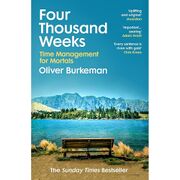
📘 Four Thousand Weeks is a 2021 nonfiction book by Oliver Burkeman, published by Farrar, Straus and Giroux on 10 August 2021, that reframes time management around human finitude.[1] It rejects the goal of getting “everything done” and warns of an “efficiency trap,” offering practical ways to choose what matters instead of chasing ever-rising throughput.[2] The book is arranged into two parts—“Choosing to choose” and “Beyond control”—across fourteen chapters, with an appendix of “Ten tools for embracing your finitude.”[3] Reviewers describe the prose as plainspoken and wry; one called it “full of … sage and sane advice” delivered with “dry wit.”[4] The publisher reports it as an instant New York Times bestseller in the United States.[1] In the United Kingdom, the Penguin/Vintage edition was billed as an instant Sunday Times bestseller and the book appeared in TIME’s “100 Must-Read Books of 2021” and the Financial Times’ year-end critics’ picks.[5][6][7]
Chapter summary
This outline follows the Farrar, Straus and Giroux hardcover edition (10 August 2021; ISBN 978-0-374-15912-2).[1][3]
I – Choosing to Choose
🧗 1 – The Limit-Embracing Life. Before mechanical clocks and factory whistles, a peasant in early‑medieval England worked by the sun and the task—ploughing when the soil was ready, harvesting as grain ripened, pausing when bells called to worship—without treating time as a ledger of hours. Historians later showed how industrial capitalism replaced this task‑orientation with clock time; what mattered became shifts, schedules, and “saving” or “wasting” minutes. That shift seeded the modern anxiety of “too much to do,” as if life were a conveyor belt of slots to be filled correctly. The fantasy of a future day when the inbox is empty and the calendar clears keeps attention in limbo and makes the present feel like a staging area. The counter‑move is to let finitude be the starting condition rather than a problem to solve. Choosing a few commitments implies declining many others, and the refusals are not failures but the cost of depth. This stance swaps infinitude’s mirage for a workable day. Control comes less from acceleration than from narrowing the field. The chapter’s practice is a limit‑embracing life that works with a fixed allotment instead of fighting it. *The real problem isn’t our limited time.*
⚙️ 2 – The Efficiency Trap. In 1955, the British historian C. Northcote Parkinson quipped in The Economist that “work expands to fill the time available,” illustrating with a bureaucracy that grew even as fleets and colonies shrank. Personal workflows behave the same way: reply faster and the inbox breeds more replies; process more tasks and the list multiplies. Efficiency invites extra demand until gains vanish, a rebound familiar in economics since William Stanley Jevons’s 1865 observation that better engines increased total coal consumption. Because modern “everything” is effectively infinite, optimizing tools only scale the flood and push peace of mind into the future. Waiting to “clear the decks” defers life to a horizon that never arrives. Relief comes from doing fewer things to completion rather than cramming more into the day. That means disappointing some people on purpose and treating busywork as optional. By narrowing scope, you trade the fantasy of total control for the reality of enough. In tying speed to scarcity, the chapter argues that limits—not throughput—are the path to a livable rhythm.
⏳ 3 – Facing Finitude. In 1927, Martin Heidegger’s Being and Time framed human existence as finite and “being‑toward‑death”: we don’t possess time from outside it; we are the time we have. Seen this way, a life is not something to schedule from above but a path formed by choices that close other paths. Every decision—study this field, move to that city, raise a family—creates the person who then has fewer, not more, possibilities, which is how reality works. Anxiety spikes when we refuse this bind and try to preserve every option, spreading ourselves thin across half‑started projects. The honest relief comes after an irreversible choice, when attention can settle and work deepen. Regret remains, but it is the price of seriousness rather than a sign of failure. Practically, the chapter suggests choosing a small set of commitments and letting the “no” to everything else stand. Doing so converts time from a hostile scarcity into a medium you can inhabit. Facing finitude, then, is how meaning arises: limits make significance possible.
🐢 4 – Becoming a Better Procrastinator. A widely circulated story about investor Warren Buffett describes him advising a longtime pilot to list his top twenty‑five career goals, circle the five that mattered most, and treat the remaining twenty as a hard “avoid‑at‑all‑costs” list—a concrete exercise in deciding what to neglect so the important work can proceed. The chapter develops that stance into everyday practice: schedule time for what matters before the day fills, like “paying yourself first” with money. It recommends working on a single meaningful task at the start of the day, when willpower and attention are least fragmented. It then narrows scope further by limiting active projects; juggling too many creates a permanent state of half‑finished efforts and displaced anxiety. The text links this scatter to the human tendency to flee discomfort by switching tasks the moment things feel uncertain or boring. Settling—committing to one path knowing others will close—becomes a feature, not a flaw, because it frees depth. The practical rhythm is small, repeated appointments with priority work, protected on the calendar like any meeting. Saying no becomes an operating rule rather than an emergency measure. In this way, procrastination isn’t abolished but steered toward the right things being neglected. Accepting that most possibilities will remain undone ties directly to the book’s theme: finitude demands focused trade‑offs, and focus only appears after real exclusions.
🍉 5 – The Watermelon Problem. On 8 April 2016, two BuzzFeed staffers live‑streamed a slow spectacle on Facebook—stacking rubber bands around a watermelon while wearing safety goggles—drawing roughly 800,000 concurrent viewers over about forty‑four minutes before the fruit finally burst. The event trended across platforms and spawned copycats, not because it was important but because it weaponized suspense and social proof in a feed designed to keep eyes from looking away. The chapter uses this viral moment to show how attentional capture works: novelty, countdown tension, and the promise of a payoff at an unpredictable time. It then argues that life is, in practice, the sum of what receives attention; minutes surrendered to manufactured curiosity are minutes of living surrendered. Because attention is finite, every scroll is a trade‑off against conversations, craft, or rest that would otherwise fill those same moments. The pull of trivial content isn’t new, but the current attention economy industrializes it with metrics, autoplay, and infinite scroll. The remedy is not heroic self‑control but intentional constraints: decide in advance where attention may go, design frictions that make drifting less likely, and give valued activities protected, device‑free time. Choosing boredom long enough to pass through the urge to switch often reveals that meaningful work becomes absorbing again. When attention is treated as life’s raw material rather than a commodity to be harvested, distraction loses its glamour and choices sharpen. The main thread links cleanly to finitude: with limited weeks, the question becomes which experiences deserve the scarce beam of awareness.
📱 6 – The Intimate Interrupter. Poet Mary Oliver coined the phrase “the intimate interrupter” in her essay “Of Power and Time” (collected in Upstream, 2016) to describe the inner voice that derails concentration from within, long before external pings arrive. The chapter borrows her image to show that the deepest distractions are self‑generated—restlessness, self‑critique, and the itch to check anything—because beginning real work exposes uncertainty and the risk of falling short. Instead of pathologizing this discomfort, the text frames it as the entry toll for meaningful focus. Brief, deliberate exposure helps: sit with the urge to flee, breathe, and do the next small unit of the task without negotiation. Physical changes reinforce the stance—single‑tasking in a plain environment, silenced notifications, and short, timed blocks that end before willpower collapses. Naming the inner interrupter reduces its power; expecting it prevents panic when it arrives. The same discipline applies to leisure: depth in a walk, a book, or a conversation requires tolerating the first few minutes of fidgeting. Over time, attention strengthens not by perfect control but by practicing return. The link to the book’s theme is straightforward: because time is finite, escaping discomfort can quietly consume a life, whereas accepting it opens the only route to experiences that matter.
II – Beyond Control
🕰️ 7 – We Never Really Have Time. Cognitive scientist Douglas Hofstadter’s 1979 formulation—“Hofstadter’s Law,” coined in *Gödel, Escher, Bach*—captures the way even padded estimates collapse, because tasks almost always take longer than we expect, even when we account for that fact. Psychologists call this the planning fallacy, the bias that seduces us into optimistic timelines and then punishes us with overruns and stress. The chapter ties that illusion to a more intimate story: a grandmother who escaped Germany before Hitler’s worst atrocities and bequeathed a family culture of meticulous contingency-planning, which led to rituals like leaving absurdly early for flights in hopes of beating uncertainty. But airports still deliver surprise traffic jams and closed security lanes, illustrating how planning can’t wrest control from an inherently uncontrollable future. The deeper trap is the anxious demand for reassurance that tomorrow will unfold as desired; worry loops arise when the mind keeps trying to manufacture certainty the future can’t supply. Plans still matter, yet they function best as present‑moment intentions rather than contracts the future must honor. Seen this way, “time” isn’t a possession to stockpile but the very medium we inhabit, so treating it as a hoardable resource only intensifies scarcity. The core idea is to relinquish the fantasy of future mastery so you can act sanely in the only time you ever touch—the present. The mechanism is psychological: by abandoning the demand for reassurance, you defuse anxiety loops and free attention for what matters now.
📍 8 – You Are Here. In London’s British Museum, visitors filming the Rosetta Stone on their phones “to look at later” embody a modern reflex: exchanging actual presence for potential future use. That habit scales into the “when‑I‑finally” mindset—when I finally clear my inbox, find the right partner, win the election, or fix myself, then life can begin—so today becomes mere transit to a fantasized tomorrow. Money metaphors like the “billable hour” reinforce the notion that moments exist to be converted into later value, not lived for their own texture. Parenting debates dramatize the same mistake: whether “Baby Trainers” (strict schedules) or “Natural Parents” (ever‑responsive routines), both camps often treat the present as training for a child’s future utility. Writer Adam Gopnik names this the “causal catastrophe,” the belief that the proof of a childhood’s worth lies solely in the adults it produces—thereby draining childhood of intrinsic value. To counter that drift, treat ordinary acts as if this instance might be your last time doing them; sooner or later, it will be. Presence isn’t an achievement to grind toward; it’s what remains when you stop negotiating with an imaginary future. The core idea is to relocate meaning from an idealized “later” back into the irreducible now. The mechanism is attentional: by refusing to instrumentalize moments, you restore their value and experience time as lived rather than leveraged.
🛌 9 – Rediscovering Rest. On a boiling summer weekend, a gathering of the “Take Back Your Time” campaign pressed a radical point: leisure shouldn’t have to justify itself by boosting Monday’s productivity. That pressure explains why “time off” so easily becomes a workout for work—reading to upskill, napping to bounce back, vacations optimized into itineraries—until rest is just labor’s pit stop. Older wisdom cut the opposite way: in Latin, *negotium* (business) literally means “not‑leisure,” implying that work is the exception and leisure the point. Mid‑century philosopher Josef Pieper made the same case in *Leisure: The Basis of Culture*: true leisure is receptive contemplation, not recovery for more output. Practically, this means reclaiming “atelic” activities—hiking, conversation, music, tinkering—done for their own sake, with no goal beyond the doing. Paradoxically, abundance can worsen the problem: more free‑time options only heighten the urge to optimize every hour, so even weekends feel graded. Many of us also suffer idleness aversion, the inability to rest without guilt, because we secretly believe usefulness is the measure of a life. The core idea is to de‑instrumentalize nonwork so that leisure resumes its role as an end, not a tool. The mechanism is behavioral and cultural: by choosing activities with no payoff to prove, you train attention to dwell in time as it is, which anchors the book’s theme that embracing finitude—not pursuing control—restores meaning.
🌀 10 – The Impatience Spiral. In New York or Mumbai, a blare of car horns does nothing to move traffic; it only broadcasts a futile demand that reality speed up to suit the honker. That sound captures a pattern I can recognize in myself: each technological gain—faster downloads, shorter queues, one‑click anything—ratchets my expectation that the world should yield instantly, so any pause feels like an affront. Taoist images from the *Tao Te Ching*—water flowing around a rock, a reed bending in wind—offer a corrective, because events take the time they take no matter how intensely I push. The more I hurry to outrun delay, the more errors and irritations I generate, which in turn provoke more hurrying: impatience becomes a self‑reinforcing loop. Even reading exposes the truth, because pages won’t compress to the tempo of my mood; attention must stretch to the book’s pace. What looks like “efficiency” often masks an addiction to acceleration that society rewards as being “driven,” though it leaves me brittle and resentful. There’s relief in relinquishing tempo control and working with time’s grain—choosing to wait, to queue, to draft carefully—so results emerge when they’re ready. The central move is to trade the fantasy of mastery for the practice of patience, which returns me to the only moment I can inhabit. By interrupting the behavioral loop—spot the flare of urgency, let it pass, and proceed at a humane pace—I align with the book’s larger theme that accepting finitude is the surest route to a meaningful life.
🚌 11 – Staying on the Bus. In 2004, Finnish‑American photographer Arno Rafael Minkkinen told graduates at the New England School of Photography to picture Helsinki’s main bus station with roughly two dozen platforms; for the first miles, many routes share the same stops, so early work looks indistinguishable from everyone else’s, and the temptation is to jump off, run back, and start over. The counsel is stranger and wiser: stay on the bus until the lines diverge and the scenery changes, because distinctiveness appears only after the tedious, derivative phase. That discipline rests on three practical habits: develop a taste for problems instead of resenting them; embrace “radical incrementalism” by doing modest daily chunks and stopping when the time is up; and tolerate the long apprenticeship where your path mirrors others’. Quitting when boredom bites or novelty beckons resets you to the crowded part of the map, so every restart costs compounding progress. The metaphor dignifies slow accumulation—drafts, iterations, patient re‑work—over spasms of heroic effort that burn out and begin again. It also reframes frustration as evidence you’re far enough along for real work to begin. The key insight is that patience, not speed, is the creative leverage that lets limited days deepen rather than scatter. Behaviorally, sticking to small, repeatable commitments works with time’s constraints so identity and originality can cohere. *More often than not, originality lies on the far side of unoriginality.*
🧑💻 12 – The Loneliness of the Digital Nomad. Consider Mario Salcedo, a Cuban American financial consultant nicknamed “Super Mario,” who has spent much of the past two decades aboard Royal Caribbean ships; the schedule is his, the chores are gone, and yet his freedom floats largely apart from the people who matter to him on land. Modern myths promise that maximum personal sovereignty over hours brings happiness, but solitary control often strips time of its social texture. Traditional nomads weren’t solo wanderers with laptops; they were intensely group‑bound and freer in community than any individual is alone. The important property of time here is networked, not private: days grow rich when they synchronize with others—office camaraderie, weekly choir practice, a shared Sabbath, school pick‑ups that align with friends. In contrast, remote‑anywhere flexibility can desynchronize you from local rhythms, making it harder to form durable ties or to be free precisely when others are free. The remedy is not another app but a willingness to yield some autonomy to common schedules and rituals, so your leisure and labor overlap with the people you love. This chapter’s claim is that meaning arises from coordinated attention, which requires accepting limits and letting other lives shape your own. Psychologically, trading a slice of control for shared cadence turns finite weeks into lived membership instead of private management. *You can grasp the truth that power over your time isn’t something best hoarded entirely for yourself: that your time can be too much your own.*
🌌 13 – Cosmic Insignificance Therapy.
🦠 14 – The Human Disease.
Background & reception
🖋️ Author & writing. Burkeman is a British journalist best known for his long-running Guardian psychology column, “This Column Will Change Your Life.”[8] He previously authored The Antidote: Happiness for People Who Can’t Stand Positive Thinking and has written widely for The Guardian.[9] Around publication he framed the book’s core idea as embracing limits and abandoning the urge to get everything under control—an argument that includes his now-familiar “efficiency trap.”[10] The U.S. first edition was published by Farrar, Straus and Giroux on 10 August 2021; a U.K. paperback followed from Penguin/Vintage in April 2022.[1][11] Its structure—two parts across fourteen chapters plus an appendix of “Ten tools for embracing your finitude”—leans toward reflective essays rather than a step-by-step system.[3] Reviewers often noted a plain, lightly humorous voice.[12]
📈 Commercial reception. The publisher reported the book as an instant New York Times bestseller upon its U.S. release on 10 August 2021.[1] In the U.K., Penguin promoted it as an “instant Sunday Times bestseller.”[13] It was named to TIME’s “100 Must-Read Books of 2021” on 29 November 2021 and appeared in the Financial Times “Best books of 2021: Critics’ picks” on 19 November 2021.[14][15]
👍 Praise. The Wall Street Journal called it “provocative and appealing … well worth your extremely limited time.”[16] In the Observer, Tim Adams said it was “perfectly pitched somewhere between practical self-help … and philosophical quest.”[17] The Evening Standard praised it as a “challenging and amusing guide” to using limited time well.[18] The Guardian highlighted its “sage and sane” counsel delivered with dry wit.[19]
👎 Criticism. Joe Moran in the Guardian questioned how far the book would actually cure “time micro-managers,” concluding “up to a point.”[20] In the Observer, Tim Adams suggested the late “how-to” appendix felt unnecessary to a work otherwise cast as a philosophical quest (“the how-to is not necessary”).[21] A later essay in The Atlantic, reflecting on the book’s influence and Burkeman’s follow-up, noted the tension in selling anti-productivity counsel in a highly packaged form, calling the enterprise “tricky.”[22]
🌍 Impact & adoption. The book has been recommended on university reading lists, including Stanford Law School’s 2024 Summer Faculty Reading List (5 June 2024).[23] U.S. pre-health advising pages at the University of Florida and Cornell list it among suggested titles for students considering health careers.[24][25] It has also been used as the focus of campus learning-community programming (2023–2024) at Grand Valley State University.[26]
Related content & more
YouTube videos
CapSach articles

References
- ↑ 1.0 1.1 1.2 1.3 1.4 "Four Thousand Weeks". Macmillan Publishers. Farrar, Straus and Giroux. 10 August 2021. Retrieved 4 November 2025.
- ↑ Pinsker, Joe (11 August 2021). "The Best Time-Management Advice Is Depressing But Liberating". The Atlantic. The Atlantic. Retrieved 4 November 2025.
- ↑ 3.0 3.1 3.2 "Four thousand weeks: time management for mortals — First edition". Colorado Mountain College Library Catalog. Colorado Mountain College. Retrieved 4 November 2025.
- ↑ Moran, Joe (1 September 2021). "Four Thousand Weeks by Oliver Burkeman review – a brief treatise on time". The Guardian. Retrieved 4 November 2025.
- ↑ "Four Thousand Weeks". Penguin Books UK. Penguin Random House UK. 7 April 2022. Retrieved 4 November 2025.
- ↑ Gutterman, Annabel (29 November 2021). "The 100 Must-Read Books of 2021: Four Thousand Weeks". TIME. Retrieved 4 November 2025.
- ↑ "Best books of 2021: Critics' picks". Financial Times. 19 November 2021. Retrieved 4 November 2025.
- ↑ "This column will change your life". The Guardian. Guardian News & Media. 4 September 2020. Retrieved 4 November 2025.
- ↑ "Oliver Burkeman". The Guardian. Guardian News & Media. 8 June 2025. Retrieved 4 November 2025.
- ↑ Pinsker, Joe (11 August 2021). "The Best Time-Management Advice Is Depressing But Liberating". The Atlantic. The Atlantic. Retrieved 4 November 2025.
- ↑ "Four Thousand Weeks". Penguin Books UK. Penguin Random House UK. 7 April 2022. Retrieved 4 November 2025.
- ↑ Moran, Joe (1 September 2021). "Four Thousand Weeks by Oliver Burkeman review – a brief treatise on time". The Guardian. Retrieved 4 November 2025.
- ↑ "Four Thousand Weeks". Penguin Books UK. Penguin Random House UK. 7 April 2022. Retrieved 4 November 2025.
- ↑ Gutterman, Annabel (29 November 2021). "The 100 Must-Read Books of 2021: Four Thousand Weeks". TIME. Retrieved 4 November 2025.
- ↑ "Best books of 2021: Critics' picks". Financial Times. 19 November 2021. Retrieved 4 November 2025.
- ↑ Spindel, Barbara (13 August 2021). "'Four Thousand Weeks' Review: No Time for Regrets". The Wall Street Journal. Retrieved 4 November 2025.
- ↑ Adams, Tim (16 August 2021). "Four Thousand Weeks: Time and How to Use It by Oliver Burkeman – review". The Observer. Retrieved 4 November 2025.
- ↑ Smith, Robbie (1 September 2021). "Four Thousand Weeks: Time and How to Use It by Oliver Burkeman – review". Evening Standard. Retrieved 4 November 2025.
- ↑ Moran, Joe (1 September 2021). "Four Thousand Weeks by Oliver Burkeman review – a brief treatise on time". The Guardian. Retrieved 4 November 2025.
- ↑ Moran, Joe (1 September 2021). "Four Thousand Weeks by Oliver Burkeman review – a brief treatise on time". The Guardian. Retrieved 4 November 2025.
- ↑ Adams, Tim (16 August 2021). "Four Thousand Weeks: Time and How to Use It by Oliver Burkeman – review". The Observer. Retrieved 4 November 2025.
- ↑ "You Are Going to Die". The Atlantic. The Atlantic. 4 October 2024. Retrieved 4 November 2025.
- ↑ "Stanford Law School's 2024 Summer Faculty Reading List". Stanford Law. Stanford University. 5 June 2024. Retrieved 4 November 2025.
- ↑ "Pre-Health – Beyond120". University of Florida. UF College of Liberal Arts & Sciences. Retrieved 4 November 2025.
- ↑ "Become an interesting applicant". Cornell University. Cornell Pre-Health Advising. Retrieved 4 November 2025.
- ↑ "Past Learning Communities (2023–2024)". Grand Valley State University. GVSU. Retrieved 4 November 2025.