
The One Thing: Difference between revisions
No edit summary |
No edit summary |
||
| Line 43: | Line 43: | ||
🧗 '''6 – A Disciplined Life.''' The chapter profiles Olympic swimmer Michael Phelps as a case of “selected discipline”: diagnosed with ADHD, told by a kindergarten teacher he wasn’t gifted, then coached by Bob Bowman from age 11 into a regimen of daily practice. From age 14 through Beijing 2008 he trained seven days a week, six hours in the water, calculating a 52‑day annual edge over rivals; the haul—six golds and two bronzes in Athens 2004, a record eight golds in Beijing 2008, and by London 2012 a total of 22 medals and 18 golds—illustrates what one habit can yield. The text distinguishes short bursts of discipline from lifelong self‑denial: use a sprint of control to install a routine, then let the habit carry the load. Evidence from University College London (2009) suggests new behaviors reach automaticity in about 66 days on average, with easier actions sooner and harder ones later; studies by Megan Oaten and Ken Cheng show spillover benefits once a keystone habit sticks. The practical play is to pick one behavior that moves the needle and marshal just enough will to make it automatic. That preserves effort for performance instead of constant self‑control. In psychological terms, habit formation shifts execution from effortful control to procedural memory, freeing attention for the next priority. ''Success is actually a short race—a sprint fueled by discipline just long enough for habit to kick in and take over.'' |
🧗 '''6 – A Disciplined Life.''' The chapter profiles Olympic swimmer Michael Phelps as a case of “selected discipline”: diagnosed with ADHD, told by a kindergarten teacher he wasn’t gifted, then coached by Bob Bowman from age 11 into a regimen of daily practice. From age 14 through Beijing 2008 he trained seven days a week, six hours in the water, calculating a 52‑day annual edge over rivals; the haul—six golds and two bronzes in Athens 2004, a record eight golds in Beijing 2008, and by London 2012 a total of 22 medals and 18 golds—illustrates what one habit can yield. The text distinguishes short bursts of discipline from lifelong self‑denial: use a sprint of control to install a routine, then let the habit carry the load. Evidence from University College London (2009) suggests new behaviors reach automaticity in about 66 days on average, with easier actions sooner and harder ones later; studies by Megan Oaten and Ken Cheng show spillover benefits once a keystone habit sticks. The practical play is to pick one behavior that moves the needle and marshal just enough will to make it automatic. That preserves effort for performance instead of constant self‑control. In psychological terms, habit formation shifts execution from effortful control to procedural memory, freeing attention for the next priority. ''Success is actually a short race—a sprint fueled by discipline just long enough for habit to kick in and take over.'' |
||
🪫 '''7 – Willpower Is Always on Will-Call.''' In a ten‑month field study of Israel’s parole system, Jonathan Levav of the Stanford Graduate School of Business and Liora Avnaim‑Pesso and Shai Danziger of Ben‑Gurion University of the Negev analyzed 1,112 hearings handled by eight judges who decided 14 to 35 cases a day with only two breaks—a morning snack and a late lunch. Approval rates spiked to about 65 percent just after each break and then fell toward zero by the end of a session, a pattern that exposed decision fatigue and a default to “no” as energy ebbed. The chapter generalizes this arc of self‑control to everyday work: implementing new behaviors, filtering distractions, resisting temptations, suppressing impulses or emotions, taking tests, trying to impress others, and choosing long‑term over short‑term rewards all draw from the same finite reserve. Like a battery indicator sliding from green to red, willpower leaks as the day advances unless it is protected and refueled. Because the resource fluctuates, the prescription is to time‑block mornings for the ONE Thing, when focus is fullest, and to keep the tank filled—eat right and regularly—so an “empty” brain doesn’t push you back to default choices. The practical upshot is simple sequencing: do what matters most first; then use what remains to support or at least not sabotage that gain. As decisions accumulate, attention narrows and the mind falls back on heuristics; arranging the day so your most meaningful action lands early prevents small, reactive choices from dictating big outcomes. The chapter’s through‑line is that willpower waxes and wanes, so extraordinary results depend on aligning your single highest‑leverage task with your strongest hours. Psychologically, this works by conserving executive control for one consequential choice, cutting switching costs and reducing the pull of the brain’s “default” option. ''Willpower isn’t on will-call.'' |
|||
🪫 '''7 – Willpower Is Always on Will-Call.''' |
|||
🧘 '''8 – A Balanced Life.''' An 11‑year study of nearly 7,100 British civil servants found that working more than 11 hours a day—roughly a 55‑plus‑hour week—raised heart‑disease risk by 67 percent, a concrete cost of living at one extreme for too long. The text argues that “balance” is a mirage: nothing stays in equilibrium, and what looks like balance is constant micro‑adjustment—counterbalancing—like a ballerina’s toe shoes vibrating en pointe. It traces the rise of the modern term as dual‑income households spread in the mid‑1980s and notes that media usage exploded from 32 articles between 1986 and 1996 to 1,674 in 2007 as technology erased boundaries. Personal vignettes—closets of never‑worn travel clothes after a parent’s death or a promise to “make up time” that never comes—show how postponement hardens into permanence. The remedy is to drop the myth of the middle and choose priorities: go long at work on the few things that matter most, and go short in personal life so family, health, friends, and integrity aren’t neglected. James Patterson’s “five balls” parable reframes the trade‑offs: work is a rubber ball that bounces; the others are glass. From there the chapter offers cues—separate work and personal “buckets,” time‑block the ONE Thing, and return frequently to what you value outside the office. The governing idea isn’t balance but priority; attention given to what matters will tilt the day, and that tilt is the point. Mechanistically, counterbalancing toggles focus across domains at different cadences, protecting non‑negotiables while giving deep work the time it demands. ''An extraordinary life is a counterbalancing act.'' |
|||
🧘 '''8 – A Balanced Life.''' |
|||
🗻 '''9 – Big Is Bad.''' Sabeer Bhatia arrived in the United States with $250, built Hotmail, and sold it to Microsoft for $400 million; by 2011 the service had more than 360 million active users, a trajectory his mentor Farouk Arjani linked to the “gargantuan” scale of Bhatia’s dream. The chapter names our reflex “megaphobia”—the irrational fear of big—and shows how equating big with bad leads people to lower their sights or walk away. Examples recast “big” as a design choice: Arthur Guinness signed a 9,000‑year lease; J. K. Rowling mapped seven years at Hogwarts before writing book one; Sam Walton structured his estate early for a company he expected to become vast. Nonprofits follow the same pattern: Candace Lightner’s Mothers Against Drunk Driving (founded 1980) is credited with saving more than 300,000 lives; Ryan’s Well has brought safe water to over 750,000 people in 16 countries; the Global Soap Project has distributed more than 250,000 bars in 21 countries. The operating advice is to choose a box as large as the future you want so the what, how, and who are designed for that level from the start. Stanford psychologist Carol Dweck’s work on growth versus fixed mindsets supplies the mechanism: expecting to grow changes strategies, effort, and resilience, and attracts teammates willing to do hard, memorable things. Big goals can feel intimidating, but on the journey the person expands to fit the goal, and what looked like a mountain becomes a hill by the time you arrive. The through‑line is that big thinking isn’t a luxury; it’s the launch pad for actions that can actually create extraordinary results. Psychologically, big reframes constraints and lowers self‑imposed ceilings, replacing cautious, incremental steps with bold sequences that compound. ''Don’t let small thinking cut your life down to size.'' |
|||
🗻 '''9 – Big Is Bad.''' |
|||
=== II – The Truth: The Simple Path to Productivity === |
=== II – The Truth: The Simple Path to Productivity === |
||
Revision as of 14:21, 4 November 2025
"If you try to do everything, you could wind up with nothing. If you try to do just ONE Thing, the right ONE Thing, you could wind up with everything you ever wanted."
— Gary Keller; Jay Papasan, The ONE Thing (2013)
Introduction
| The One Thing | |
|---|---|
 | |
| Full title | The ONE Thing: The Surprisingly Simple Truth Behind Extraordinary Results |
| Author | Gary Keller; Jay Papasan |
| Language | English |
| Subject | Productivity; Time management; Personal development |
| Genre | Nonfiction; Self-help |
| Publisher | Bard Press |
Publication date | 1 April 2013 |
| Publication place | United States |
| Media type | Print (hardcover, paperback); e-book; audiobook |
| Pages | 240 |
| ISBN | 978-1-885167-77-4 |
| Goodreads rating | 4.1/5 (as of 4 November 2025) |
| Website | the1thing.com |
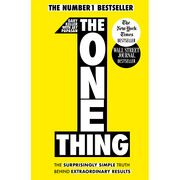
📘 The ONE Thing is a 2013 self-help book by Gary Keller and Jay Papasan, published by Bard Press, which argues that extraordinary results come from concentrating on a single priority. [1] It centers on a single tool—the Focusing Question, “What’s the ONE Thing I can do such that by doing it everything else will be easier or unnecessary?”—and on time-blocking as the daily practice that makes that focus real. [2] The book is arranged in three parts (“The Lies,” “The Truth,” and “Extraordinary Results”) in brief chapters that end with “Big Ideas” recaps and a direct, coaching register. [2] Trade reviewers described the prose as energetic and prescriptive—Publishers Weekly praised its “appealing style and energy” while noting its coach’s verve. [1] The title debuted strongly: the authors’ company reported it reached #1 on the *Wall Street Journal* business list, #2 on the *New York Times* Advice/How-To list, and sold more than 60,000 copies in its first month in May 2013. [3]
Chapter summary
This outline follows the Bard Press hardcover first edition (1 April 2013; 240 pp.; ISBN 978-1-885167-77-4).[4][5]
🎯 1 – The ONE Thing. On 7 June 1991, the comedy film City Slickers (112 minutes) put a crisp idea on the screen when Jack Palance’s trail boss Curly held up one finger and told Billy Crystal’s Mitch that life turns on “one thing.” In the years that followed, I hit a wall running Keller Williams and asked a coach to unpack the mess; he mapped my org chart and concluded that 14 key seats needed new people. I stepped down as CEO and made hiring those 14 my singular mission. Within three years the company entered a nearly decade-long run averaging about 40 percent growth year over year, shifting from a regional player to an international contender. Coaching my top people, I noticed that long task lists produced motion without results, so I kept shrinking the list until a single priority stood front and center each week. The language of the ONE Thing emerged from that practice and from a simple, repeatable question that made every next action obvious. I call the approach “going small,” a bias toward the essential that trades breadth for progress. The lesson is that focus converts effort into traction. Narrowing attention reduces decision friction and channels limited time and energy into the one action most likely to move everything else. *The way to get the most out of your work and your life is to go as small as possible.*
🧩 2 – The Domino Effect. In Leeuwarden, Netherlands, on Domino Day, 13 November 2009, Weijers Domino Productions set more than 4,491,863 dominoes and released over 94,000 joules—about the energy of 545 push-ups—from a single tap. In 1983, University of British Columbia physicist Lorne Whitehead showed that one domino can topple another 50 percent larger, turning a line into a geometric progression. In 2001, San Francisco’s Exploratorium built eight plywood dominoes from two inches to nearly three feet tall; the chain began with a soft tick and ended with a loud slam. Extrapolated, the 10th domino reaches Peyton Manning’s height, the 18th rivals the Leaning Tower of Pisa, the 23rd clears the Eiffel Tower, the 31st rises more than 3,000 feet above Everest, and the 57th spans the distance from Earth toward the moon. The physics is simple: line up potential energy, then tip the lead piece to unlock outsized force. In life, priorities rarely arrive prearranged, so the work is to array them daily, find the lead domino, and keep striking it until it falls. That is how small wins compound into breakthroughs. Extraordinary results come from sequential focus, not simultaneous effort; when the right first action falls, the rest becomes easier or unnecessary. *Success is built sequentially.*
👣 3 – Success Leaves Clues. Extraordinary enterprises tend to be known for one thing: KFC began with one guarded chicken recipe; Adolph Coors grew roughly 1,500 percent from 1947 to 1967 on a single beer brewed in one plant; Intel’s revenue is driven largely by microprocessors; Google’s search enables its ad engine; and in the Star Wars universe, merchandise revenue has surpassed $10 billion versus about $4.3 billion in combined box office for the first six films. Apple shows how a company can transition its ONE Thing over time—from Macs to iMacs to iTunes to iPods to iPhones (with iPad waiting in the wings)—while the flagship casts a halo that lifts the rest of the line. The pattern holds for people: Walt Disney had Roy Disney opening doors; Sam Walton relied early on L. S. Robson’s $20,000 backing and pivotal lease; Albert Einstein benefited from mentor Max Talmud; Oprah Winfrey credits her father and adviser Jeffrey D. Jacobs; the Beatles’ studio sound was shaped by producer George Martin. It also shows up as one passion maturing into one signature skill: painter Pat Matthews produced a painting a day; guide Angelo Amorico built a business from love of country; runner Gilbert Tuhabonye survived a 1993 massacre in Burundi, earned six All-America honors at Abilene Christian University, and later founded Austin’s Gazelle Foundation and its “Run for the Water.” These cases reveal a common engine: concentration organizes resources, attracts allies, and creates a flywheel where mastery, results, and reputation reinforce one another. Focused effort yields spillover effects—the “halo”—that make adjacent wins more likely. *If today your company doesn’t know what its ONE Thing is, then the company’s ONE Thing is to find out.*
I – The Lies: They Mislead and Derail Us
⚖️ 4 – Everything Matters Equally. In the late 1930s at General Motors, managers discovered that a card reader feeding early computing gear was spitting out gibberish; a visiting Western Electric consultant, Joseph M. Juran, took the challenge home and cracked the cipher by three o’clock the next morning, then later used the insight to separate the “vital few” from the “useful many.” That story sets up Pareto’s Principle: a minority of inputs drives a majority of outcomes, whether the split looks like 80/20, 90/20, or some other uneven ratio. Left raw, to‑do lists become survival lists that reward noise over impact; achievers convert them into short “success lists” by ranking tasks against results. The chapter argues that equality is a worthy social ideal but a faulty lens for decisions—work isn’t equal, and neither are tasks on a page. The essential move is prioritization that keeps asking what matters most until only one thing remains. Focus directs energy to the small set of actions with disproportionate payoff. In psychological terms, selective attention and deliberate choice reduce overload and replace reactive busyness with traction toward a single outcome. That mechanism ties directly to the book’s theme: identify the lead domino and let other work orbit around it. A to-do list becomes a success list when you apply Pareto’s Principle to it.
🔀 5 – Multitasking. In the summer of 2009 at Stanford University, communication professor Clifford Nass tested 262 students, sorted them into high and low media‑multitasking groups, and expected the heavy multitaskers to excel; instead, they were outperformed and proved most distractible across measures. The chapter then explains that “multitasking” began as a 1960s computer term for time‑sharing a single CPU, not for human beings doing two complex things at once. Research on task switching shows the catch: each shift triggers a reorientation cost, with University of Michigan’s David Meyer reporting time losses from around 25% for simple tasks to well over 100% for complex ones. The book tallies everyday leakage too—e‑mail and window switching dozens of times per hour and an estimated 28% of a workday lost to switching inefficiencies. Juggling looks simultaneous, but in reality it’s rapid alternation: catch, toss, catch, toss—one ball at a time. Neuroscience frames this as divided attention across channels; when two tasks tap the same channel—like visual processing while driving—performance degrades sharply. The core idea is that attempting parallel focus dilutes effectiveness; sequential focus protects depth and quality. Mechanistically, switching taxes working memory and control processes, so choosing one priority preserves cognitive bandwidth for meaningful progress. You can do two things at once, but you can’t focus effectively on two things at once.
🧗 6 – A Disciplined Life. The chapter profiles Olympic swimmer Michael Phelps as a case of “selected discipline”: diagnosed with ADHD, told by a kindergarten teacher he wasn’t gifted, then coached by Bob Bowman from age 11 into a regimen of daily practice. From age 14 through Beijing 2008 he trained seven days a week, six hours in the water, calculating a 52‑day annual edge over rivals; the haul—six golds and two bronzes in Athens 2004, a record eight golds in Beijing 2008, and by London 2012 a total of 22 medals and 18 golds—illustrates what one habit can yield. The text distinguishes short bursts of discipline from lifelong self‑denial: use a sprint of control to install a routine, then let the habit carry the load. Evidence from University College London (2009) suggests new behaviors reach automaticity in about 66 days on average, with easier actions sooner and harder ones later; studies by Megan Oaten and Ken Cheng show spillover benefits once a keystone habit sticks. The practical play is to pick one behavior that moves the needle and marshal just enough will to make it automatic. That preserves effort for performance instead of constant self‑control. In psychological terms, habit formation shifts execution from effortful control to procedural memory, freeing attention for the next priority. Success is actually a short race—a sprint fueled by discipline just long enough for habit to kick in and take over.
🪫 7 – Willpower Is Always on Will-Call. In a ten‑month field study of Israel’s parole system, Jonathan Levav of the Stanford Graduate School of Business and Liora Avnaim‑Pesso and Shai Danziger of Ben‑Gurion University of the Negev analyzed 1,112 hearings handled by eight judges who decided 14 to 35 cases a day with only two breaks—a morning snack and a late lunch. Approval rates spiked to about 65 percent just after each break and then fell toward zero by the end of a session, a pattern that exposed decision fatigue and a default to “no” as energy ebbed. The chapter generalizes this arc of self‑control to everyday work: implementing new behaviors, filtering distractions, resisting temptations, suppressing impulses or emotions, taking tests, trying to impress others, and choosing long‑term over short‑term rewards all draw from the same finite reserve. Like a battery indicator sliding from green to red, willpower leaks as the day advances unless it is protected and refueled. Because the resource fluctuates, the prescription is to time‑block mornings for the ONE Thing, when focus is fullest, and to keep the tank filled—eat right and regularly—so an “empty” brain doesn’t push you back to default choices. The practical upshot is simple sequencing: do what matters most first; then use what remains to support or at least not sabotage that gain. As decisions accumulate, attention narrows and the mind falls back on heuristics; arranging the day so your most meaningful action lands early prevents small, reactive choices from dictating big outcomes. The chapter’s through‑line is that willpower waxes and wanes, so extraordinary results depend on aligning your single highest‑leverage task with your strongest hours. Psychologically, this works by conserving executive control for one consequential choice, cutting switching costs and reducing the pull of the brain’s “default” option. Willpower isn’t on will-call.
🧘 8 – A Balanced Life. An 11‑year study of nearly 7,100 British civil servants found that working more than 11 hours a day—roughly a 55‑plus‑hour week—raised heart‑disease risk by 67 percent, a concrete cost of living at one extreme for too long. The text argues that “balance” is a mirage: nothing stays in equilibrium, and what looks like balance is constant micro‑adjustment—counterbalancing—like a ballerina’s toe shoes vibrating en pointe. It traces the rise of the modern term as dual‑income households spread in the mid‑1980s and notes that media usage exploded from 32 articles between 1986 and 1996 to 1,674 in 2007 as technology erased boundaries. Personal vignettes—closets of never‑worn travel clothes after a parent’s death or a promise to “make up time” that never comes—show how postponement hardens into permanence. The remedy is to drop the myth of the middle and choose priorities: go long at work on the few things that matter most, and go short in personal life so family, health, friends, and integrity aren’t neglected. James Patterson’s “five balls” parable reframes the trade‑offs: work is a rubber ball that bounces; the others are glass. From there the chapter offers cues—separate work and personal “buckets,” time‑block the ONE Thing, and return frequently to what you value outside the office. The governing idea isn’t balance but priority; attention given to what matters will tilt the day, and that tilt is the point. Mechanistically, counterbalancing toggles focus across domains at different cadences, protecting non‑negotiables while giving deep work the time it demands. An extraordinary life is a counterbalancing act.
🗻 9 – Big Is Bad. Sabeer Bhatia arrived in the United States with $250, built Hotmail, and sold it to Microsoft for $400 million; by 2011 the service had more than 360 million active users, a trajectory his mentor Farouk Arjani linked to the “gargantuan” scale of Bhatia’s dream. The chapter names our reflex “megaphobia”—the irrational fear of big—and shows how equating big with bad leads people to lower their sights or walk away. Examples recast “big” as a design choice: Arthur Guinness signed a 9,000‑year lease; J. K. Rowling mapped seven years at Hogwarts before writing book one; Sam Walton structured his estate early for a company he expected to become vast. Nonprofits follow the same pattern: Candace Lightner’s Mothers Against Drunk Driving (founded 1980) is credited with saving more than 300,000 lives; Ryan’s Well has brought safe water to over 750,000 people in 16 countries; the Global Soap Project has distributed more than 250,000 bars in 21 countries. The operating advice is to choose a box as large as the future you want so the what, how, and who are designed for that level from the start. Stanford psychologist Carol Dweck’s work on growth versus fixed mindsets supplies the mechanism: expecting to grow changes strategies, effort, and resilience, and attracts teammates willing to do hard, memorable things. Big goals can feel intimidating, but on the journey the person expands to fit the goal, and what looked like a mountain becomes a hill by the time you arrive. The through‑line is that big thinking isn’t a luxury; it’s the launch pad for actions that can actually create extraordinary results. Psychologically, big reframes constraints and lowers self‑imposed ceilings, replacing cautious, incremental steps with bold sequences that compound. Don’t let small thinking cut your life down to size.
II – The Truth: The Simple Path to Productivity
❓ 10 – The Focusing Question.
🔁 11 – The Success Habit.
🛣️ 12 – The Path to Great Answers.
III – Extraordinary Results: Unlocking the Possibilities Within You
🧭 13 – Live with Purpose.
🔝 14 – Live by Priority.
⚙️ 15 – Live for Productivity.
🤝 16 – The Three Commitments.
🦹 17 – The Four Thieves.
🛤️ 18 – The Journey.
Background & reception
🖋️ Author & writing. Gary Keller is the co-founder and executive chairman of Keller Williams Realty, and Jay Papasan serves as a senior content leader at the company. [6][7] Before this book, Keller’s business writing included the national-bestselling The Millionaire Real Estate Agent (2004), positioning the new title as a general-audience guide rather than a real-estate manual. [8] Keller says the core idea arose from years of coaching when he shortened long task lists to one “Focusing Question.” [2] The manuscript packages the method around habit-building and time-blocking, with “Big Ideas” summaries reinforcing each section. [2] In a contemporaneous interview, Keller emphasized prioritization and managing distractions as the practical consequences of the approach. [9] Reviewers also noted the writing’s coach-like tone. [1]
📈 Commercial reception. Keller Williams reported that, as of 4 May 2013, the book had reached #1 on the *Wall Street Journal* business list, #2 on the *New York Times* Advice/How-To list, and sold more than 60,000 copies in its first month. [3] *WSJ*’s combined best-seller chart for the week ended 28 April 2013 also recorded the title. [10]
👍 Praise. *Publishers Weekly* highlighted the book’s “appealing style and energy” and clarity of purpose. [1] *The National* called it a practical guide that “banishes multitasking and to-do lists to the bin,” foregrounding focus on the most important task. [11] Quartz (via Yahoo syndication) underscored the core claim that highly successful people are known for “one thing,” echoing the book’s central message. [12]
👎 Criticism. *Kirkus Reviews* judged that the book offers “encouraging bones of advice worth gnawing on” but is “absent substantial meat,” arguing it skirts specifics. [13] *Publishers Weekly* similarly wrote that, despite its energy, “more intellectual substance would have helped,” calling some points “more rhetoric than argument.” [1] Critics have also noted that the central question repackages familiar productivity principles rather than breaking new theoretical ground, with concerns about specificity reflected in *Kirkus*’s assessment. [13]
🌍 Impact & adoption. By May 2013 the authors had toured North America with a half-day seminar based on the book, reaching more than 12,000 business leaders. [3] The title’s concepts have been incorporated into corporate learning libraries via services such as GetAbstract, which provides an organizational summary of the book. [14] Public-sector and nonprofit teams have circulated one-page guides for staff training—for example, a Texas statewide program distributed a summary of the book’s core ideas for team use. [15]
Related content & more
YouTube videos
CapSach articles
References
- ↑ 1.0 1.1 1.2 1.3 1.4 "The One Thing: The Surprisingly Simple Truth Behind Extraordinary Results". Publishers Weekly. PWxyz, LLC. 25 February 2013. Retrieved 4 November 2025.
- ↑ 2.0 2.1 2.2 2.3 "The ONE Thing (front matter and chapters)" (PDF). Internet Archive. Bard Press. 2013. Retrieved 4 November 2025.
- ↑ 3.0 3.1 3.2 "Keller Williams Realty Founder Hits #1 on Wall Street Journal Bestseller List". Keller Williams Realty. Keller Williams Realty, Inc. 4 May 2013. Retrieved 4 November 2025.
- ↑ "The one thing : the surprisingly simple truth behind extraordinary results". WorldCat.org. OCLC. Retrieved 4 November 2025.
- ↑ "The ONE Thing (CIP data page and front matter)" (PDF). Internet Archive. Bard Press. 2013. Retrieved 4 November 2025.
- ↑ "Gary Keller". Keller Williams Realty International. Keller Williams Realty, LLC. Retrieved 4 November 2025.
- ↑ "About Jay Papasan". JayPapasan.com. Jay Papasan. Retrieved 4 November 2025.
- ↑ "Our Story". Keller Williams. Keller Williams Realty, LLC. Retrieved 4 November 2025.
- ↑ "Gary Keller: How To Find Your One Thing". Forbes. Forbes Media. 23 May 2013. Retrieved 4 November 2025.
- ↑ "Best-Selling Books, Week Ended April 28". The Wall Street Journal. 3 May 2013. Retrieved 4 November 2025.
- ↑ "Actions speak louder than to-do lists". The National. Abu Dhabi Media. Retrieved 4 November 2025.
- ↑ "Forget the long to-do lists and choose one thing to be good at". Yahoo (syndicated from Quartz). Yahoo. 19 April 2013. Retrieved 4 November 2025.
- ↑ 13.0 13.1 "THE ONE THING". Kirkus Reviews. Kirkus Media. 2013. Retrieved 4 November 2025.
- ↑ "The One Thing". GetAbstract. GetAbstract AG. Retrieved 4 November 2025.
- ↑ "The ONE Thing — Summary of Concepts" (PDF). Achieving Together (Texas). Texas Department of State Health Services partners. Retrieved 4 November 2025.