
Make Your Bed: Difference between revisions
No edit summary |
No edit summary |
||
| Line 41: | Line 41: | ||
🦁 '''6 – You must dare greatly.''' Midway through the Coronado obstacle course, I reached the “slide for life,” a thick nylon rope that runs from a thirty‑foot tower to a pole about a hundred feet away. Hanging underneath “possum‑style,” I inched along hand over hand, feeling the seconds bleed out while an instructor called my time across the sand. At the finish a Vietnam‑era SEAL squared up to me and delivered a lesson I didn’t want but needed. A week later, I climbed the tower again, swung my legs over the top, and pushed off headfirst “commando‑style,” trading a safer technique for speed and finishing with a personal best. The risk wasn’t reckless; it was calculated—a bet on skill under pressure. That one adjustment unlocked the course and, later, informed decisions that required speed, surprise, and limited windows. Risk properly weighed is a force multiplier; timidity, a quiet tax on performance. In practice, daring is not theatrics but an evidence‑based shift from avoidance to calibrated action, which aligns with the book’s through‑line: disciplined choices repeated over time change outcomes. *“That obstacle course is going to beat you every time unless you start taking some risks.”* |
🦁 '''6 – You must dare greatly.''' Midway through the Coronado obstacle course, I reached the “slide for life,” a thick nylon rope that runs from a thirty‑foot tower to a pole about a hundred feet away. Hanging underneath “possum‑style,” I inched along hand over hand, feeling the seconds bleed out while an instructor called my time across the sand. At the finish a Vietnam‑era SEAL squared up to me and delivered a lesson I didn’t want but needed. A week later, I climbed the tower again, swung my legs over the top, and pushed off headfirst “commando‑style,” trading a safer technique for speed and finishing with a personal best. The risk wasn’t reckless; it was calculated—a bet on skill under pressure. That one adjustment unlocked the course and, later, informed decisions that required speed, surprise, and limited windows. Risk properly weighed is a force multiplier; timidity, a quiet tax on performance. In practice, daring is not theatrics but an evidence‑based shift from avoidance to calibrated action, which aligns with the book’s through‑line: disciplined choices repeated over time change outcomes. *“That obstacle course is going to beat you every time unless you start taking some risks.”* |
||
🛡️ '''7 – Stand up to the bullies.''' During BUD/S on San Clemente Island, the four‑mile night swim tested nerve as much as endurance; with only a thin wetsuit top, a mask, and fins, my swim buddy Ensign Marc Thomas and I stroked into cold, choppy water while instructors reminded us that sharks prowled the Pacific beneath us. The rule was clear: if a shark circled, don’t flee—hold your ground and, if it charges, strike the snout. The point was courage under uncertainty, because hesitation invites danger and panic spreads fast in the dark. Years later, in December 2003, after U.S. forces captured Saddam Hussein, I spent thirty days entering his cell daily to show that intimidation no longer worked; the simple, repeated act communicated that his power had ended. The two episodes rhymed: predators—animal or human—feed on fear and retreat. Composure, presence, and a willingness to push back reclaim initiative for you and those you lead. Bullies shrink when they meet someone who won’t yield, and that stance gives others permission to stand tall. The deeper lesson is that moral courage is a daily practice, not a momentary pose, and small, steady acts make it a habit that lasts. *If you want to change the world… don’t back down from the sharks.* |
|||
🛡️ '''7 – Stand up to the bullies.''' |
|||
🚀 '''8 – Rise to the occasion.''' Dive Phase culminated at San Diego Bay, with an anchored target across the water from the 32nd Street Naval Base and twenty‑five pairs of trainees kitted in SCUBA and the bubble‑less Emerson closed‑circuit “death rig.” Our mission was to swim two thousand meters underwater at night, fix a practice limpet mine to the keel, and return undetected—navigating by a compass lit only by a small green chemical light. Fog rolled in, visibility vanished, and a missed bearing could dump a diver into the shipping channel beneath a destroyer’s hull. Instructors paced the shore and, for once, looked nervous; the exercise carried the highest risk in basic training. The only way through was calm, precise work: check gear, trust your buddy line, read the compass, keep moving. When the water turned black and the clock pressed, skill and self‑control—not bravado—kept us safe and on course. This is how performance under pressure actually works: preparation lets you convert stress into focus, and focus turns fear into decisive action. That conversion sits at the heart of the book’s promise—disciplined habits make you reliable when it matters most. *If you want to change the world… be your very best in the darkest moments.* |
|||
🚀 '''8 – Rise to the occasion.''' |
|||
🕯️ '''9 – Give people hope.''' Midweek in Hell Week we paddled to the Tijuana mudflats, a low, sucking bog between San Diego and the Mexican border, and spent long night hours submerged to our chests in cold mud and wind. The instructors offered escape if five men quit, tempting us with firelight, hot chow, and sleep while we shivered, teeth clacking so loudly orders were hard to hear. One trainee started singing—off‑key, loud, and relentless—then two joined, then three, until the whole class was bellowing into the dark. The threats kept coming, but the chorus made the cold feel a touch less cruel and the dawn a bit closer. That moment taught how quickly morale can flip when one person chooses to lift others instead of yielding. Hope is contagious; a visible act of endurance licenses the group to endure. Practically, it changes behavior by widening attention from private misery to shared purpose, which restores effort and keeps teams intact. This is the thread that runs through the lessons: small acts, offered at the worst time, can steady many. *If you want to change the world… start singing when you’re up to your neck in mud.* |
|||
🕯️ '''9 – Give people hope.''' |
|||
🏁 '''10 – Never, ever quit!.''' On day one at Coronado an instructor in boots, khaki shorts, and a blue‑and‑gold tee walked us to the brass bell that hangs in the middle of the grinder and promised to make us want to ring it. Ring the bell and the cold swims, predawn wake‑ups, the obstacle course, and the endless PT end at once; you’re done. Over months that bell became a constant proposition—comfort now in exchange for a lifetime of wondering if you could have gone farther. Some men took the bargain, and no one mocked them; it is always easier to step away when the wind bites and the legs shake. I learned to treat the bell as a decision I would make a hundred times, one evolution at a time, until refusal became reflex. Grit isn’t bravado; it’s the quiet discipline of choosing the next right step when your body and mind demand relief. That choice compounds into identity and results, which is why the book returns to it at the end. *If you want to change the world… don’t ever, ever ring the bell.* |
|||
🏁 '''10 – Never, ever quit!.''' |
|||
== Background & reception == |
== Background & reception == |
||
Revision as of 13:14, 4 November 2025
"That obstacle course is going to beat you every time unless you start taking some risks."
— William H. McRaven, Make Your Bed (2017)
Introduction
| Make Your Bed | |
|---|---|
 | |
| Full title | Make Your Bed: Little Things That Can Change Your Life...And Maybe the World |
| Author | William H. McRaven |
| Language | English |
| Subject | Personal development; Leadership; Motivation |
| Genre | Nonfiction; Self-help |
| Publisher | Grand Central Publishing |
Publication date | 4 April 2017 |
| Publication place | United States |
| Media type | Print (hardcover, paperback); e-book; audiobook |
| Pages | 144 |
| ISBN | 978-1-4555-7024-9 |
| Website | grandcentralpublishing.com |
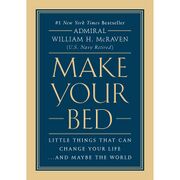
📘 Make Your Bed is a concise self-help book by retired U.S. Navy admiral William H. McRaven that expands his 2014 University of Texas at Austin commencement address into ten everyday principles for resilience and leadership.[1][2] Drawing on SEAL training and operational experience, it offers brief, anecdote-driven chapters that translate military lessons into civilian habits and leadership practice.[3] The book is structured as ten short chapters—each built around one rule—and includes the text of the UT speech.[4] It was published by Grand Central Publishing on 4 April 2017 and runs 144 pages in the first U.S. hardcover edition.[1] The publisher bills it as a #1 “New York Times” bestseller.[1] Trade reporting showed strong early sales—25.7k print units and #1 in Hardcover Nonfiction in its third week—scaling to 354k U.S. print copies by October 2017 and 811k by mid-2019.[5][6][7]
Chapter summary
This outline follows the Grand Central Publishing hardcover edition (4 April 2017; ISBN 978-1-4555-7024-9).[1][8][9]
🛏️ 1 – Start your day with a task completed. In basic SEAL training in Coronado, California, my instructors—Vietnam veterans—stepped into the barracks each morning and inspected one thing first: the bed. The corners had to be square, the covers pulled tight, the pillow centered under the headboard, and the extra blanket folded neatly at the foot of the rack. It was a simple, repeatable task that had to be done to a standard, no matter how cold the surf had been or how little sleep we had managed. Making that bed turned chaos into one controllable action and created momentum for the next task, and then the next. Even on bad days, the room offered a small sanctuary—evidence that discipline still held. The ritual taught attention to detail under stress and the value of finishing what you start. Over time, the small win of a perfect bed became a daily cue that the rest of the day could be organized and conquered. The deeper lesson is that small, reliable actions compound into identity and outcomes. Mechanistically, a visible early win triggers a feedback loop—pride, motivation, next step—that carries through demanding work and anchors resilience.
🤝 2 – You can't go it alone. Training divided us into boat crews of seven: three paddlers on each side of a small rubber boat and a coxswain calling the stroke. We formed up on the beach and, in winter swells off San Diego, pushed through eight-to-ten‑foot surf that punished any lapse in timing. Each paddle had to match the count; if one person lagged or freelanced, the boat slewed sideways and dumped us back on the sand. Progress depended on steady rhythm, mutual effort, and listening to the coxswain’s voice over wind and breaking water. The lesson was vivid: across long miles, the only way out was together. When the crew synchronized, we cleared the breakers, found smooth water, and made speed; when we fractured, we started over cold and exhausted. Beneath the surface, teamwork converts individual strength into coordinated power. The mechanism is simple: shared goals, clear roles, and tight feedback reduce friction and amplify effort, turning a group into a dependable system under pressure.
❤️ 3 – Only the size of your heart matters. A few grueling weeks into training, our class had shrunk from about 150 men to roughly 35, and the best boat crew wasn’t the one full of tall athletes—it was a crew of shorter men we nicknamed the “munchkins.” None stood much over five‑foot‑five, and their tiny swim fins drew jokes from larger classmates before every evolution. Then they out‑paddled, out‑ran, and out‑swam the field, hitting the beach ahead of everyone else, day after day. The roster mixed backgrounds and origins, but performance turned on grit, refusal to complain, and relentless pace. Watching them erase disadvantages in the cold Pacific made the selection standard unmistakable: will over optics. In that environment, lineage, stature, and résumé markers fell away; persistence and teamwork decided outcomes. The core claim is that capability is revealed by sustained effort under stress, not by surface traits. Psychologically, high motivation and collective efficacy offset physical disparities, proving that commitment and character—not measurements—predict who finishes the course.
🏃 4 – Life's not fair; drive on!. In Basic Underwater Demolition/SEAL training at Naval Amphibious Base Coronado, the uniform inspection came first: a starched cap, a pressed blouse and trousers, and a belt buckle polished to a mirror. No matter how perfect everything looked, an instructor always found a flaw and ordered a “sugar cookie”—a sprint, fully clothed, into the cold surf and a roll in the sand until every seam and crease was gritty. You stayed that way all day, wet and chafed, tracking sand into the classroom, the chow hall, and the grinder. The point wasn’t hygiene; it was learning to carry on when effort goes unrewarded. The ritual repeated until the lesson stuck: excellence doesn’t guarantee fairness, and resentment makes you slower. What mattered was the next evolution, not the verdict on the last one. The habit that formed—reset fast and move—proved more valuable than any single inspection score. The deeper truth is resilience grows when you accept variance you can’t control and invest energy where you can. That shift quiets rumination and restores forward motion, which is the book’s central promise: small acts of discipline compound into durable momentum.
🔁 5 – Failure can make you stronger. Each day in BUD/S came with timed standards—four‑mile beach runs, two‑mile ocean swims, the obstacle course, and endless calisthenics—and anyone who missed a mark saw their name posted for a dreaded “circus.” A circus meant two extra hours of punishing PT after dark, designed to wear you down and make the next day harder, which often led to another circus and then another. My swim buddy and I hit that list more than once, limping back to the barracks convinced we were falling behind for good. But a strange adaptation kicked in: lungs opened, legs hardened, and our times began to drop even when we were sore. The cycle of failure turned into progressive overload; what was meant to break us instead built capacity. Instructors never promised mercy—only the chance to try again with stronger muscles and a thicker hide. Over weeks, the posted lists stopped feeling like shame and started reading like training plans. The lesson that stuck was simple: don’t flinch from extra reps that come with setbacks; they are often the gateway to breakthroughs. Psychologically, reframing punishment as useful stress turns avoidance into approach, and approach behavior is how small, repeatable wins accrue—the engine that drives this book’s ethic of daily, compounding effort.
🦁 6 – You must dare greatly. Midway through the Coronado obstacle course, I reached the “slide for life,” a thick nylon rope that runs from a thirty‑foot tower to a pole about a hundred feet away. Hanging underneath “possum‑style,” I inched along hand over hand, feeling the seconds bleed out while an instructor called my time across the sand. At the finish a Vietnam‑era SEAL squared up to me and delivered a lesson I didn’t want but needed. A week later, I climbed the tower again, swung my legs over the top, and pushed off headfirst “commando‑style,” trading a safer technique for speed and finishing with a personal best. The risk wasn’t reckless; it was calculated—a bet on skill under pressure. That one adjustment unlocked the course and, later, informed decisions that required speed, surprise, and limited windows. Risk properly weighed is a force multiplier; timidity, a quiet tax on performance. In practice, daring is not theatrics but an evidence‑based shift from avoidance to calibrated action, which aligns with the book’s through‑line: disciplined choices repeated over time change outcomes. *“That obstacle course is going to beat you every time unless you start taking some risks.”*
🛡️ 7 – Stand up to the bullies. During BUD/S on San Clemente Island, the four‑mile night swim tested nerve as much as endurance; with only a thin wetsuit top, a mask, and fins, my swim buddy Ensign Marc Thomas and I stroked into cold, choppy water while instructors reminded us that sharks prowled the Pacific beneath us. The rule was clear: if a shark circled, don’t flee—hold your ground and, if it charges, strike the snout. The point was courage under uncertainty, because hesitation invites danger and panic spreads fast in the dark. Years later, in December 2003, after U.S. forces captured Saddam Hussein, I spent thirty days entering his cell daily to show that intimidation no longer worked; the simple, repeated act communicated that his power had ended. The two episodes rhymed: predators—animal or human—feed on fear and retreat. Composure, presence, and a willingness to push back reclaim initiative for you and those you lead. Bullies shrink when they meet someone who won’t yield, and that stance gives others permission to stand tall. The deeper lesson is that moral courage is a daily practice, not a momentary pose, and small, steady acts make it a habit that lasts. *If you want to change the world… don’t back down from the sharks.*
🚀 8 – Rise to the occasion. Dive Phase culminated at San Diego Bay, with an anchored target across the water from the 32nd Street Naval Base and twenty‑five pairs of trainees kitted in SCUBA and the bubble‑less Emerson closed‑circuit “death rig.” Our mission was to swim two thousand meters underwater at night, fix a practice limpet mine to the keel, and return undetected—navigating by a compass lit only by a small green chemical light. Fog rolled in, visibility vanished, and a missed bearing could dump a diver into the shipping channel beneath a destroyer’s hull. Instructors paced the shore and, for once, looked nervous; the exercise carried the highest risk in basic training. The only way through was calm, precise work: check gear, trust your buddy line, read the compass, keep moving. When the water turned black and the clock pressed, skill and self‑control—not bravado—kept us safe and on course. This is how performance under pressure actually works: preparation lets you convert stress into focus, and focus turns fear into decisive action. That conversion sits at the heart of the book’s promise—disciplined habits make you reliable when it matters most. *If you want to change the world… be your very best in the darkest moments.*
🕯️ 9 – Give people hope. Midweek in Hell Week we paddled to the Tijuana mudflats, a low, sucking bog between San Diego and the Mexican border, and spent long night hours submerged to our chests in cold mud and wind. The instructors offered escape if five men quit, tempting us with firelight, hot chow, and sleep while we shivered, teeth clacking so loudly orders were hard to hear. One trainee started singing—off‑key, loud, and relentless—then two joined, then three, until the whole class was bellowing into the dark. The threats kept coming, but the chorus made the cold feel a touch less cruel and the dawn a bit closer. That moment taught how quickly morale can flip when one person chooses to lift others instead of yielding. Hope is contagious; a visible act of endurance licenses the group to endure. Practically, it changes behavior by widening attention from private misery to shared purpose, which restores effort and keeps teams intact. This is the thread that runs through the lessons: small acts, offered at the worst time, can steady many. *If you want to change the world… start singing when you’re up to your neck in mud.*
🏁 10 – Never, ever quit!. On day one at Coronado an instructor in boots, khaki shorts, and a blue‑and‑gold tee walked us to the brass bell that hangs in the middle of the grinder and promised to make us want to ring it. Ring the bell and the cold swims, predawn wake‑ups, the obstacle course, and the endless PT end at once; you’re done. Over months that bell became a constant proposition—comfort now in exchange for a lifetime of wondering if you could have gone farther. Some men took the bargain, and no one mocked them; it is always easier to step away when the wind bites and the legs shake. I learned to treat the bell as a decision I would make a hundred times, one evolution at a time, until refusal became reflex. Grit isn’t bravado; it’s the quiet discipline of choosing the next right step when your body and mind demand relief. That choice compounds into identity and results, which is why the book returns to it at the end. *If you want to change the world… don’t ever, ever ring the bell.*
Background & reception
🖋️ Author & writing. McRaven is a retired four-star admiral who commanded U.S. Special Operations Command from 2011 to 2014 and later served as chancellor of the University of Texas System from 2015 to 2018.[10][11] The book grew directly from his UT Austin commencement address and keeps its spare, imperative voice, with each rule illustrated by brief vignettes from SEAL training and operations; the publisher notes the original speech “went viral” with over 10 million views.[1][12] Structurally it comprises ten stand-alone chapters capped by a reprint of the speech, reinforcing a direct, anecdote-driven style aimed at practical takeaway.[8][13] McRaven has since published additional trade books in a similar register, including Sea Stories (2019) and The Hero Code (2021).[14][15]
📈 Commercial reception. The hardcover went on sale on 4 April 2017; within three weeks it hit #1 in Hardcover Nonfiction with weekly print sales of 25.7k units, according to Publishers Weekly and BookScan.[16] It spent 34 weeks on Publishers Weekly’’s 2017 Hardcover Nonfiction list,[17] and had sold 354k U.S. print copies by late October 2017, rising to about 811k by mid-2019.[18][19] It also appeared repeatedly on The Washington Post’’s weekly nonfiction bestseller charts through summer 2017, reflecting broad retail momentum.[20]
👍 Praise. The Wall Street Journal reviewed the book on publication, describing McRaven’s rules-based program as a brisk guide to refocusing daily discipline and leadership (“Reset Your Life in an Hour,” 3 April 2017).[21] The U.S. Army’s NCO Journal endorsed its plain style and practical emphasis, calling it “a blueprint for becoming not just a great leader, but a decent human being.”[22] A Financial Times column later highlighted the broader appeal of McRaven’s keep-it-simple approach to communicating life lessons to wide audiences.[23]
👎 Criticism. The Guardian’’s “Digested Read” lampooned the book’s military aphorisms and straight-line moralizing, suggesting its lessons can come off as pat or overliteral in civilian life.[24] A Washington Post feature questioned the universal value of bed-making as a happiness tactic, arguing the habit can be counterproductive for some—an implicit caution about one of the book’s signature prescriptions.[25] Even favorable notices have framed it as a slim, highly condensed program, emphasizing brevity alongside utility.[26]
🌍 Impact & adoption. The publisher reports that McRaven’s original UT speech surpassed 10 million views, helping the book circulate as a graduation-gift staple and a shorthand for habit-first leadership.[1] The message has also been referenced in public-sector leadership talks—for example, a 2019 U.S. SEC speech used McRaven’s ten lessons to frame entrepreneurial guidance.[27] The franchise extended to younger readers with the picture-book adaptation Make Your Bed with Skipper the Seal from Little, Brown Books for Young Readers.[28]
Related content & more
YouTube videos
CapSach articles

References
- ↑ 1.0 1.1 1.2 1.3 1.4 1.5 "Make Your Bed". Grand Central Publishing. Hachette Book Group. 4 April 2017. Retrieved 4 November 2025.
- ↑ "Adm. McRaven Urges Graduates to Find Courage to Change the World". UT Austin News. 16 May 2014. Retrieved 4 November 2025.
- ↑ "Make Your Bed (review)". Army University Press – NCO Journal. 6 March 2019. Retrieved 4 November 2025.
- ↑ "Make your bed : little things that can change your life-- and maybe the world". WorldCat. OCLC. Retrieved 4 November 2025.
- ↑ "This Week's Bestsellers: May 1, 2017". Publishers Weekly. 28 April 2017. Retrieved 4 November 2025.
- ↑ "This Week's Bestsellers: October 30, 2017". Publishers Weekly. 27 October 2017. Retrieved 4 November 2025.
- ↑ "This Week's Bestsellers: June 3, 2019". Publishers Weekly. 31 May 2019. Retrieved 4 November 2025.
- ↑ 8.0 8.1 "Make your bed : record & contents". Marmot Library Network. Buena Vista Public Library. Retrieved 4 November 2025.
- ↑ "Admiral William H. McRaven — Title details (includes page count)" (PDF). Hachette Book Group. Grand Central Publishing. 2024. Retrieved 4 November 2025.
- ↑ "Admiral William McRaven". United States Navy. 2 February 2022. Retrieved 4 November 2025.
- ↑ "Former Chancellors". The University of Texas System. Retrieved 4 November 2025.
- ↑ "Adm. McRaven Urges Graduates to Find Courage to Change the World". UT Austin News. 16 May 2014. Retrieved 4 November 2025.
- ↑ "Make your bed : little things that can change your life-- and maybe the world". WorldCat. OCLC. Retrieved 4 November 2025.
- ↑ "SEA STORIES (review)". Kirkus Reviews. 21 May 2019. Retrieved 4 November 2025.
- ↑ "The Hero Code". Hachette Book Group. Retrieved 4 November 2025.
- ↑ "This Week's Bestsellers: May 1, 2017". Publishers Weekly. 28 April 2017. Retrieved 4 November 2025.
- ↑ "The Bestsellers of 2017". Publishers Weekly. 12 January 2018. Retrieved 4 November 2025.
- ↑ "This Week's Bestsellers: October 30, 2017". Publishers Weekly. 27 October 2017. Retrieved 4 November 2025.
- ↑ "This Week's Bestsellers: June 3, 2019". Publishers Weekly. 31 May 2019. Retrieved 4 November 2025.
- ↑ "Washington Post bestsellers: 30 July 2017". The Washington Post. 27 July 2017. Retrieved 4 November 2025.
- ↑ "Reset Your Life in an Hour". The Wall Street Journal. 3 April 2017. Retrieved 4 November 2025.
- ↑ "Make Your Bed (review)". Army University Press – NCO Journal. 6 March 2019. Retrieved 4 November 2025.
- ↑ "The world-changing power of making your bed". Financial Times. 5 October 2022. Retrieved 4 November 2025.
- ↑ "Make Your Bed… – digested read". The Guardian. 30 July 2017. Retrieved 4 November 2025.
- ↑ "Making your bed can change your life. Or it can bum you out". The Washington Post. 18 December 2021. Retrieved 4 November 2025.
- ↑ "Reset Your Life in an Hour". The Wall Street Journal. 3 April 2017. Retrieved 4 November 2025.
- ↑ "Start Off by Making Your Bed: Translating Military Lessons to Entrepreneurship". U.S. Securities and Exchange Commission. 9 October 2019. Retrieved 4 November 2025.
- ↑ "William McRaven Adapts 'Make Your Bed' for Kids". Kirkus Reviews. 14 February 2021. Retrieved 4 November 2025.