
Atomic Habits: Difference between revisions
No edit summary |
No edit summary |
||
| Line 84: | Line 84: | ||
🧬 '''18 – The Truth About Talent (When Genes Matter and When They Don't).''' {{Tooltip|Michael Phelps}} and {{Tooltip|Hicham El Guerrouj}} open this chapter as a study in fit: one dominates water, the other owns the track. Phelps is six feet four with a long torso and relatively short legs; El Guerrouj is five feet nine with long legs and a compact upper body—yet they share the same inseam length. At the 2004 {{Tooltip|Athens Olympics}}, El Guerrouj won gold in both the 1,500-meter and 5,000-meter races; at peak fitness Phelps weighed about 194 pounds to El Guerrouj’s 138, a difference that punishes distance running. Since 1976, the average height of men’s 1,500-meter Olympic champions has been around five-ten, while men’s 100-meter freestyle swimming champions average six-four—sports sort bodies. If they swapped events, physics would tax them from the first stride or stroke. The practical lesson is to choose arenas that amplify your advantages so effort feels rewarding and progress sticks. The mechanism is match quality: when habits align with your natural abilities and interests, the work is satisfying enough to repeat, which compounds results. In short, aim for fields where your traits set a higher ceiling and your systems can do the daily lifting. ''Genes do not eliminate the need for hard work''. |
🧬 '''18 – The Truth About Talent (When Genes Matter and When They Don't).''' {{Tooltip|Michael Phelps}} and {{Tooltip|Hicham El Guerrouj}} open this chapter as a study in fit: one dominates water, the other owns the track. Phelps is six feet four with a long torso and relatively short legs; El Guerrouj is five feet nine with long legs and a compact upper body—yet they share the same inseam length. At the 2004 {{Tooltip|Athens Olympics}}, El Guerrouj won gold in both the 1,500-meter and 5,000-meter races; at peak fitness Phelps weighed about 194 pounds to El Guerrouj’s 138, a difference that punishes distance running. Since 1976, the average height of men’s 1,500-meter Olympic champions has been around five-ten, while men’s 100-meter freestyle swimming champions average six-four—sports sort bodies. If they swapped events, physics would tax them from the first stride or stroke. The practical lesson is to choose arenas that amplify your advantages so effort feels rewarding and progress sticks. The mechanism is match quality: when habits align with your natural abilities and interests, the work is satisfying enough to repeat, which compounds results. In short, aim for fields where your traits set a higher ceiling and your systems can do the daily lifting. ''Genes do not eliminate the need for hard work''. |
||
🎯 '''19 – The Goldilocks Rule: How to Stay Motivated in Life and Work.''' In 1955 at {{Tooltip|Disneyland}} in {{Tooltip|Anaheim}}, a ten-year-old {{Tooltip|Steve Martin}} started by selling 50-cent guidebooks, then moved into the park’s magic shop, learning tricks from older employees and testing jokes on tourists. As a teenager he played five-minute sets in small {{Tooltip|Los Angeles}} clubs, often to distracted crowds, and each year expanded his routine by a minute or two—just enough to stretch, not snap. This is the Goldilocks Rule in action: keep tasks on the edge of your current ability so they’re challenging but doable. Psychology backs the pattern: the {{Tooltip|Yerkes–Dodson law}} places peak motivation between boredom and anxiety, and researchers estimate flow tends to appear when the challenge is roughly 4% beyond your skill. The rhythm—win a few, lose a few, stay engaged—kept Martin practicing long enough for mastery to accrue. The core idea is that motivation is a design problem: set difficulty to “just manageable” and you’ll want to return tomorrow. The mechanism is immediate, visible progress—small wins and quick feedback create the emotional rewards that make habits self-sustaining. ''The greatest threat to success is not failure but boredom''. |
🎯 '''19 – The Goldilocks Rule: How to Stay Motivated in Life and Work.''' In 1955 at {{Tooltip|Disneyland}} in {{Tooltip|Anaheim}}, a ten-year-old {{Tooltip|Steve Martin}} started by selling 50-cent guidebooks, then moved into the park’s magic shop, learning tricks from older employees and testing jokes on tourists. As a teenager he played five-minute sets in small {{Tooltip|Los Angeles}} clubs, often to distracted crowds, and each year expanded his routine by a minute or two—just enough to stretch, not snap. This is the Goldilocks Rule in action: keep tasks on the edge of your current ability so they’re challenging but doable. Psychology backs the pattern: the {{Tooltip|Yerkes–Dodson law}} places peak motivation between boredom and anxiety, and researchers estimate flow tends to appear when the challenge is roughly 4% beyond your skill. The rhythm—win a few, lose a few, stay engaged—kept Martin practicing long enough for mastery to accrue. The core idea is that motivation is a design problem: set difficulty to “just manageable” and you’ll want to return tomorrow. The mechanism is immediate, visible progress—small wins and quick feedback create the emotional rewards that make habits self-sustaining. ''The greatest threat to success is not failure but boredom''. |
||
| ⚫ | ⚠️ '''20 – The Downside of Creating Good Habits.''' The chapter opens with chess: only when the basic moves are automatic can a player think ahead and spot patterns, which is the upside of habit. But automation dulls attention; once a routine runs itself, feedback fades and small errors slide by. Top performers counter this with deliberate reflection and review: {{Tooltip|Eliud Kipchoge}} writes notes after each practice; {{Tooltip|Katie Ledecky}} logs wellness on a 1–10 scale, along with sleep, nutrition, and competitors’ times, and her coach reviews weekly; {{Tooltip|Chris Rock}} workshopped hundreds of jokes in tiny clubs with a notepad, keeping only the lines that landed. Teams systematize it too: in 1986 {{Tooltip|Pat Riley}} introduced the {{Tooltip|Los Angeles Lakers}}’ “{{Tooltip|Career Best Effort (CBE)}}” metric, baseline-tracking each player and asking for at least 1% improvement, posting weekly leaderboards; after rolling it out in October 1986, the Lakers won the {{Tooltip|NBA}} title and repeated a year later. You can build a similar loop personally: an Annual Review each December to tally outputs (articles, workouts, trips) and a summer Integrity Report to test values and reset standards. The core idea is that habits make you competent, while deliberate practice plus periodic review keeps you from coasting and pushes new edges. The mechanism is awareness: structured audits restore sensitivity to errors and keep identity flexible enough to adapt. ''Reflection and review is a process that allows you to remain conscious of your performance over time''. |
||
| ⚫ | ⚠️ '''20 – The Downside of Creating Good Habits.''' The chapter opens with chess: only when the basic moves are automatic can a player think ahead and spot patterns, which is the upside of habit. But automation dulls attention; once a routine runs itself, feedback fades and small errors slide by. Top performers counter this with deliberate reflection and review: {{Tooltip|Eliud Kipchoge}} writes notes after each practice; {{Tooltip|Katie Ledecky}} logs wellness on a 1–10 scale, along with sleep, nutrition, and competitors’ times, and her coach reviews weekly; {{Tooltip|Chris Rock}} workshopped hundreds of jokes in tiny clubs with a notepad, keeping only the lines that landed. Teams systematize it too: in 1986 {{Tooltip|Pat Riley}} introduced the {{Tooltip|Los Angeles Lakers}}’ “{{Tooltip|Career Best Effort (CBE)}}” metric, baseline-tracking each player and asking for at least 1% improvement, posting weekly leaderboards; after rolling it out in October 1986, the Lakers won the {{Tooltip|NBA}} title and repeated a year later. You can build a similar loop personally: an Annual Review each December to tally outputs (articles, workouts, trips) and a summer Integrity Report to test values and reset standards. The core idea is that habits make you competent, while deliberate practice plus periodic review keeps you from coasting and pushes new edges. The mechanism is awareness: structured audits restore sensitivity to errors and keep identity flexible enough to adapt. ''Reflection and review is a process that allows you to remain conscious of your performance over time''. |
||
{{CS/products/card |
|||
| url=https://etsy.com/ |
|||
| img=atomic-habits-cheatsheet.png |
|||
| button=Get it on Etsy |
|||
}} |
|||
== Background & reception == |
== Background & reception == |
||
Revision as of 16:19, 26 October 2025
"True behavior change is identity change."
— James Clear, Atomic Habits (2018)
Introduction
| Atomic Habits | |
|---|---|
 | |
| Full title | Atomic Habits: An Easy & Proven Way to Build Good Habits & Break Bad Ones |
| Author | James Clear |
| Language | English |
| Subject | Habit formation; Behavior change; Personal development |
| Genre | Nonfiction; Self-help |
| Publisher | Avery |
Publication date | 16 October 2018 |
| Publication place | United States |
| Media type | Print (hardcover, paperback); e-book; audiobook |
| Pages | 306 |
| ISBN | 978-0-7352-1129-2 |
| Goodreads rating | 4.4/5 (as of 19 October 2025) |
| Website | jamesclear.com |
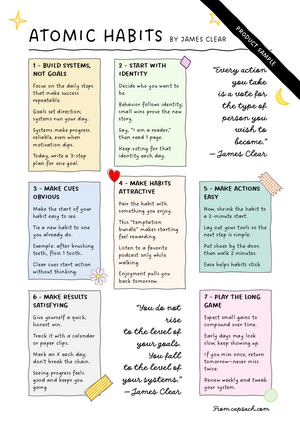
📘 Atomic Habits is a 2018 book by James Clear, published by Avery (Penguin Random House), that frames tiny, compounding changes as a practical system for behavior change. [1] It organizes habit formation into a four-step loop—cue, craving, response, reward—and translates this into the Four Laws of Behavior Change: make it obvious, attractive, easy, and satisfying. [2] The first edition is structured in six parts and twenty chapters, moving from fundamentals through four “laws” to advanced tactics. [3] Clear’s prose is example-driven and tool-oriented, emphasizing identity-based habits, environment design, habit tracking, and the “two-minute rule.” [4][5] The book has been a sustained bestseller—PRH reports “over 25 million copies sold” and translations into 60+ languages, with #1 placement on the New York Times list. [1] Avery further noted the title had reached 260 consecutive weeks on the New York Times list by 21 November 2024. [6]
Chapter summary
This outline follows the Avery hardcover first edition (16 October 2018; ISBN 978-0-7352-1129-2).[1] WorldCat records this edition and its bibliographic details.[7] A university library catalog provides the detailed contents used below.[3]
I – The Fundamentals: Why Tiny Changes Make a Big Difference
⚛️ 1 – The Surprising Power of Atomic Habits. Dave Brailsford took charge of British Cycling and chased “the aggregation of marginal gains,” tweaking everything from redesigned saddles and alcohol-wiped tires to electrically heated overshorts, wind-tunnel-tested fabrics, biofeedback sensors, personalized pillows and mattresses, and even painting the inside of the team truck white to spot dust. Five years later, at the 2008 Beijing Olympics, the team dominated road and track cycling—winning eight of the fourteen golds on offer—then set nine Olympic records and seven world records when the Games came to London in 2012. In the same span, Bradley Wiggins became the first British Tour de France winner (2012) and Chris Froome added titles in 2013, 2015, 2016, and 2017, contributing to five Tour victories in six years. Across 2007–2017, the program amassed 178 world championships and 66 Olympic or Paralympic gold medals alongside those five Tours—a decade widely regarded as the sport’s most successful run. Small improvements compound like interest: 1 percent better each day becomes roughly 37 times better after a year (1.01^365 ≈ 37.78). The mechanism is compounding—tiny, reliable gains accruing beneath the surface until a critical threshold triggers visible results—so systems beat goals because processes keep paying off. In short, focus on trajectory, not snapshots; consistent 1% gains quietly rewire outcomes. Habits are the compound interest of self-improvement.
🧠 2 – How Your Habits Shape Your Identity (and Vice Versa). Two people refuse a cigarette: one says, “No thanks. I’m trying to quit,” the other, “No thanks. I’m not a smoker”—a tiny wording shift that signals an identity already changed. The chapter frames behavior at three levels—outcomes, processes, identity—and argues that lasting change starts from the inside out. Each action becomes evidence for who you are becoming; “every action is a vote for the type of person you wish to become,” and votes accumulate until a new self-image feels true. Research echoes this: in three randomized experiments published in PNAS (2011), phrasing appeals as “be a voter” (identity) rather than “to vote” (behavior) measurably increased turnout and related actions. The mechanism is cognitive alignment—people act in ways that are congruent with their self-story—so the practical move is to choose a small habit that casts the kind of vote you want to keep tallying. Identity-based habits tie motivation to who you are, making consistency the default rather than the exception. True behavior change is identity change.
🧩 3 – How to Build Better Habits in 4 Simple Steps. In 1898, psychologist Edward Thorndike timed cats escaping “puzzle boxes” that opened when a lever was pressed or a cord pulled; after 20–30 trials, performance became automatic—Cat 12, for example, dropped from ~1.5 minutes in early attempts to ~6.3 seconds in the final trials to reach the bowl of food. From these data he stated the Law of Effect: behaviors followed by satisfying consequences are more likely to be repeated, the backbone of habit learning. As behaviors repeat, the brain offloads effort, locks onto predictive cues, and frees mental bandwidth—habits become efficient solutions to recurring problems. This sets up the four-stage loop you can deliberately design to build or break routines—ideas later distilled into the Four Laws of Behavior Change. The process of building a habit can be divided into four simple steps: cue, craving, response, and reward.
II – The 1st Law: Make It Obvious
👀 4 – The Man Who Didn't Look Right. Psychologist Gary Klein recounts a family gathering where a veteran paramedic glanced at her father-in-law and urged an immediate hospital visit; surgeons soon cleared a blocked major artery and averted a heart attack. Years of reading skin tone and micro-signals trained her eye—pattern recognition running faster than conscious thought. To make that kind of perception deliberate, Japanese rail operators use Pointing-and-Calling: they physically point to signals, speedometers, and timetables while naming what they see. That ritual reduces errors by up to 85 percent and cuts accidents by 30 percent, and a “point-only” adaptation in New York City cut incorrectly berthed trains by 57 percent within two years. The same shift from autopilot to awareness is what the Habits Scorecard does when you list and label your daily actions. The core idea is attention engineering: when cues are made unmistakable, you notice them, and noticing precedes choice. Mechanistically, raising cue salience moves behavior from nonconscious loops to intentional action—exactly what “make it obvious” demands. You need to be aware of your habits before you can change them.
🚦 5 – The Best Way to Start a New Habit. In 2001, researchers in Great Britain tracked 248 adults for two weeks to build an exercise habit. One group simply recorded workouts; a second read about heart-health benefits; a third wrote a precise plan that specified the day, time, and place they would do at least twenty minutes of vigorous exercise. The first two groups saw 35–38 percent exercise at least once; the planning group hit 91 percent. That jump came from an implementation intention—anchoring a behavior to time and location so the cue is unmissable. A companion tactic, habit stacking, links a new action to an existing one so the prior behavior becomes the trigger. Because actions cascade, a small “when-then” plan can chain into a reliable routine. The core idea is clarity over motivation: precise plans remove the decision friction at the moment of action. Mechanistically, pairing behavior with time/location (and with a preceding habit) converts an abstract goal into a concrete, repeatable cue—putting the first law, make it obvious, to work. Many people think they lack motivation when what they really lack is clarity.
🏠 6 – Motivation Is Overrated: Environment Often Matters More. At Massachusetts General Hospital in Boston, physician Anne Thorndike ran a six-month cafeteria redesign that quietly altered “choice architecture.” Her team added bottled water to the refrigerators by the registers and placed baskets of water beside food stations throughout the room. In three months, soda sales fell 11.4 percent while bottled-water sales rose 25.8 percent; similar food tweaks produced similar shifts—no announcements, no lectures. The experiment showed that people choose not just based on what something is, but where it is. Cues in the room pull behavior long before willpower shows up, which is why your counter full of cookies beats your best intentions. The core idea is environmental defaults: design spaces so desired actions are the path of least resistance. Mechanistically, arranging visible, convenient cues exploits context dependence—letting the room do the work and operationalizing “make it obvious.” Environment is the invisible hand that shapes human behavior.
🧘 7 – The Secret to Self-Control. In 1971, during a congressional visit to Vietnam, Representatives Robert Steele (Connecticut) and Morgan Murphy (Illinois) learned over 15 percent of U.S. soldiers were heroin addicts; follow-up data showed 35 percent had tried it and up to 20 percent were addicted. The Nixon administration created the Special Action Office of Drug Abuse Prevention, and sociologist Lee Robins tracked returning soldiers: only 5 percent relapsed within a year and 12 percent within three years. The change wasn’t willpower; it was context—back home, the cues that fueled the habit vanished. That finding reframed discipline: people who look “strong” mostly spend less time around temptations. In practice, the inversion of the first law is the move—make bad cues invisible by removing triggers (phone in another room, TV out of the bedroom, feeds that spark envy unfollowed). The core idea is exposure control: prevent the urge by cutting the cue, not by wrestling cravings forever. Mechanistically, reducing contact with triggers keeps desire from booting up, turning self-control into a design problem instead of a daily battle. Self-control is a short-term strategy, not a long-term one.
III – The 2nd Law: Make It Attractive
🧲 8 – How to Make a Habit Irresistible. In the 1940s, Dutch scientist Niko Tinbergen ran a string of animal-behavior experiments showing that herring gull chicks peck harder at a beak painted with three red dots and geese will try to brood volleyball-sized plaster eggs—“supernormal stimuli” that exaggerate real cues. The same pattern shows up in modern life: engineered foods, feeds, and media overstimulate our reward system. In labs, mice will nose-poke nearly 800 times per hour; in casinos, the average slot-machine player spins about 600 times per hour. Because dopamine surges more in anticipation than in receipt, desire—more than satisfaction—drives action. To harness it, an electrical-engineering student in Dublin, Ronan Byrne, built a “Cycflix” rig so Netflix only played while he pedaled at a set speed. On a bigger stage, ABC’s 2014–2015 “TGIT” block bundled Shonda Rhimes’s Grey’s Anatomy, Scandal, and How to Get Away with Murder with a ritual of popcorn and red wine to make Thursday nights feel like a treat. This is temptation bundling in action and it rests on Premack’s Principle: let a “want” reinforce a “should.” The Second Law—Make it Attractive—works because linking immediate pleasure to desired behavior turns tiny steps into immediate wins. It connects craving to action so small changes compound. Habits are a dopamine-driven feedback loop.
👥 9 – The Role of Family and Friends in Shaping Your Habits. In 1965, Hungarian educator László Polgár wrote Klára a series of letters proposing an experiment: raise children to become geniuses through deliberate practice. They home-schooled in Budapest, filled their apartment with chess books and photos, kept file cards on opponents, and funneled their daughters—Susan, Sofia, and Judit—into constant tournaments. Susan started at four and beat adults within six months; Sofia was a world champion at fourteen; Judit became the youngest grandmaster, surpassing Bobby Fischer’s mark. Social gravity shows up elsewhere too: in the 1950s, Solomon Asch’s line-length studies found nearly 75% of people conformed to a group’s wrong answer at least once. It also shows up in elite circles: when astronaut Mike Massimino took a ten-person robotics class at MIT, four students became astronauts. We copy the close, the many, and the powerful because belonging and status make behaviors feel attractive. The practical play is environmental: pick a tribe where your desired behavior is normal and you share something in common. When the culture applauds the habit, sticking with it requires less willpower and yields compounding returns. The normal behavior of the tribe often overpowers the desired behavior of the individual.
🔧 10 – How to Find and Fix the Causes of Your Bad Habits. In late 2012, in an old apartment a few blocks from Istanbul’s İstiklal Caddesi, a small group compared notes on smoking; half had quit, and a guide from Maine credited Allen Carr’s Easy Way to Stop Smoking. Carr’s method reframes every cue—“relief,” “social,” “stress”—as false promises so the expected benefits disappear and the craving loses its charge. The point is predictive: the cause of a habit is the meaning you attach to a cue, not the cue itself. Flip the Second Law—Make it Unattractive—by rewriting those meanings until the old behavior no longer feels rewarding. Clear shows the same move in miniature with “motivation rituals”—a breath, a smile, a quick mood lift—so the mind expects a better outcome before you act. The mechanism is cognitive reappraisal: change the prediction, and the craving fades; change the craving, and the response changes. Small shifts in interpretation compound because the loop runs on expectation. The key to finding and fixing the causes of your bad habits is to reframe the associations you have about them.
IV – The 3rd Law: Make It Easy
🐢 11 – Walk Slowly, but Never Backward. On the first day of class at the University of Florida, photographer Jerry Uelsmann split his students into two groups: one graded purely on quantity and the other on quality; one hundred photos earned an A, ninety a B, eighty a C. By semester’s end, the best images came from the quantity group because they spent months shooting, developing, and iterating while the quality group theorized. This story sets up the difference between “motion” (planning and perfecting) and “action” (reps that produce results). Habit automaticity rises along a learning curve: each repetition wires the behavior more deeply until you cross the “habit line.” What matters is frequency—how many times you do the thing—not the calendar time that passes. The fastest way to learn a habit is to practice it in small, real contexts and let the repetitions accumulate. The core idea is that action builds evidence and identity; psychologically, repetition strengthens the neural pathway so the behavior becomes the default. This ties back to the book’s theme: build systems that make consistent action easy and let compounding do the heavy lifting. The most effective form of learning is practice, not planning.
💤 12 – The Law of Least Effort. James Clear highlights Oswald Nuckols, an IT developer from Natchez, Mississippi, who “resets the room”: after watching TV he returns the remote to the stand, fluffs the pillows, and folds the blanket; while the shower warms, he wipes the toilet. The point isn’t tidiness; it’s preparing the next action so it’s the easiest option. Priming works in kitchens (skillet, plates, and utensils set out the night before) and living rooms (unplug the TV or stash the phone in another room) because small frictions multiply. Every step removed—one fewer tap, one fewer drawer, one fewer decision—tilts behavior. Environmental design turns good choices into the path of least resistance and bad ones into a hassle. The core idea is effort economics: we conserve energy and follow the lowest-friction path; reduce friction for desired behaviors and add friction to undesired ones. This connects to the book’s system-first theme: shape surroundings so the right action happens even on low-motivation days. The greater the friction, the less likely the habit.
⏱️ 13 – How to Stop Procrastinating by Using the Two-Minute Rule. Choreographer Twyla Tharp describes her 5:30 A.M. ritual in Manhattan: dress, step outside, hail a cab to the Pumping Iron gym at 91st Street and First Avenue, then work out for two hours—the ritual is the cab. That tiny start flips inertia and makes the rest of the sequence follow. The Two-Minute Rule applies the same logic to any habit: boil “read before bed” down to reading one page, “exercise” to rolling out a yoga mat, “fold the laundry” to one pair of socks. The aim is to master the art of showing up before you optimize. These decisive first moments act like on-ramps: once moving, momentum carries you. The core idea is to design a gateway behavior that’s trivially easy; psychologically, crossing a tiny threshold reduces resistance and builds a success loop. This aligns with the book’s theme: standardize first, then optimize—because you can’t improve a habit that doesn’t yet exist. When you start a new habit, it should take less than two minutes to do.
🔒 14 – How to Make Good Habits Inevitable and Bad Habits Impossible. In the fall and winter of 1830, with a six-month deadline looming, Victor Hugo collected his clothes and had an assistant lock them in a chest, leaving himself only a large shawl; confined at home, he wrote furiously and The Hunchback of Notre-Dame was published two weeks early on January 14, 1831. That stunt is a commitment device—precommit now to constrain later choices. Make bad habits hard (e.g., remove apps, use outlet timers, or store the TV remote in another room) and good habits automatic (e.g., automatic savings plans, one-time purchases like a better mattress). One-time decisions and automation create an “environment of inevitability” where the default favors your goals. When the system is locked in, willpower isn’t required at the moment of choice. The core idea is precommitment: by altering options in advance, you change future behavior through constraints and automation. This fits the book’s thesis: design systems that do the heavy lifting so the right behavior happens on autopilot. A commitment device is a choice you make in the present that controls your actions in the future.
V – The 4th Law: Make It Satisfying
📏 15 – The Cardinal Rule of Behavior Change. In the late 1990s, public health worker Stephen Luby left Omaha for Karachi, Pakistan, a city that by 1998 had swelled past nine million people and where many residents lived in crowded slums without reliable sanitation. His team partnered with Procter & Gamble to supply Safeguard soap, a premium bar that foamed easily and smelled good, and taught families to wash with it. Within months, researchers recorded sharp drops in childhood illness: diarrhea fell 52 percent, pneumonia 48 percent, and impetigo 35 percent. Six years later, more than 95 percent of households in the intervention group still had a soap-and-water handwashing station set up when the team returned. The reason was simple: the suds and scent made washing feel good right away, much like how flavored Wrigley gum or minty toothpaste turned basic hygiene into a satisfying experience. When a habit delivers immediate pleasure, the behavior repeats. The core idea is reinforcement: immediate rewards tell the brain “this worked,” while distant benefits rarely retrain instincts tuned for instant feedback. Making a habit satisfying closes the loop so the next repetition feels obvious. To get a habit to stick you need to feel immediately successful—even if it’s in a small way.
📆 16 – How to Stick with Good Habits Every Day. In 1993, a bank in Abbotsford, Canada, hired twenty-three-year-old stockbroker Trent Dyrsmid, who began each morning with two jars on his desk—one filled with 120 paper clips, the other empty. After every sales call he moved one clip, repeating the cycle until the second jar was full. Eighteen months later he was bringing in $5 million; by twenty-four he earned $75,000 per year (roughly $125,000 today) and soon landed a six-figure job. Clear calls this the Paper Clip Strategy, and readers have echoed it with hairpins or marbles to make progress visible. Habit tracking scales the idea: mark an X on a calendar—echoing Benjamin Franklin’s thirteen-virtues booklet—or log reps in a journal; even Jerry Seinfeld is shown in Comedian focusing on “never break the chain.” Studies back it up: people who track goals like weight, smoking, and blood pressure improve more, and in one study of 1,600+ dieters, daily food logs doubled weight loss. Tracking works because it becomes a cue, shows progress, and makes the process satisfying in itself. Mechanically, recording the action right after it happens glues repetition to immediate evidence, reinforcing the identity of “the kind of person who shows up.” Tactically, measure what matters most and, when life breaks your streak, focus on a quick rebound rather than perfection. Never miss twice.
🤝 17 – How an Accountability Partner Can Change Everything. After World War II, Roger Fisher went to Harvard Law School, founded the Harvard Negotiation Project, and in 1981 proposed a brutal safeguard against nuclear war: implant the launch code in a capsule near a volunteer’s heart and give the president a big, heavy butcher knife—if he wanted to fire, he’d have to kill one person with his own hands, “Blood on the White House carpet.” The point was to make the choice immediately painful—an inversion of the “make it satisfying” rule. On a societal level, immediate costs change behavior: New York’s first seat-belt law took effect December 1, 1984; within five years most states followed, and by 2016 over 88 percent of Americans buckled up with laws enforceable in forty-nine states. Personally, a habit contract makes stakes local and real. Entrepreneur Bryan Harris signed a written pact with his wife and trainer to log food and weigh in daily—or pay $200 to his trainer, $500 to his wife, and wear an Alabama hat to work, a stinging penalty for an Auburn fan. Comedian Margaret Cho’s “song a day” with a friend and creator Thomas Frank’s 5:55 a.m. text-penalty are everyday versions: someone is watching, and not following through hurts now. The mechanism is social cost: because reputation and belonging matter, adding fast, concrete consequences shrinks the gap between action and outcome. When bad options become immediately unsatisfying, the easier path is the good one. The inversion of the 4th Law of Behavior Change is make it unsatisfying.
VI – Advanced Tactics: How to Go from Being Merely Good to Being Truly Great
🧬 18 – The Truth About Talent (When Genes Matter and When They Don't). Michael Phelps and Hicham El Guerrouj open this chapter as a study in fit: one dominates water, the other owns the track. Phelps is six feet four with a long torso and relatively short legs; El Guerrouj is five feet nine with long legs and a compact upper body—yet they share the same inseam length. At the 2004 Athens Olympics, El Guerrouj won gold in both the 1,500-meter and 5,000-meter races; at peak fitness Phelps weighed about 194 pounds to El Guerrouj’s 138, a difference that punishes distance running. Since 1976, the average height of men’s 1,500-meter Olympic champions has been around five-ten, while men’s 100-meter freestyle swimming champions average six-four—sports sort bodies. If they swapped events, physics would tax them from the first stride or stroke. The practical lesson is to choose arenas that amplify your advantages so effort feels rewarding and progress sticks. The mechanism is match quality: when habits align with your natural abilities and interests, the work is satisfying enough to repeat, which compounds results. In short, aim for fields where your traits set a higher ceiling and your systems can do the daily lifting. Genes do not eliminate the need for hard work.
🎯 19 – The Goldilocks Rule: How to Stay Motivated in Life and Work. In 1955 at Disneyland in Anaheim, a ten-year-old Steve Martin started by selling 50-cent guidebooks, then moved into the park’s magic shop, learning tricks from older employees and testing jokes on tourists. As a teenager he played five-minute sets in small Los Angeles clubs, often to distracted crowds, and each year expanded his routine by a minute or two—just enough to stretch, not snap. This is the Goldilocks Rule in action: keep tasks on the edge of your current ability so they’re challenging but doable. Psychology backs the pattern: the Yerkes–Dodson law places peak motivation between boredom and anxiety, and researchers estimate flow tends to appear when the challenge is roughly 4% beyond your skill. The rhythm—win a few, lose a few, stay engaged—kept Martin practicing long enough for mastery to accrue. The core idea is that motivation is a design problem: set difficulty to “just manageable” and you’ll want to return tomorrow. The mechanism is immediate, visible progress—small wins and quick feedback create the emotional rewards that make habits self-sustaining. The greatest threat to success is not failure but boredom.
⚠️ 20 – The Downside of Creating Good Habits. The chapter opens with chess: only when the basic moves are automatic can a player think ahead and spot patterns, which is the upside of habit. But automation dulls attention; once a routine runs itself, feedback fades and small errors slide by. Top performers counter this with deliberate reflection and review: Eliud Kipchoge writes notes after each practice; Katie Ledecky logs wellness on a 1–10 scale, along with sleep, nutrition, and competitors’ times, and her coach reviews weekly; Chris Rock workshopped hundreds of jokes in tiny clubs with a notepad, keeping only the lines that landed. Teams systematize it too: in 1986 Pat Riley introduced the Los Angeles Lakers’ “Career Best Effort (CBE)” metric, baseline-tracking each player and asking for at least 1% improvement, posting weekly leaderboards; after rolling it out in October 1986, the Lakers won the NBA title and repeated a year later. You can build a similar loop personally: an Annual Review each December to tally outputs (articles, workouts, trips) and a summer Integrity Report to test values and reset standards. The core idea is that habits make you competent, while deliberate practice plus periodic review keeps you from coasting and pushes new edges. The mechanism is awareness: structured audits restore sensitivity to errors and keep identity flexible enough to adapt. Reflection and review is a process that allows you to remain conscious of your performance over time.
Background & reception
🖋️ Author & writing. James Clear is a writer and speaker focused on habits, decision-making, and continuous improvement. [8] He has written at JamesClear.com since 2012 and sends a weekly “3-2-1” newsletter to more than 3 million subscribers. [9] In discussing the book’s origins, he has linked his interest in behavior change to rebuilding after a serious high-school injury and to the value of “showing up” consistently. [10] In the text, he formalizes a habit loop—cue, craving, response, reward—and develops the Four Laws of Behavior Change to design behavior. [11] He popularizes tactics such as habit stacking, temptation bundling, and the “two-minute rule.” [12] The first edition’s outline spans six parts and twenty chapters. [3]
📈 Commercial reception. PRH reports more than 25 million copies sold worldwide and translations into 60+ languages, alongside #1 New York Times bestseller status. [1] Avery marked a run of 260 consecutive weeks on the New York Times list as of 21 November 2024. [13] The book continued to chart in major U.S. lists—e.g., No. 8 on the Washington Post hardcover nonfiction list on 12 March 2025. [14]
👍 Praise. The Financial Times’ business-books column called Atomic Habits “a step-by-step manual for changing routines,” highlighting its cue-craving-response-reward model. [15] The Washington Post said it “presents interesting ideas about how habits form” and stresses identity in behavior change. [16] In 2025, WIRED recommended the book as “a great next step” for setting up systems that support durable habits. [17]
👎 Criticism. In a survey essay on “Tedcore” self-help, The Guardian argued that Atomic Habits repackages existing ideas with “feel-good” language, citing “stacking” and “temptation bundling.” [18] The Financial Times warned that bestsellers like Clear’s can encourage “endless routine refinement,” questioning over-optimization. [19] An academic review in the International Journal of Social Impact critiqued the framework as overly simplified and called for stronger causal evidence behind claims. [20]
🌍 Impact & adoption. Clear’s framework has been extended into products and programs, including the official Atoms habit-tracking app. [21] Avery announced *The Atomic Habits Workbook* as an official companion, scheduled for publication on 9 December 2025. [22] The title appears on university reading lists—for example, a 2024 recommended list issued via RCSI’s Inside portal. [23] Publisher and author pages also note Clear’s frequent talks for Fortune 500 audiences, reflecting corporate uptake of the book’s methods. [24]
Related content & more
YouTube videos
Provided ID could not be validated.Summary of Atomic Habits (9 min) Provided ID could not be validated.Summary of Atomic Habits (28 min)
CapSach articles
References
- ↑ 1.0 1.1 1.2 1.3 "Atomic Habits". Penguin Random House. Penguin Random House. 16 October 2018. Retrieved 19 October 2025.
- ↑ "Atomic Habits Summary". JamesClear.com. James Clear. Retrieved 19 October 2025.
- ↑ 3.0 3.1 3.2 "Contents: Atomic habits". Colorado Mesa University Library Catalog (Marmot). Marmot Library Network. Retrieved 19 October 2025.
- ↑ "Atomic Habits (Excerpt): Habit tracking & identity-based habits". Penguin Random House. Penguin Random House. Retrieved 19 October 2025.
- ↑ "How to make a habit stick (and it's not about trying harder)". The Washington Post. The Washington Post. 21 December 2018. Retrieved 19 October 2025.
- ↑ "Avery Celebrates 5 Years of ATOMIC HABITS & an Astounding 260 Weeks on the NYT Bestseller List". Penguin Random House. Penguin Random House. 21 November 2024. Retrieved 19 October 2025.
- ↑ "Atomic habits : an easy & proven way to build good habits & break bad ones". WorldCat. OCLC. 2018. Retrieved 19 October 2025.
- ↑ "About James Clear". JamesClear.com. James Clear. Retrieved 19 October 2025.
- ↑ "About James Clear". JamesClear.com. James Clear. Retrieved 19 October 2025.
- ↑ "A Conversation with James Clear". Penguin Random House. Penguin Random House. Retrieved 19 October 2025.
- ↑ "Atomic Habits Summary". JamesClear.com. James Clear. Retrieved 19 October 2025.
- ↑ "How to make a habit stick (and it's not about trying harder)". The Washington Post. The Washington Post. 21 December 2018. Retrieved 19 October 2025.
- ↑ "Avery Celebrates 5 Years of ATOMIC HABITS & an Astounding 260 Weeks on the NYT Bestseller List". Penguin Random House. Penguin Random House. 21 November 2024. Retrieved 19 October 2025.
- ↑ "Washington Post hardcover bestsellers (12 March 2025)". The Washington Post. The Washington Post. 12 March 2025. Retrieved 19 October 2025.
- ↑ "FT business books of the month: November edition". Financial Times. 8 November 2018. Retrieved 19 October 2025.
- ↑ McGregor, Jena (21 December 2018). "How to make a habit stick (and it's not about trying harder)". The Washington Post. Retrieved 19 October 2025.
- ↑ "How to Start (and Keep) a Healthy Habit". WIRED. 1 January 2025. Retrieved 19 October 2025.
- ↑ Phillips-Horst, Steven (18 May 2022). "Tedcore: the self-help books that have changed the way we live, speak and think". The Guardian. Retrieved 19 October 2025.
- ↑ "The life-ruining power of routines". Financial Times. 7 March 2024. Retrieved 19 October 2025.
- ↑ "A Psychological Perspective on Behaviour Change: A Critical Analysis of Atomic Habits" (PDF). International Journal of Social Impact. International Journal of Social Impact. 31 August 2025. Retrieved 19 October 2025.
- ↑ "Atoms — The official Atomic Habits app". JamesClear.com. James Clear. Retrieved 19 October 2025.
- ↑ "Avery Announces James Clear's THE ATOMIC HABITS WORKBOOK". Penguin Random House. Penguin Random House. 28 August 2025. Retrieved 19 October 2025.
- ↑ "Recommended Reading List (MCP)" (PDF). Royal College of Surgeons in Ireland (Inside RCSI). RCSI. May 2024. Retrieved 19 October 2025.
- ↑ "James Clear". Penguin Random House. Penguin Random House. Retrieved 19 October 2025.