
The Compound Effect: Difference between revisions
No edit summary |
No edit summary |
||
| Line 24: | Line 24: | ||
}} |
}} |
||
📘 '''''The Compound Effect''''' is a self-help book by Darren Hardy that argues small, consistent choices and behaviors |
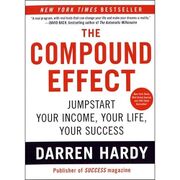
📘 '''''The Compound Effect''''' is a self-help book by Darren Hardy that argues small, consistent choices and behaviors compound into outsized results, offering practical routines for measuring progress and building momentum.<ref name="Hachette2020">{{cite web |title=The Compound Effect (10th Anniversary Edition) |url=https://www.hachettebookgroup.com/titles/darren-hardy/the-compound-effect-10th-anniversary-edition/9780306924644/ |website=Hachette Book Group |publisher=Balance |date=15 September 2020 |access-date=4 November 2025}}</ref> The text is organized into six compact chapters—an opening on the idea followed by “Choices,” “Habits,” “Momentum,” “Influences,” and “Acceleration”—and teaches readers to track behaviors, install disciplined routines, and harness momentum.<ref name="OCLC890950294" /><ref name="Hachette2020" /> It first appeared in 2010 from Success Books, was reissued as a Da Capo Press paperback in 2013, and later received a 10th-anniversary edition from Balance on 15 September 2020.<ref name="OCLC890950294" /><ref name="Hachette2020" /> Hardy writes in a direct, anecdote-driven register shaped by his background leading SUCCESS media and interviewing high performers.<ref name="DarrenSite">{{cite web |title=Darren Hardy |url=https://darrenhardy.com/ |website=DarrenHardy.com |publisher=Darren Hardy |access-date=4 November 2025}}</ref><ref name="Adweek2007">{{cite news |title=Success Magazine to Rise From Scrap Heap Once More |url=https://www.adweek.com/media/success-magazine-rise-from-scrap-heap-once-more-82402/ |work=Adweek |date=16 November 2007 |access-date=4 November 2025}}</ref> Its visibility has persisted across formats and markets, with a 2020 update and recurring appearances on Apple iBooks Business & Personal Finance bestseller lists reported by ''Publishers Weekly'' in January 2015, February 2015, and July 2018.<ref name="PW2015Jan11">{{cite news |title=Apple iBooks Category Bestsellers, January 11, 2015 |url=https://www.publishersweekly.com/pw/by-topic/digital/content-and-e-books/article/65272-apple-ibooks-category-bestsellers-january-11-2015.html |work=Publishers Weekly |date=11 January 2015 |access-date=4 November 2025}}</ref><ref name="PW2015Feb22">{{cite news |title=Apple iBooks Category Bestsellers, February 22, 2015 |url=https://www.publishersweekly.com/pw/by-topic/digital/content-and-e-books/article/65724-apple-ibooks-category-bestsellers-february-22-2015.html |work=Publishers Weekly |date=22 February 2015 |access-date=4 November 2025}}</ref><ref name="PW2018Jul6">{{cite news |title=Apple iBooks Category Bestsellers, July 1, 2018 |url=https://www.publishersweekly.com/pw/by-topic/digital/content-and-e-books/article/77432-apple-ibooks-category-bestsellers-july-1-2018.html |work=Publishers Weekly |date=6 July 2018 |access-date=4 November 2025}}</ref> |
||
== Chapter summary == |
== Chapter summary == |
||
''This outline follows the Da Capo Press paperback edition (2013; ISBN 978-1-59315-724-1).''<ref name="OCLC890950294">{{cite web |title=The compound effect : multiplying your success, one simple step at a time |url=https://search.worldcat.org/ja/title/890950294?tab=details |website=WorldCat |publisher=OCLC |access-date=4 November 2025}}</ref> |
''This outline follows the Da Capo Press paperback edition (2013; ISBN 978-1-59315-724-1).''<ref name="OCLC890950294">{{cite web |title=The compound effect : multiplying your success, one simple step at a time |url=https://search.worldcat.org/ja/title/890950294?tab=details |website=WorldCat |publisher=OCLC |access-date=4 November 2025}}</ref> |
||
📈 '''1 – The Compound Effect in Action.''' A simple money riddle frames the idea: take $3 million today or a penny that doubles daily for 31 days; by Day 20 the penny is only $5,242.88, but by Day 31 it reaches $10,737,418.24 |
📈 '''1 – The Compound Effect in Action.''' A simple money riddle frames the idea: take $3 million today or a penny that doubles daily for 31 days; by Day 20 the penny is only $5,242.88, but by Day 31 it reaches $10,737,418.24 and surpasses the cash. Three friends—Larry, Scott, and Brad—show how this math plays out in life. Scott adopts tiny upgrades after reading a ''SUCCESS'' interview with Dr. Mehmet Oz: he trims 125 calories a day, reads 10 pages nightly, listens to 30 minutes of instructional audio on his commute, and adds a couple thousand steps. Brad moves the other way, buying a big-screen TV, cooking Food Channel desserts, and installing a family-room bar with one extra drink a week; Larry changes nothing. For five months nothing looks different; by 18 months slight differences appear; around month 25 gaps are measurable, by month 27 expansive, and by month 31 stark. Scott’s 125-calorie cut over 940 days equals 117,500 calories, or 33.5 pounds lost; Brad’s extra 125 calories adds 33.5 pounds—a 67-pound spread. Over the same period Scott accrues roughly 1,000 hours of study, earns a promotion, and strengthens his marriage, while Brad grows sluggish at work and strains his relationship. A ripple-effect vignette traces how one new muffin habit cascades into poor sleep, lower productivity, friction at home, and more comfort eating. Small, repeated behaviors compound through time and feedback loops, staying invisible until a threshold makes the gains—or losses—obvious; consistent systems beat sporadic pushes because “overnight success” is often months or years of quiet accumulation. |
||
⚖️ '''2 – Choices.''' A blunt contrast—elephants don’t bite, mosquitoes |
⚖️ '''2 – Choices.''' A blunt contrast—elephants don’t bite, mosquitoes do—shows that small, frequent decisions shape outcomes more than dramatic events. A relationship experiment makes it concrete: keeping a “Thanks Giving” journal for his wife, recording one appreciated act every day for a year, then presenting the filled notebook the following Thanksgiving, proves more moving than an earlier BMW birthday gift and changes how both partners behave. Attention drives behavior: what you monitor multiplies, so a personal scorecard nudges choices toward stated aims. At age eighteen, a seminar instructor writes 100/0 on an easel to demand full responsibility for a relationship with zero expectation of return—a stance later applied to work, health, and money. Luck is reframed as preparation plus attitude plus opportunity plus action, making serendipity something you can influence. Practical tools include auditing tiny defaults (snacks, media, gossip), shaping the environment so the right option is easy, and tracking choices so momentum builds. Because responsibility, attention, and tracking change what you do next, micro-decisions stack into disproportionate results over time. ''You alone are responsible for what you do, don’t do, or how you respond to what’s done to you.'' |
||
🔁 '''3 – Habits.''' In a forest parable, a wise teacher asks a young pupil to pull up a tiny sprout, then a |
🔁 '''3 – Habits.''' In a forest parable, a wise teacher asks a young pupil to pull up a tiny sprout, then a knee-high sapling, then an evergreen as tall as the boy, and finally points to a mighty oak the boy cannot budge; the exercise shows how roots deepen with time, and how the effort required grows with them. Habits are defined plainly—acquired behaviors that become nearly involuntary—and many people ride routines they never chose deliberately. The “instant gratification trap” explains why change is hard: if skipping the tenth sales call got you fired today, you’d make it; if the first forkful of cake added fifty pounds instantly, you’d pass, but consequences rarely arrive on schedule. Build “why-power”: a ten-inch-wide, thirty-foot plank on the ground becomes terrifying when it spans two 100-story rooftops, until saving a child is at stake—then desire overwhelms fear. A real-world vignette follows an executive who spends about three and a half hours a day on news; swapping to a selective feed frees time for exercise, reading, and family. Next, “Game Changers” for breaking patterns—map triggers across the who/what/where/when, clean house so cues disappear, swap harmful defaults for lighter alternatives, ease in when roots run deep, or jump in when decisive overhaul helps—come with concrete swaps, from cutting ice-cream binges to two chocolate kisses to replacing a 10-soda habit with water. With goals clarified and triggers mapped, new behaviors install the same way old ones formed: small actions repeated until automatic. Attention and environment design power the change; measure what you do, remove friction, and anchor routines to a purpose strong enough to survive boredom and setbacks. Over weeks and months those choices harden into identity, and identity makes the next right choice easier, letting the compound effect work quietly in the background. ''My son, you have just demonstrated the power that habits will have over your life!'' |
||
🚀 '''4 – Momentum.''' Momentum arrives as |
🚀 '''4 – Momentum.''' Momentum arrives as “Big Mo,” the quiet ally of Bill Gates, Steve Jobs, Richard Branson, Michael Jordan, Lance Armstrong, and Michael Phelps, whose presence makes progress feel easier. Physics frames the point: by Newton’s first law, couch potatoes tend to stay put while achievers in motion keep moving; like pushing a packed merry-go-round, the first steps are hardest and only later does speed build with less strain. A parallel image notes that rockets burn more fuel in the first few minutes to escape gravity; once free of the pull, they glide. Momentum also cuts both ways, amplifying drift as easily as discipline. To harness it, use routine power: pilots run a preflight checklist every time, golfers such as Jack Nicklaus rely on an unbroken pre-shot routine, and lives benefit from similar “bookends” that lock down mornings and evenings. “Rise & Shine,” “Sweet Dreams,” and “Shake It Up” show how to slot reading, planning, and review into those edges of the day so the middle can be chaotic without derailing the whole. “Registering Your Rhythm” introduces a one-page Rhythm Register to tally a half-dozen daily behaviors and run a weekly plan–do–review–improve loop, turning streaks into momentum. A cautionary story follows “Richard,” who launches a two-hours-a-day, five-days-a-week gym plan; scaling to a sustainable hour protects consistency—the critical safeguard—because stop-start flying burns fuel and kills pace. The “Pump Well” metaphor drives it home: keep pumping through the dry stretch until water flows, because quitting resets the vacuum and wastes the work already banked. Consistent routines convert friction into flow and make the next rep cheaper than the last; once motion is won, the compound effect multiplies results with less effort. ''Big Mo is, without doubt, one of the most powerful and enigmatic forces of success.'' |
||
🧭 '''5 – Influences.''' Under |
🧭 '''5 – Influences.''' Under “Don’t Drink Dirty Water,” the mind is an empty glass that clouds when filled with sensational news and talk-show rants; the remedy is to flush it with better input by reading instructional material for thirty minutes in the morning and evening and by playing personal-development CDs while driving. The media numbers are blunt: Americans twelve and older average about 1,704 hours of television a year—roughly 4.7 hours a day, or about thirty-three hours a week—so a deliberate media diet matters. To reclaim commute time, Brian Tracy’s “Drive-Time U” reframes the typical 12,000 miles a year (about 300 hours) as the equivalent of two semesters of an advanced college education if used for learning. Associations follow: citing Harvard researcher David McClelland, the text argues a person’s “reference group” can determine as much as 95 percent of success or failure and offers tactics such as limiting contacts that drain momentum, choosing peak-performance partners, and assembling a personal board of advisors. Environment becomes concrete in Tiburon, Marin County: regular brunches at Sam’s on the Wharf and repeated walks past a blue, four-story hillside home with an elevator and a whale lightning rod expand ambition until the contract is signed on the spot. Surroundings—including clutter, unfinished commitments, and tolerated standards—quietly set ceilings; clearing them lifts energy and resets norms. Together, inputs, associations, and environment shape attention, expectations, and behavior, which in turn govern choices. By curating what goes into the mind, who has access to time, and the spaces one inhabits, small decisions start compounding in the right direction. ''Your mind is like an empty glass; it’ll hold anything you put into it.'' |
||
⏫ '''6 – Acceleration.''' A climb up Mount Soledad in La Jolla frames the “moment of truth”: legs burning on a steep grade, the choice is to crack or push through the wall. The |
⏫ '''6 – Acceleration.''' A climb up Mount Soledad in La Jolla frames the “moment of truth”: legs burning on a steep grade, the choice is to crack or push through the wall. The narrative then spotlights Lance Armstrong’s first Tour de France victory, singling out the mountain stage to Sestriere—eighteen miles of final ascent in freezing rain and hail—where he is thirty-two seconds down with five miles to go, surges to the leaders, attacks, and wins the stage and ultimately the Tour. Coaching lore adds texture: Lou Holtz’s team once trailed 42–0 at halftime, then won after a reel of “second efforts” and a demand for plays beyond “best.” Strategy matters, too: Muhammad Ali’s 30 October 1974 “Rope-a-Dope” against George Foreman conserves energy until the eighth round, when a drained Foreman falls to a late combination. The mechanics of multiplication follow: push three to five reps past a twelve-rep set to trigger outsized gains; add one extra weekly doubling to the “magic penny” and the 31-day total leaps from about $10 million to roughly $171 million. Exceeding expectations amplifies results in public life as well—Oprah’s September 2004 season opener escalates from giving a dozen audience members a 2005 Pontiac G6 to handing keys to everyone, a masterclass in “Beat the Expectations.” “Do the Unexpected” and “Do Better Than Expected” round out the playbook with contrarian gestures, personal “shock and awe” campaigns, and case studies like the Invisible Children “Rescue” that secures national media after days of persistence. Compounding accelerates when effort crosses thresholds others avoid, creating reputation effects, surprise, and momentum that attract more opportunity. Push past discomfort—then add a little more—and nonlinear returns stack over time. ''Find the line of expectation and then exceed it.'' |
||
== Background & reception == |
== Background & reception == |
||
🖋️ '''Author & writing'''. Hardy built his brand in the “success media” space and served as the driving figure behind SUCCESS, positioning himself as a curator of high-performer playbooks.<ref name="DarrenSite" /> Adweek reported his selection to relaunch SUCCESS as publisher in November 2007, |
🖋️ '''Author & writing'''. Hardy built his brand in the “success media” space and served as the driving figure behind SUCCESS, positioning himself as a curator of high-performer playbooks.<ref name="DarrenSite" /> ''Adweek'' reported his selection to relaunch SUCCESS as publisher in November 2007, which contextualizes his access to prominent business figures and informs the book’s anecdote-driven style.<ref name="Adweek2007" /> The 10th-anniversary edition frames the book as an “operator’s manual,” promising strategies to eradicate bad habits, install key disciplines, and capture momentum.<ref name="Hachette2020" /> The structure is tight: an opening chapter on the core idea, followed by “Choices,” “Habits,” “Momentum,” “Influences,” and “Acceleration.”<ref name="OCLC890950294" /> Pagination varies by edition: the first Success Books release runs 173 pages, the 2013 Da Capo paperback 172 pages, and the 2020 Balance edition 208 pages.<ref name="OCLC890950294" /><ref name="Hachette2020" /> Hachette UK reissued the title in 2022 under its John Murray One imprint, signaling continued international distribution.<ref name="HachetteUK2022">{{cite web |title=The Compound Effect |url=https://www.hachette.co.uk/titles/darren-hardy-llc/the-compound-effect/9781399805780/ |website=Hachette UK |publisher=John Murray One |access-date=4 November 2025}}</ref> |
||
📈 '''Commercial reception'''. Publishers Weekly documented the book on Apple’s iBooks Business & Personal Finance bestseller lists on 11 January 2015 and 22 February 2015, and again in a category roundup dated 1 July 2018, indicating sustained digital-retail traction years after first publication.<ref name="PW2015Jan11" /><ref name="PW2015Feb22" /><ref name="PW2018Jul6" /> A 10th-anniversary edition went on sale on 15 September 2020 through Balance (Hachette), adding new packaging and maintaining availability across hardcover and ebook formats.<ref name="Hachette2020" /> Hachette UK’s 2022 paperback further broadened reach in the UK market.<ref name="HachetteUK2022" /> |
📈 '''Commercial reception'''. ''Publishers Weekly'' documented the book on Apple’s iBooks Business & Personal Finance bestseller lists on 11 January 2015 and 22 February 2015, and again in a category roundup dated 1 July 2018, indicating sustained digital-retail traction years after first publication.<ref name="PW2015Jan11" /><ref name="PW2015Feb22" /><ref name="PW2018Jul6" /> A 10th-anniversary edition went on sale on 15 September 2020 through Balance (Hachette), adding new packaging and maintaining availability across hardcover and ebook formats.<ref name="Hachette2020" /> Hachette UK’s 2022 paperback further broadened reach in the UK market.<ref name="HachetteUK2022" /> |
||
👍 '''Praise'''. Business Insider highlighted the book’s applicability for practitioners: in a 5 May 2023 feature, investor Dan Rivers recommended it for breaking ambitious goals into bite-sized steps and daily improvements.<ref name="BI2023">{{cite news |title=A real-estate investor who owns 12 properties shares the 10 books that helped him build a $2.7 million portfolio in just 4 years |url=https://www.businessinsider.com/best-real-estate-investing-business-personal-development-building-wealth-books-2023-4 |work=Business Insider |date=5 May 2023 |access-date=4 November 2025 |last=Han |first=Lisa Kailai}}</ref> Inc. described Hardy’s earlier work on the |
👍 '''Praise'''. ''Business Insider'' highlighted the book’s applicability for practitioners: in a 5 May 2023 feature, investor Dan Rivers recommended it for breaking ambitious goals into bite-sized steps and daily improvements.<ref name="BI2023">{{cite news |title=A real-estate investor who owns 12 properties shares the 10 books that helped him build a $2.7 million portfolio in just 4 years |url=https://www.businessinsider.com/best-real-estate-investing-business-personal-development-building-wealth-books-2023-4 |work=Business Insider |date=5 May 2023 |access-date=4 November 2025 |last=Han |first=Lisa Kailai}}</ref> ''Inc.'' described Hardy’s earlier work on the theme as “an easy-to-follow formula for personal success,” reinforcing the book’s reputation for clarity and pragmatism.<ref name="Inc2015">{{cite news |title=7 Books You Should Preorder Today |url=https://www.inc.com/geoffrey-james/7-books-you-should-pre-order-today.html |work=Inc. |date=4 January 2015 |access-date=4 November 2025 |last=James |first=Geoffrey}}</ref> ''Entrepreneur'' favorably cited Hardy’s “why-power” framing when discussing motivation for creators and founders, reflecting positive reception in the small-business press.<ref name="Entrepreneur2015">{{cite news |title=Tell Your Own Story: Write, Market and Publish Your First Book |url=https://www.entrepreneur.com/franchises/tell-your-own-story-write-market-and-publish-your-first/247945 |work=Entrepreneur |date=2 July 2015 |access-date=4 November 2025 |last=Patton |first=Meiko}}</ref> |
||
👎 '''Criticism'''. Researchers caution that habit formation is slower and more variable than popular summaries suggest: a widely cited study modeled real-world habit formation with a median of 66 days and large individual ranges, implying that results may be gradual rather than “exponential.”<ref name="Lally2010">{{cite journal |author=Phillippa Lally; Cornelia H. M. van Jaarsveld; Henry W. W. Potts; Jane Wardle |date=2010 |title=How are habits formed: Modelling habit formation in the real world |journal=European Journal of Social Psychology |volume=40 |issue=6 |pages=998–1009 |doi=10.1002/ejsp.674 |url=https://onlinelibrary.wiley.com/doi/full/10.1002/ejsp.674 |access-date=4 November 2025}}</ref> Science reporting reiterates that there is no universal “21-day rule,” and that timelines depend on behavior and context, complicating simplified promises of rapid change.<ref name="SciAm2024">{{cite news |title=How Long Does It Really Take to Form a Habit? |url=https://www.scientificamerican.com/article/how-long-does-it-really-take-to-form-a-habit/ |work=Scientific American |date=24 January 2024 |access-date=4 November 2025 |last=Solis-Moreira |first=Jocelyn}}</ref> Journalists have also questioned the broader “marginal gains” narrative often invoked to justify compounding metaphors, warning that its golden aura can be overstated outside specific elite-sport contexts.<ref name="Guardian2019">{{cite news |title=Golden aura around marginal gains is beginning to look a little tarnished |url=https://www.theguardian.com/sport/blog/2019/oct/20/marginal-gains-tarnished-bradley-wiggins-dave-brailsford |work=The Guardian |date=20 October 2019 |access-date=4 November 2025 |last=Ingle |first=Sean}}</ref> |
👎 '''Criticism'''. Researchers caution that habit formation is slower and more variable than popular summaries suggest: a widely cited study modeled real-world habit formation with a median of 66 days and large individual ranges, implying that results may be gradual rather than “exponential.”<ref name="Lally2010">{{cite journal |author=Phillippa Lally; Cornelia H. M. van Jaarsveld; Henry W. W. Potts; Jane Wardle |date=2010 |title=How are habits formed: Modelling habit formation in the real world |journal=European Journal of Social Psychology |volume=40 |issue=6 |pages=998–1009 |doi=10.1002/ejsp.674 |url=https://onlinelibrary.wiley.com/doi/full/10.1002/ejsp.674 |access-date=4 November 2025}}</ref> Science reporting reiterates that there is no universal “21-day rule,” and that timelines depend on behavior and context, complicating simplified promises of rapid change.<ref name="SciAm2024">{{cite news |title=How Long Does It Really Take to Form a Habit? |url=https://www.scientificamerican.com/article/how-long-does-it-really-take-to-form-a-habit/ |work=Scientific American |date=24 January 2024 |access-date=4 November 2025 |last=Solis-Moreira |first=Jocelyn}}</ref> Journalists have also questioned the broader “marginal gains” narrative often invoked to justify compounding metaphors, warning that its golden aura can be overstated outside specific elite-sport contexts.<ref name="Guardian2019">{{cite news |title=Golden aura around marginal gains is beginning to look a little tarnished |url=https://www.theguardian.com/sport/blog/2019/oct/20/marginal-gains-tarnished-bradley-wiggins-dave-brailsford |work=The Guardian |date=20 October 2019 |access-date=4 November 2025 |last=Ingle |first=Sean}}</ref> |
||
🌍 '''Impact & adoption'''. Business |
🌍 '''Impact & adoption'''. ''Business Insider'' lists in 2020 and 2023 show the book circulating as recommended reading among working investors and sales professionals, signaling practical adoption beyond the self-help aisle.<ref>{{cite news |title=The Best Real-Estate Career Books, According to Rising Stars |url=https://www.businessinsider.com/rising-stars-real-estate-commercial-residential-books-advice-success-2020-12 |work=Business Insider |date=15 December 2020 |access-date=4 November 2025}}</ref><ref name="BI2023" /> Continued reissues—Balance’s 2020 anniversary edition and Hachette UK’s 2022 paperback—keep the title in active use for corporate learning and personal development programs that favor concise, behavior-tracking playbooks.<ref name="Hachette2020" /><ref name="HachetteUK2022" /> In management scholarship, adjacent work on “small wins” and daily progress has entered leadership training and curricula, providing an evidence-based complement to the book’s compounding motif.<ref>{{cite web |title=How Small Wins Unleash Creativity |url=https://www.library.hbs.edu/working-knowledge/how-small-wins-unleash-creativity |website=Harvard Business School Working Knowledge |date=6 September 2011 |access-date=4 November 2025 | author=Teresa M. Amabile; Steven J. Kramer}}</ref> |
||
== Related content & more == |
== Related content & more == |
||
Revision as of 23:43, 4 November 2025
"Big Mo is, without doubt, one of the most powerful and enigmatic forces of success. You can’t see or feel Mo, but you know when you’ve got it."
— Darren Hardy, The Compound Effect (2010)
Introduction
| The Compound Effect | |
|---|---|
 | |
| Full title | The Compound Effect: Multiplying Your Success, One Simple Step at a Time |
| Author | Darren Hardy |
| Language | English |
| Subject | Success; Self-help techniques; Personal development |
| Genre | Nonfiction; Self-help |
| Publisher | Success Books |
| Publication place | United States |
| Media type | Print (hardcover, paperback); e-book; audiobook |
| Pages | 173 |
| ISBN | 978-0-9819512-4-9 |
| Website | hachettebookgroup.com |
📘 The Compound Effect is a self-help book by Darren Hardy that argues small, consistent choices and behaviors compound into outsized results, offering practical routines for measuring progress and building momentum.[1] The text is organized into six compact chapters—an opening on the idea followed by “Choices,” “Habits,” “Momentum,” “Influences,” and “Acceleration”—and teaches readers to track behaviors, install disciplined routines, and harness momentum.[2][1] It first appeared in 2010 from Success Books, was reissued as a Da Capo Press paperback in 2013, and later received a 10th-anniversary edition from Balance on 15 September 2020.[2][1] Hardy writes in a direct, anecdote-driven register shaped by his background leading SUCCESS media and interviewing high performers.[3][4] Its visibility has persisted across formats and markets, with a 2020 update and recurring appearances on Apple iBooks Business & Personal Finance bestseller lists reported by Publishers Weekly in January 2015, February 2015, and July 2018.[5][6][7]
Chapter summary
This outline follows the Da Capo Press paperback edition (2013; ISBN 978-1-59315-724-1).[2]
📈 1 – The Compound Effect in Action. A simple money riddle frames the idea: take $3 million today or a penny that doubles daily for 31 days; by Day 20 the penny is only $5,242.88, but by Day 31 it reaches $10,737,418.24 and surpasses the cash. Three friends—Larry, Scott, and Brad—show how this math plays out in life. Scott adopts tiny upgrades after reading a SUCCESS interview with Dr. Mehmet Oz: he trims 125 calories a day, reads 10 pages nightly, listens to 30 minutes of instructional audio on his commute, and adds a couple thousand steps. Brad moves the other way, buying a big-screen TV, cooking Food Channel desserts, and installing a family-room bar with one extra drink a week; Larry changes nothing. For five months nothing looks different; by 18 months slight differences appear; around month 25 gaps are measurable, by month 27 expansive, and by month 31 stark. Scott’s 125-calorie cut over 940 days equals 117,500 calories, or 33.5 pounds lost; Brad’s extra 125 calories adds 33.5 pounds—a 67-pound spread. Over the same period Scott accrues roughly 1,000 hours of study, earns a promotion, and strengthens his marriage, while Brad grows sluggish at work and strains his relationship. A ripple-effect vignette traces how one new muffin habit cascades into poor sleep, lower productivity, friction at home, and more comfort eating. Small, repeated behaviors compound through time and feedback loops, staying invisible until a threshold makes the gains—or losses—obvious; consistent systems beat sporadic pushes because “overnight success” is often months or years of quiet accumulation.
⚖️ 2 – Choices. A blunt contrast—elephants don’t bite, mosquitoes do—shows that small, frequent decisions shape outcomes more than dramatic events. A relationship experiment makes it concrete: keeping a “Thanks Giving” journal for his wife, recording one appreciated act every day for a year, then presenting the filled notebook the following Thanksgiving, proves more moving than an earlier BMW birthday gift and changes how both partners behave. Attention drives behavior: what you monitor multiplies, so a personal scorecard nudges choices toward stated aims. At age eighteen, a seminar instructor writes 100/0 on an easel to demand full responsibility for a relationship with zero expectation of return—a stance later applied to work, health, and money. Luck is reframed as preparation plus attitude plus opportunity plus action, making serendipity something you can influence. Practical tools include auditing tiny defaults (snacks, media, gossip), shaping the environment so the right option is easy, and tracking choices so momentum builds. Because responsibility, attention, and tracking change what you do next, micro-decisions stack into disproportionate results over time. You alone are responsible for what you do, don’t do, or how you respond to what’s done to you.
🔁 3 – Habits. In a forest parable, a wise teacher asks a young pupil to pull up a tiny sprout, then a knee-high sapling, then an evergreen as tall as the boy, and finally points to a mighty oak the boy cannot budge; the exercise shows how roots deepen with time, and how the effort required grows with them. Habits are defined plainly—acquired behaviors that become nearly involuntary—and many people ride routines they never chose deliberately. The “instant gratification trap” explains why change is hard: if skipping the tenth sales call got you fired today, you’d make it; if the first forkful of cake added fifty pounds instantly, you’d pass, but consequences rarely arrive on schedule. Build “why-power”: a ten-inch-wide, thirty-foot plank on the ground becomes terrifying when it spans two 100-story rooftops, until saving a child is at stake—then desire overwhelms fear. A real-world vignette follows an executive who spends about three and a half hours a day on news; swapping to a selective feed frees time for exercise, reading, and family. Next, “Game Changers” for breaking patterns—map triggers across the who/what/where/when, clean house so cues disappear, swap harmful defaults for lighter alternatives, ease in when roots run deep, or jump in when decisive overhaul helps—come with concrete swaps, from cutting ice-cream binges to two chocolate kisses to replacing a 10-soda habit with water. With goals clarified and triggers mapped, new behaviors install the same way old ones formed: small actions repeated until automatic. Attention and environment design power the change; measure what you do, remove friction, and anchor routines to a purpose strong enough to survive boredom and setbacks. Over weeks and months those choices harden into identity, and identity makes the next right choice easier, letting the compound effect work quietly in the background. My son, you have just demonstrated the power that habits will have over your life!
🚀 4 – Momentum. Momentum arrives as “Big Mo,” the quiet ally of Bill Gates, Steve Jobs, Richard Branson, Michael Jordan, Lance Armstrong, and Michael Phelps, whose presence makes progress feel easier. Physics frames the point: by Newton’s first law, couch potatoes tend to stay put while achievers in motion keep moving; like pushing a packed merry-go-round, the first steps are hardest and only later does speed build with less strain. A parallel image notes that rockets burn more fuel in the first few minutes to escape gravity; once free of the pull, they glide. Momentum also cuts both ways, amplifying drift as easily as discipline. To harness it, use routine power: pilots run a preflight checklist every time, golfers such as Jack Nicklaus rely on an unbroken pre-shot routine, and lives benefit from similar “bookends” that lock down mornings and evenings. “Rise & Shine,” “Sweet Dreams,” and “Shake It Up” show how to slot reading, planning, and review into those edges of the day so the middle can be chaotic without derailing the whole. “Registering Your Rhythm” introduces a one-page Rhythm Register to tally a half-dozen daily behaviors and run a weekly plan–do–review–improve loop, turning streaks into momentum. A cautionary story follows “Richard,” who launches a two-hours-a-day, five-days-a-week gym plan; scaling to a sustainable hour protects consistency—the critical safeguard—because stop-start flying burns fuel and kills pace. The “Pump Well” metaphor drives it home: keep pumping through the dry stretch until water flows, because quitting resets the vacuum and wastes the work already banked. Consistent routines convert friction into flow and make the next rep cheaper than the last; once motion is won, the compound effect multiplies results with less effort. Big Mo is, without doubt, one of the most powerful and enigmatic forces of success.
🧭 5 – Influences. Under “Don’t Drink Dirty Water,” the mind is an empty glass that clouds when filled with sensational news and talk-show rants; the remedy is to flush it with better input by reading instructional material for thirty minutes in the morning and evening and by playing personal-development CDs while driving. The media numbers are blunt: Americans twelve and older average about 1,704 hours of television a year—roughly 4.7 hours a day, or about thirty-three hours a week—so a deliberate media diet matters. To reclaim commute time, Brian Tracy’s “Drive-Time U” reframes the typical 12,000 miles a year (about 300 hours) as the equivalent of two semesters of an advanced college education if used for learning. Associations follow: citing Harvard researcher David McClelland, the text argues a person’s “reference group” can determine as much as 95 percent of success or failure and offers tactics such as limiting contacts that drain momentum, choosing peak-performance partners, and assembling a personal board of advisors. Environment becomes concrete in Tiburon, Marin County: regular brunches at Sam’s on the Wharf and repeated walks past a blue, four-story hillside home with an elevator and a whale lightning rod expand ambition until the contract is signed on the spot. Surroundings—including clutter, unfinished commitments, and tolerated standards—quietly set ceilings; clearing them lifts energy and resets norms. Together, inputs, associations, and environment shape attention, expectations, and behavior, which in turn govern choices. By curating what goes into the mind, who has access to time, and the spaces one inhabits, small decisions start compounding in the right direction. Your mind is like an empty glass; it’ll hold anything you put into it.
⏫ 6 – Acceleration. A climb up Mount Soledad in La Jolla frames the “moment of truth”: legs burning on a steep grade, the choice is to crack or push through the wall. The narrative then spotlights Lance Armstrong’s first Tour de France victory, singling out the mountain stage to Sestriere—eighteen miles of final ascent in freezing rain and hail—where he is thirty-two seconds down with five miles to go, surges to the leaders, attacks, and wins the stage and ultimately the Tour. Coaching lore adds texture: Lou Holtz’s team once trailed 42–0 at halftime, then won after a reel of “second efforts” and a demand for plays beyond “best.” Strategy matters, too: Muhammad Ali’s 30 October 1974 “Rope-a-Dope” against George Foreman conserves energy until the eighth round, when a drained Foreman falls to a late combination. The mechanics of multiplication follow: push three to five reps past a twelve-rep set to trigger outsized gains; add one extra weekly doubling to the “magic penny” and the 31-day total leaps from about $10 million to roughly $171 million. Exceeding expectations amplifies results in public life as well—Oprah’s September 2004 season opener escalates from giving a dozen audience members a 2005 Pontiac G6 to handing keys to everyone, a masterclass in “Beat the Expectations.” “Do the Unexpected” and “Do Better Than Expected” round out the playbook with contrarian gestures, personal “shock and awe” campaigns, and case studies like the Invisible Children “Rescue” that secures national media after days of persistence. Compounding accelerates when effort crosses thresholds others avoid, creating reputation effects, surprise, and momentum that attract more opportunity. Push past discomfort—then add a little more—and nonlinear returns stack over time. Find the line of expectation and then exceed it.
Background & reception
🖋️ Author & writing. Hardy built his brand in the “success media” space and served as the driving figure behind SUCCESS, positioning himself as a curator of high-performer playbooks.[3] Adweek reported his selection to relaunch SUCCESS as publisher in November 2007, which contextualizes his access to prominent business figures and informs the book’s anecdote-driven style.[4] The 10th-anniversary edition frames the book as an “operator’s manual,” promising strategies to eradicate bad habits, install key disciplines, and capture momentum.[1] The structure is tight: an opening chapter on the core idea, followed by “Choices,” “Habits,” “Momentum,” “Influences,” and “Acceleration.”[2] Pagination varies by edition: the first Success Books release runs 173 pages, the 2013 Da Capo paperback 172 pages, and the 2020 Balance edition 208 pages.[2][1] Hachette UK reissued the title in 2022 under its John Murray One imprint, signaling continued international distribution.[8]
📈 Commercial reception. Publishers Weekly documented the book on Apple’s iBooks Business & Personal Finance bestseller lists on 11 January 2015 and 22 February 2015, and again in a category roundup dated 1 July 2018, indicating sustained digital-retail traction years after first publication.[5][6][7] A 10th-anniversary edition went on sale on 15 September 2020 through Balance (Hachette), adding new packaging and maintaining availability across hardcover and ebook formats.[1] Hachette UK’s 2022 paperback further broadened reach in the UK market.[8]
👍 Praise. Business Insider highlighted the book’s applicability for practitioners: in a 5 May 2023 feature, investor Dan Rivers recommended it for breaking ambitious goals into bite-sized steps and daily improvements.[9] Inc. described Hardy’s earlier work on the theme as “an easy-to-follow formula for personal success,” reinforcing the book’s reputation for clarity and pragmatism.[10] Entrepreneur favorably cited Hardy’s “why-power” framing when discussing motivation for creators and founders, reflecting positive reception in the small-business press.[11]
👎 Criticism. Researchers caution that habit formation is slower and more variable than popular summaries suggest: a widely cited study modeled real-world habit formation with a median of 66 days and large individual ranges, implying that results may be gradual rather than “exponential.”[12] Science reporting reiterates that there is no universal “21-day rule,” and that timelines depend on behavior and context, complicating simplified promises of rapid change.[13] Journalists have also questioned the broader “marginal gains” narrative often invoked to justify compounding metaphors, warning that its golden aura can be overstated outside specific elite-sport contexts.[14]
🌍 Impact & adoption. Business Insider lists in 2020 and 2023 show the book circulating as recommended reading among working investors and sales professionals, signaling practical adoption beyond the self-help aisle.[15][9] Continued reissues—Balance’s 2020 anniversary edition and Hachette UK’s 2022 paperback—keep the title in active use for corporate learning and personal development programs that favor concise, behavior-tracking playbooks.[1][8] In management scholarship, adjacent work on “small wins” and daily progress has entered leadership training and curricula, providing an evidence-based complement to the book’s compounding motif.[16]
Related content & more
YouTube videos
CapSach articles
References
- ↑ 1.0 1.1 1.2 1.3 1.4 1.5 1.6 "The Compound Effect (10th Anniversary Edition)". Hachette Book Group. Balance. 15 September 2020. Retrieved 4 November 2025.
- ↑ 2.0 2.1 2.2 2.3 2.4 "The compound effect : multiplying your success, one simple step at a time". WorldCat. OCLC. Retrieved 4 November 2025.
- ↑ 3.0 3.1 "Darren Hardy". DarrenHardy.com. Darren Hardy. Retrieved 4 November 2025.
- ↑ 4.0 4.1 "Success Magazine to Rise From Scrap Heap Once More". Adweek. 16 November 2007. Retrieved 4 November 2025.
- ↑ 5.0 5.1 "Apple iBooks Category Bestsellers, January 11, 2015". Publishers Weekly. 11 January 2015. Retrieved 4 November 2025.
- ↑ 6.0 6.1 "Apple iBooks Category Bestsellers, February 22, 2015". Publishers Weekly. 22 February 2015. Retrieved 4 November 2025.
- ↑ 7.0 7.1 "Apple iBooks Category Bestsellers, July 1, 2018". Publishers Weekly. 6 July 2018. Retrieved 4 November 2025.
- ↑ 8.0 8.1 8.2 "The Compound Effect". Hachette UK. John Murray One. Retrieved 4 November 2025.
- ↑ 9.0 9.1 Han, Lisa Kailai (5 May 2023). "A real-estate investor who owns 12 properties shares the 10 books that helped him build a $2.7 million portfolio in just 4 years". Business Insider. Retrieved 4 November 2025.
- ↑ James, Geoffrey (4 January 2015). "7 Books You Should Preorder Today". Inc. Retrieved 4 November 2025.
- ↑ Patton, Meiko (2 July 2015). "Tell Your Own Story: Write, Market and Publish Your First Book". Entrepreneur. Retrieved 4 November 2025.
- ↑ Phillippa Lally; Cornelia H. M. van Jaarsveld; Henry W. W. Potts; Jane Wardle (2010). "How are habits formed: Modelling habit formation in the real world". European Journal of Social Psychology. 40 (6): 998–1009. doi:10.1002/ejsp.674. Retrieved 4 November 2025.
{{cite journal}}: CS1 maint: multiple names: authors list (link) - ↑ Solis-Moreira, Jocelyn (24 January 2024). "How Long Does It Really Take to Form a Habit?". Scientific American. Retrieved 4 November 2025.
- ↑ Ingle, Sean (20 October 2019). "Golden aura around marginal gains is beginning to look a little tarnished". The Guardian. Retrieved 4 November 2025.
- ↑ "The Best Real-Estate Career Books, According to Rising Stars". Business Insider. 15 December 2020. Retrieved 4 November 2025.
- ↑ Teresa M. Amabile; Steven J. Kramer (6 September 2011). "How Small Wins Unleash Creativity". Harvard Business School Working Knowledge. Retrieved 4 November 2025.
{{cite web}}: CS1 maint: multiple names: authors list (link)