
Emotional Intelligence: Difference between revisions
No edit summary |
No edit summary |
||
| Line 64: | Line 64: | ||
=== IV – Windows of Opportunity === |
=== IV – Windows of Opportunity === |
||
🏠 '''12 – The Family Crucible.''' In a low‑key domestic scene, five‑year‑old Leslie tries to play a new video game while her parents, Carl and Ann, fire contradictory instructions; tears come, and neither adult notices, turning a simple lesson into a lesson about feelings. The vignette shows how parental responses teach “emotional rules” about attention, criticism, and comfort that children carry forward. At the University of Washington in the 1990s, John Gottman and Carole Hooven’s meta‑emotion work contrasted dismissing, laissez‑faire, and disapproving styles with “emotion coaching,” in which adults name the feeling, set limits, and help a child problem‑solve. Diana Baumrind’s Berkeley studies on authoritative, authoritarian, and permissive parenting give this a structural backbone: warmth with clear limits predicts stronger social competence than cold control or indulgent neglect. Micro‑moments—tone at bedtime, repairing after a quarrel, whether feedback targets behavior rather than character—accumulate into a template for self‑worth and trust. Even when adults disagree, noticing and soothing emotion becomes the model children use later with friends and partners. The mechanism is observational learning: children track faces, voices, and timing, absorbing both what is said and how it is handled between adults. In that light, self‑aware parents turn upsets into practice reps for self‑regulation and empathy, aligning feeling and reason. The chapter threads this into the book’s theme: emotional skill is taught first at home, and those early lessons govern how thinking performs under stress. ''Family life is our first school for emotional learning; in this intimate cauldron we learn how to feel about ourselves and how others will react to our feelings; how to think about these feelings and what choices we have in reacting; how to read and express hopes and fears.'' |
|||
🏠 '''12 – The Family Crucible.''' |
|||
🩹 '''13 – Trauma and Emotional Relearning.''' In 1976 in Chowchilla, California, a school bus with twenty‑six children was hijacked and the victims buried in a truck; San Francisco child psychiatrist Lenore Terr followed them and documented how terror resurfaced in flashbacks and was reworked in play and dreams. She observed repetitive games that reenacted the ordeal—sometimes with new, victorious endings—showing how children try to regain mastery. Across assaults and other man‑made disasters, small cues—the smell of diesel, a siren, a slammed door—can summon full alarm, evidence that the amygdala tags fragments of sensation with danger and fires fast. In those moments arousal spikes, attention tunnels, and the body readies to flee or fight, even years later. Therapies harness that wiring: gradual exposure, relaxation, and cognitive reframing pair the trigger with safety until the fear link weakens. Children often do a version of this spontaneously through symbolic play, while adults use imaginal and in‑vivo exercises to process memory and restore control. Recovery improves when people regain agency and social support; helplessness and isolation embed symptoms. Because strong emotional memories persist, good treatment seeks new routes around the alarm rather than erasure. These pages connect directly to the book’s theme: emotion can be trained, and with practice the prefrontal cortex relearns how to quiet limbic surges so judgment and connection return. |
|||
🩹 '''13 – Trauma and Emotional Relearning.''' |
|||
🧬 '''14 – Temperament Is Not Destiny.''' At Harvard, Jerome Kagan’s group tested four‑month‑old infants with unfamiliar sights and sounds; highly reactive babies arched, cried, and flailed, and many later showed shy, cautious behavior, while low‑reactive infants more often became outgoing. The New York Longitudinal Study by Alexander Thomas and Stella Chess had already mapped “easy,” “difficult,” and “slow‑to‑warm‑up” temperaments and the importance of a “goodness of fit” between child and environment. Richard J. Davidson’s EEG work added a neural signature: relatively greater left‑frontal activation aligned with approach and positive mood; greater right‑frontal activation aligned with withdrawal and negative affect. These biases tilt the speed and strength of amygdala alarms but do not fix character. Coaching attention, modeling calm, and practicing small, manageable exposures widen the behavioral range even for the highly reactive. Repeated mastery experiences write new associations to the same cues, so approach gets easier and avoidance loosens. Biology leans, but experience steers—especially in the early years when circuits are most plastic. The chapter folds this into the book’s through‑line: trainable emotional skills determine how far raw temperament will carry—or limit—someone in school, work, and love. ''Innate emotional patterns can change to some degree.'' |
|||
🧬 '''14 – Temperament Is Not Destiny.''' |
|||
=== V – Emotional Literacy === |
=== V – Emotional Literacy === |
||
Revision as of 18:26, 27 October 2025
"For better or worse, intelligence can come to nothing when emotions hold sway."
— Daniel Goleman, Emotional Intelligence (1995)
Introduction
| Emotional Intelligence | |
|---|---|
 | |
| Full title | Emotional Intelligence: Why It Can Matter More Than IQ |
| Author | Daniel Goleman |
| Language | English |
| Subject | Emotional intelligence; Psychology; Self-help |
| Genre | Nonfiction; Popular psychology |
| Publisher | Bantam Books |
| Publication place | United States |
| Media type | Print (hardcover, paperback); e-book |
| Pages | 352 |
| ISBN | 978-0-553-09503-6 |
| Goodreads rating | 4.1/5 (as of 27 October 2025) |
| Website | randomhousebooks.com |
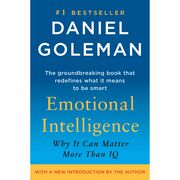
📘 Emotional Intelligence is Daniel Goleman’s 1995 synthesis of psychology and neuroscience arguing that abilities such as self-awareness, self-management, empathy, and social skill can matter as much as IQ for life outcomes.[1] It builds on the academic construct first defined by Peter Salovey and John D. Mayer (1990) and helped bring the idea into the mainstream for general readers.[2][3] Structured in five parts that move from “The Emotional Brain” to “Emotional Literacy,” it mixes case studies with accessible reporting on brain science and school/workplace programs.[4][5] Reviewers noted the book’s clear, engaging style and “highly accessible” survey of research.[5][6] Goleman reports that the book spent a year and a half on The New York Times bestseller list, sold over five million copies, and appeared in about forty languages.[7] Its influence has endured; in 2011, Time named it one of the “25 Most Influential Business Management Books.”[8]
Chapter summary
This outline follows the Bantam Books hardcover edition (1995; ISBN 978-0-553-09503-6).[4][1]
I – The Emotional Brain
🎯 1 – What Are Emotions For?. Charles Darwin’s 1872 treatise The Expression of the Emotions in Man and Animals sets the chapter’s frame: emotions evolved as adaptive “impulses to action,” not as noise. The text walks through hard‑wired physiology—anger shunting blood to the hands for grasping or striking, fear routing blood to the large leg muscles to prime a sprint, surprise lifting the eyebrows to widen the visual field, and joy quieting worry circuits while restoring energy. These fast shifts ride on the limbic system beneath the neocortex, designed to act in milliseconds when a threat or opportunity appears. In everyday scenes—a parent jerking a child back from a curb, a driver braking before awareness catches up—the same circuitry outruns deliberation. Because these reflexes are coarse, they can misfire under symbolic modern stressors, producing overreactions to slights, deadlines, or ambiguous cues. The chapter introduces “emotional memory,” which tags experiences with value signals that guide decisions long before conscious analysis completes. The aim is not to mute feeling but to align it with reason so ancient survival gear serves present goals. Taken together, these pages set up the book’s skills—self‑awareness, self‑management, empathy, and social skill—as ways to turn feelings into usable information. Emotional intelligence, in this sense, is the capacity to sense and shape rapid affective signals so thinking can do its best work.
⚡ 2 – Anatomy of an Emotional Hijacking. At New York University’s Center for Neural Science in the early 1990s, Joseph LeDoux mapped fear learning in rats and traced a quick “low road” from the sensory thalamus to the amygdala during tone‑and‑shock conditioning. That shortcut launches a rough first‑draft appraisal—freezing, heart pounding, and a hormone surge—before the slower, more precise cortical “high road” can finish its analysis. Once tripped, the amygdala recruits the hypothalamus, pituitary, and adrenal glands to flood the body with adrenaline and cortisol, while the locus coeruleus sprays norepinephrine through the brain. The chapter links this cascade to everyday blowups—road rage, sharp words at work, sudden tears—that feel as if something else “took over.” Prior emotional memories sensitize the trigger, so present cues that rhyme with past hurts can ignite outsized reactions. Goleman names this pattern an “amygdala hijack,” illustrated with episodes where remorse arrives only after arousal subsides and perspective returns. Mechanistically, high arousal weakens prefrontal oversight, narrowing attention and biasing perception toward threat. Training attention to early cues and practicing recovery—breathing, reframing, brief time‑outs—keeps the reflex from running the show. In this light, emotional intelligence is the know‑how to notice a hijack in real time and restore balance between limbic urgency and executive control. When the amygdala’s rapid warnings are integrated—not obeyed blindly—they become data that sharpens judgment rather than distorts it.
II – The Nature of Emotional Intelligence
🧩 3 – When Smart Is Dumb. In October 1990 at J. P. Taravella High School in Coral Springs, Florida, Jason H., a 16‑year‑old honors student, brought a kitchen knife to class and stabbed his physics teacher, David Pologruto, after a grade he believed threatened his ambitions; a judge later ruled him temporarily insane, and he eventually graduated as a valedictorian at American Heritage School in Plantation. The incident, covered by Florida papers and the wire services, frames the chapter’s question: how can measurable intellect coexist with catastrophic judgment? The narrative turns to neurologist Antonio Damasio’s University of Iowa cases—most notably “Elliot,” whose ventromedial prefrontal damage left IQ intact but wrecked planning, decision‑making, and everyday prudence. Without emotion’s “somatic markers,” options feel flat, analysis bloats, and choices skew toward impulse or paralysis. Across schools and workplaces, examples show bright people derailed by brittle impulse control, thin empathy, and poor stress tolerance. Standard tests miss these capacities even though they govern persistence, collaboration, and self‑management under pressure. Practical behaviors—delaying gratification, reading social cues, and recovering from upsets—forecast outcomes better than small differences in IQ. The larger point is that intellect without emotional competence becomes a liability in complex life. Emotional intelligence supplies the signaling and self‑regulation that let the prefrontal cortex steer behavior, turning talent into sound judgment rather than volatility.
🪞 4 – Know Thyself. In the early 1990s, University of New Hampshire psychologist John D. Mayer outlined three ways people attend to their feelings—self‑aware, engulfed, and accepting—work he circulated with Alexander Stevens in a 1993 paper on the “meta‑experience of mood.” The chapter then pivots to alexithymia, the label Harvard psychiatrist Peter Sifneos introduced in the early 1970s for patients who struggle to name or distinguish their emotions. A clinical vignette—“Gary,” an emotionally bland surgeon described in the literature—shows how technical competence can coexist with a muted inner radar for one’s own states. Research by Ed Diener and Randy Larsen on affect intensity explains why some people ride tall emotional waves while others move through low swells. The text contrasts “monitoring” and “blunting” under stress, drawing on Suzanne Miller’s Temple University measures that use situations such as airplane turbulence to test one’s attentional stance. Self‑observation is framed not as brooding but as an “evenly hovering attention” that notices cues before they harden into reactions. With that stance, moods can be labeled as they arise and their bodily markers—tight throat, shallow breathing, clenched jaw—spotted early enough to choose a response. Naming what is felt loosens its grip and steadies decisions in work and relationships. The chapter’s through‑line is that self‑awareness is the base skill on which the rest of emotional intelligence is built. It turns rapid limbic signals into information the prefrontal cortex can actually use.
🔥 5 – Passion's Slaves. At the University of Alabama, Dolf Zillmann’s experiments across the late twentieth century showed how high arousal and a sense of endangerment—even a mere insult—prime angry impulses and keep the body on a hair‑trigger. The chapter pairs that physiology with fieldwork on emotional labor, including Arlie Hochschild’s bill‑collector studies where a hard, cool tone is part of the job. Diane Tice and Roy Baumeister’s 1993 contribution to the Handbook of Mental Control catalogs common mood‑repair strategies—exercise, distraction, reframing, taking space—and which ones shorten distress versus prolong it. Lab tests of catharsis, including Mallick and McCandless’s 1966 study, find that “letting it out” tends to intensify anger rather than drain it. Redford and Virginia Williams’s work in Anger Kills (1993) adds low‑tech levers—counting to ten, breathing, time‑outs—that cool the cascade before words or fists do harm. Anxiety gets similar treatment: Lizabeth Roemer and Thomas Borkovec describe worry as a repetitive loop that sustains arousal, while protocols in David Barlow’s clinical handbook teach exposure and relaxation to break it. For depression, Susan Nolen‑Hoeksema documents the trap of rumination and gender patterns in mood regulation, and meta‑analyses show cognitive therapy can help many climb out. Ed Diener and Randy Larsen’s findings on the balance of positive to negative affect tie everyday well‑being to how often small uplifts occur relative to setbacks. Taken together, the chapter reframes temperance not as dampening feeling but as interrupting the spiral before it narrows judgment. Emotional intelligence here means catching early signs, choosing a counter‑move, and letting prefrontal oversight retake the wheel before passion runs the show.
🧭 6 – The Master Aptitude. In a lab task that became famous, psychologist Walter Mischel posed a simple dilemma to four‑year‑olds: take one marshmallow now, or wait until the experimenter returned and receive two. Follow‑ups into adolescence linked those early choices with later outcomes, including standardized test performance and teacher and parent ratings of coping and attention, underscoring that resisting impulse is foundational to emotional self‑control. The chapter then shows how emotion can either clog or clear cognition, with distress hijacking working memory while well‑harnessed feeling sharpens focus. Using experience‑sampling diaries from secondary‑school students, it contrasts low achievers, who studied about fifteen hours a week at home, with high achievers, who studied roughly twenty‑seven; the latter reported the “flow” of absorbed attention during 40 percent of study time versus 16 percent for the former. Flow functions as a practical lever: when challenge and skill match, motivation and persistence rise, and effort compounds into mastery. Tempering moods, delaying gratification, sustaining enthusiasm, and finding entry to flow all serve the same end—keeping attention and effort aligned with long‑range aims. In this framing, self‑regulation and self‑motivation operate like a control system for every other competence, enabling talent to become performance. It is in this sense that emotional intelligence is a master aptitude, a capacity that profoundly affects all other abilities, either facilitating or interfering with them.
🌱 7 – The Roots of Empathy. The chapter opens “back to Gary,” a brilliant but alexithymic surgeon whose fiancée, Ellen, feels unseen; his difficulty naming his own emotions carries over into missing hers. From there it shifts to Harvard psychologist Robert Rosenthal’s Profile of Nonverbal Sensitivity (PONS): brief videotaped scenes of a young woman expressing feelings—from loathing to gratitude—with specific channels (face, body, or voice) systematically masked so viewers must decode the remaining cues. Tested on more than seven thousand people across the United States and eighteen other countries, higher PONS performance tracks with being better adjusted, more popular, and more outgoing; women, on average, score higher, and a children’s version with 1,011 participants ties empathic acuity to popularity and emotional stability, independent of IQ or SAT results. Developmental observations place empathy’s beginnings in infancy: nine‑month‑old “Hope” cries when another infant falls; by fifteen months “Michael” brings a teddy bear and then a security blanket to a crying friend. Early “motor mimicry” fades by about two and a half years as toddlers recognize the other’s distress as distinct from their own and shift toward comforting acts. The practical lesson is that empathy depends on attention to nonverbal channels—tone, posture, gaze, and timing—and on having access to one’s own feeling states. When self‑awareness is thin, social perception is dulled; when it is steady, the social radar sharpens and relationships improve. Empathy builds on self‑awareness; the more open we are to our own emotions, the more skilled we will be in reading feelings.
🎭 8 – The Social Arts. A domestic vignette sets the tone: five‑year‑old Len, frustrated with two‑and‑a‑half‑year‑old Jay over a jumble of Lego blocks, lashes out; comfort, apologies, and guidance turn the moment into a lesson in handling feelings between people. With that base the chapter maps “people skills,” showing how self‑management and empathy combine into relationship competence. Paul Ekman’s “display rules” illustrate how culture shapes expression, from Japanese students masking distress while watching a graphic film in the presence of an authority figure, to everyday coaching of children to “smile and say thank you” despite disappointment. The text then traces “emotional contagion,” beginning with a battlefield story of monks whose calm defused a firefight and continuing with experiments where the mood of a more expressive person quietly shifts a partner’s state within minutes. Ulf Dimberg’s facial‑EMG studies reveal split‑second mimicry of smiles and frowns below awareness, while John Cacioppo describes the moment‑to‑moment “dance” of mood synchrony. In classrooms, Frank Bernieri finds that tighter nonverbal coordination between teachers and students goes with higher rapport and more positive feelings. These findings converge on a simple mechanism: emotions move through channels we barely notice, and skillful interaction means managing the exchange—what we send, what we catch, and how we steer it. Set the emotional tone well, and influence follows; misread or leak negativity, and even high intellect stumbles in social life. In short, coordination of moods is the essence of rapport, the adult version of the attunement a mother has with her infant.
III – Emotional Intelligence Applied
💔 9 – Intimate Enemies. The chapter opens on shifting American divorce risks across cohorts—about 10 percent for couples wed in 1890, roughly 30 percent by 1950, and a fifty–fifty chance by 1970—framing why newlyweds in 1990 face greater odds unless they can handle conflict skillfully. At the University of Washington, John Gottman videotaped couples during brief problem‑solving talks while tracking physiology, then followed them for years to see who stayed together. Contempt proved especially toxic: its facial “dimpler” cue reliably raised a partner’s heart rate by two to three beats per minute and forecast health complaints for the spouse on the receiving end, from frequent colds and flus to gastrointestinal problems. A striking marker was frequency of disgust—four or more flashes within a fifteen‑minute exchange often preceded separation within four years. The pattern tends to escalate through criticism, contempt, defensiveness, and finally stonewalling, where one partner “goes blank” and withdraws. Because high arousal narrows attention and hardens hostile attributions, couples need deliberate de‑escalators—softer openings, specific complaints, brief time‑outs, and genuine validation—to regain perspective. Differences seeded in childhood play and peer culture, including gendered norms for talking about feelings, later shape these conflict styles. The mechanism is simple but stubborn: contempt and withdrawal drive sympathetic arousal, which in turn fuels more contempt and withdrawal. Emotional intelligence here means noticing early cues in the body and face, naming the feeling, and steering back to solvable issues before the cycle locks in. In essence, these antidotes to marital disintegration are a small remedial education in emotional intelligence.
💼 10 – Managing with Heart. In December 1978 an airliner approaching Portland, Oregon, circled while the captain—Melburn McBroom—fixated on a balky landing‑gear indicator; his intimidated crew watched fuel drop toward empty but stayed silent, and the aircraft crashed, killing ten people. The case became a mainstay of cockpit safety courses, which now stress crew resource practices—speaking up, active listening, and mutual monitoring—because a large share of crashes involve preventable human errors when teamwork fails. The chapter then turns to ordinary workplaces, where the costs of poor emotional climate are less dramatic but show up as mistakes, missed deadlines, and turnover. A 1970s survey of 250 executives captured a prevailing belief that jobs demanded “heads, not hearts,” a view undermined once global competition and information technology flattened hierarchies in the 1980s. Harvard Business School’s Shoshona Zuboff describes the shift from the “jungle‑fighter” boss to leaders who can read a room, hold difficult conversations, and build commitment. Practically, that means critiquing behavior rather than character, pairing honest feedback with specific next steps, and organizing work so challenge and skill match enough to invite flow rather than anxiety. Because high stress impairs working memory and judgment, teams perform best when leaders set a calm, clear tone that reduces unnecessary arousal. Emotional intelligence in management is the blend of empathy and assertiveness that gets people aligned—not merely compliant—around a common goal. The cockpit is a microcosm of any working organization.
🩺 11 – Mind and Medicine. A clinic vignette sets the stakes: a routine urine test, the word “cytology,” and a patient’s attention collapses into fear, illustrating how illness tilts cognition toward alarm. From there the chapter tracks psychoneuroimmunology’s evidence that the brain and immune system talk through hormones and nerves, and that mood can nudge vulnerability. In a prospective study run by Sheldon Cohen of Carnegie Mellon with the Common Cold Unit in Sheffield, England, healthy volunteers were assessed for life stress, given nasal drops with a cold virus, and quarantined; 27 percent of the low‑stress group developed colds versus 47 percent of the high‑stress group. Cardiovascular data show similar links: at Duke, Redford Williams found physicians who scored highest on hostility in medical school were seven times more likely to die by age fifty; at UNC, John Barefoot tied hostility scores to the severity of coronary lesions. After a first heart attack, Stanford researchers followed 1,012 patients for up to eight years and found the most aggressive and hostile men had the highest rate of a second attack; a Yale cohort of 929 survivors tracked for up to ten years showed the easily angered were three times more likely to die of cardiac arrest (five times if they also had high cholesterol). Harvard data added a temporal twist: among more than fifteen hundred heart‑disease patients, being angry more than doubled the risk of a cardiac event for about two hours. Depression and anxiety worsen adherence and outcomes, but brief, humane changes in how clinicians relate—clear language, empathy, attention to mood—improve satisfaction, compliance, and in some studies recovery. The thread is physiological: sustained distress primes stress hormones, dampens immunity, and strains the heart, while emotional skills and social support can buffer that load. In the land of the sick, emotions reign supreme; fear is a thought away.
IV – Windows of Opportunity
🏠 12 – The Family Crucible. In a low‑key domestic scene, five‑year‑old Leslie tries to play a new video game while her parents, Carl and Ann, fire contradictory instructions; tears come, and neither adult notices, turning a simple lesson into a lesson about feelings. The vignette shows how parental responses teach “emotional rules” about attention, criticism, and comfort that children carry forward. At the University of Washington in the 1990s, John Gottman and Carole Hooven’s meta‑emotion work contrasted dismissing, laissez‑faire, and disapproving styles with “emotion coaching,” in which adults name the feeling, set limits, and help a child problem‑solve. Diana Baumrind’s Berkeley studies on authoritative, authoritarian, and permissive parenting give this a structural backbone: warmth with clear limits predicts stronger social competence than cold control or indulgent neglect. Micro‑moments—tone at bedtime, repairing after a quarrel, whether feedback targets behavior rather than character—accumulate into a template for self‑worth and trust. Even when adults disagree, noticing and soothing emotion becomes the model children use later with friends and partners. The mechanism is observational learning: children track faces, voices, and timing, absorbing both what is said and how it is handled between adults. In that light, self‑aware parents turn upsets into practice reps for self‑regulation and empathy, aligning feeling and reason. The chapter threads this into the book’s theme: emotional skill is taught first at home, and those early lessons govern how thinking performs under stress. Family life is our first school for emotional learning; in this intimate cauldron we learn how to feel about ourselves and how others will react to our feelings; how to think about these feelings and what choices we have in reacting; how to read and express hopes and fears.
🩹 13 – Trauma and Emotional Relearning. In 1976 in Chowchilla, California, a school bus with twenty‑six children was hijacked and the victims buried in a truck; San Francisco child psychiatrist Lenore Terr followed them and documented how terror resurfaced in flashbacks and was reworked in play and dreams. She observed repetitive games that reenacted the ordeal—sometimes with new, victorious endings—showing how children try to regain mastery. Across assaults and other man‑made disasters, small cues—the smell of diesel, a siren, a slammed door—can summon full alarm, evidence that the amygdala tags fragments of sensation with danger and fires fast. In those moments arousal spikes, attention tunnels, and the body readies to flee or fight, even years later. Therapies harness that wiring: gradual exposure, relaxation, and cognitive reframing pair the trigger with safety until the fear link weakens. Children often do a version of this spontaneously through symbolic play, while adults use imaginal and in‑vivo exercises to process memory and restore control. Recovery improves when people regain agency and social support; helplessness and isolation embed symptoms. Because strong emotional memories persist, good treatment seeks new routes around the alarm rather than erasure. These pages connect directly to the book’s theme: emotion can be trained, and with practice the prefrontal cortex relearns how to quiet limbic surges so judgment and connection return.
🧬 14 – Temperament Is Not Destiny. At Harvard, Jerome Kagan’s group tested four‑month‑old infants with unfamiliar sights and sounds; highly reactive babies arched, cried, and flailed, and many later showed shy, cautious behavior, while low‑reactive infants more often became outgoing. The New York Longitudinal Study by Alexander Thomas and Stella Chess had already mapped “easy,” “difficult,” and “slow‑to‑warm‑up” temperaments and the importance of a “goodness of fit” between child and environment. Richard J. Davidson’s EEG work added a neural signature: relatively greater left‑frontal activation aligned with approach and positive mood; greater right‑frontal activation aligned with withdrawal and negative affect. These biases tilt the speed and strength of amygdala alarms but do not fix character. Coaching attention, modeling calm, and practicing small, manageable exposures widen the behavioral range even for the highly reactive. Repeated mastery experiences write new associations to the same cues, so approach gets easier and avoidance loosens. Biology leans, but experience steers—especially in the early years when circuits are most plastic. The chapter folds this into the book’s through‑line: trainable emotional skills determine how far raw temperament will carry—or limit—someone in school, work, and love. Innate emotional patterns can change to some degree.
V – Emotional Literacy
💸 15 – The Cost of Emotional Illiteracy.
🎓 16 – Schooling the Emotions.
Background & reception
🖋️ Author & writing. Goleman is a psychologist and former New York Times science reporter; he frames emotional intelligence for general readers by weaving neuroscience with everyday cases.[7][1] The book explicitly draws on the academic construct introduced by Salovey and Mayer (1990), translating it from scholarly journals into a practical vocabulary for self-management and relationships.[2] Its organization spans five parts (from “The Emotional Brain” to “Emotional Literacy”), signaling a progression from theory to application in health, education, and work.[4] Contemporary trade reviewers highlighted the accessible, reportorial voice and Goleman’s use of school and workplace examples to illustrate claims.[5]
📈 Commercial reception. Goleman states that Emotional Intelligence remained on the New York Times bestseller list for 18 months, sold more than five million copies worldwide, and was issued in roughly forty languages.[7] The book’s cross-sector resonance was later reflected in Time’’s 2011 list of the “25 Most Influential Business Management Books.”[8]
👍 Praise. Publishers Weekly called the book a “highly accessible survey” and “an intriguing and practical guide,” noting its concrete school and workplace illustrations (reviewed 4 September 1995).[5] Kirkus Reviews praised Goleman’s “clear, engaging style” and the strong case made for the importance of emotional intelligence (1 October 1995).[6] The publisher also quotes USA Today describing it as “a thoughtfully written, persuasive account,” a line that has appeared in later catalogue copy.[1]
👎 Criticism. Scholars have challenged the construct’s scope and measurement: Frank J. Landy argued that EI research suffered from historical and scientific ambiguities and over-generalized claims (2005).[9] Edwin A. Locke contended that EI, as popularly defined, is not a distinct intelligence and risks becoming “so broadly defined as to be meaningless” (2005).[10] Methodologists have also noted heterogeneity and psychometric challenges across EI measures, urging careful use (2019 review).[11] In cultural criticism, Merve Emre argued that the book’s managerial framing promotes a regimen of self-monitoring aligned with corporate priorities (The New Yorker, 12 April 2021).[12]
🌍 Impact & adoption. In management, Goleman extended the book’s framework in the widely read Harvard Business Review article “What Makes a Leader?” (originally 1998; reprinted January 2004), which emphasized EI as a leadership sine qua non.[13] Corporations drew on EI models; a Johnson & Johnson multi-rater study reported that higher-performing leaders scored higher on emotional-competence clusters (2006).[14] In education, the SEL movement gained institutional footing (CASEL was formed in 1994), and educators widely cited Goleman’s book for popularizing SEL in the mid-1990s.[15][16]
Related content & more
YouTube videos
CapSach articles

References
- ↑ 1.0 1.1 1.2 1.3 "Emotional Intelligence". Random House Publishing Group. Penguin Random House. Retrieved 27 October 2025.
- ↑ 2.0 2.1 Salovey, Peter; Mayer, John D. (1990). "Emotional Intelligence". Imagination, Cognition and Personality. 9 (3): 185–211. doi:10.2190/DUGG-P24E-52WK-6CDG. Retrieved 27 October 2025.
- ↑ Pink, Daniel H. (20 December 2013). "How deep, mental focus enhances self-awareness and empathy". The Washington Post. Retrieved 27 October 2025.
- ↑ 4.0 4.1 4.2 "Emotional intelligence". WorldCat. OCLC. Retrieved 27 October 2025.
- ↑ 5.0 5.1 5.2 5.3 "Emotional Intelligence: Why It Can Matter More Than IQ". Publishers Weekly. 4 September 1995. Retrieved 27 October 2025.
- ↑ 6.0 6.1 "EMOTIONAL INTELLIGENCE". Kirkus Reviews. 1 October 1995. Retrieved 27 October 2025.
- ↑ 7.0 7.1 7.2 "Daniel Goleman". Daniel Goleman. Key Step Media. Retrieved 27 October 2025.
- ↑ 8.0 8.1 Sachs, Andrea (9 August 2011). "Emotional Intelligence (1995), by Daniel Goleman". Time. Retrieved 27 October 2025.
- ↑ Landy, Frank J. (2005). "Some historical and scientific issues related to research on emotional intelligence". Journal of Organizational Behavior. 26: 411–424. doi:10.1002/job.317. Retrieved 27 October 2025.
- ↑ Locke, Edwin A. (2005). "Why emotional intelligence is an invalid concept". Journal of Organizational Behavior. 26: 425–431. doi:10.1002/job.318. Retrieved 27 October 2025.
- ↑ O'Connor, Peter J.; Hill, Alex; Kay, Sue; Martin, Brett (2019). "The Measurement of Emotional Intelligence: A Critical Review of Current Tools". Frontiers in Psychology. 10: 1116. Retrieved 27 October 2025.
- ↑ Emre, Merve (12 April 2021). "The Repressive Politics of Emotional Intelligence". The New Yorker. Retrieved 27 October 2025.
- ↑ "What Makes a Leader?". Harvard Business Review. January 2004. Retrieved 27 October 2025.
- ↑ "Emotional Competence and Leadership Excellence at Johnson & Johnson: The Emotional Intelligence and Leadership Study" (PDF). Consortium for Research on Emotional Intelligence in Organizations. Retrieved 27 October 2025.
- ↑ "Our History". CASEL. Collaborative for Academic, Social, and Emotional Learning. Retrieved 27 October 2025.
- ↑ "Social and Emotional Learning: A Short History". Edutopia. 6 October 2011. Retrieved 27 October 2025.