
Emotional Intelligence: Difference between revisions
Created page with "{{Insert top}}{{Insert quote panel | {{Emotional Intelligence/random quote}} }} == Introduction == {{Infobox book | name = Emotional Intelligence | image = emotional-intelligence-daniel-goleman.jpg | full_title = ''Emotional Intelligence: Why It Can Matter More Than IQ'' | author = Daniel Goleman | country = United States | language = English | subject = Emotional intel..." |
No edit summary |
||
| Line 23: | Line 23: | ||
| website = [https://www.randomhousebooks.com/books/69105/ randomhousebooks.com] |
| website = [https://www.randomhousebooks.com/books/69105/ randomhousebooks.com] |
||
}} |
}} |
||
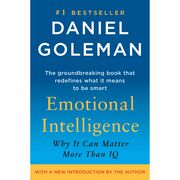
📘 '''''Emotional Intelligence''''' is Daniel Goleman’s 1995 synthesis of psychology and neuroscience arguing that abilities such as self-awareness, self-management, empathy, and social skill can matter as much as IQ for life outcomes.<ref name="PRH" /> |
|||
It builds on the academic construct first defined by Peter Salovey and John D. Mayer (1990) and helped bring the idea into the mainstream for general readers.<ref name="SaloveyMayer1990">{{cite journal |last=Salovey |first=Peter |author2=Mayer, John D. |date=1990 |title=Emotional Intelligence |journal=Imagination, Cognition and Personality |volume=9 |issue=3 |pages=185–211 |doi=10.2190/DUGG-P24E-52WK-6CDG |url=https://journals.sagepub.com/doi/10.2190/DUGG-P24E-52WK-6CDG |access-date=27 October 2025}}</ref><ref name="WaPo2013">{{cite news |last=Pink |first=Daniel H. |title=How deep, mental focus enhances self-awareness and empathy |url=https://www.washingtonpost.com/entertainment/books/2013/12/20/c3774f2c-672a-11e3-a0b9-249bbb34602c_story.html |work=The Washington Post |date=20 December 2013 |access-date=27 October 2025}}</ref> |
|||
Structured in five parts that move from “The Emotional Brain” to “Emotional Literacy,” it mixes case studies with accessible reporting on brain science and school/workplace programs.<ref name="OCLC32430189" /><ref name="PW1995">{{cite news |title=Emotional Intelligence: Why It Can Matter More Than IQ |url=https://www.publishersweekly.com/9780553095036 |work=Publishers Weekly |date=4 September 1995 |access-date=27 October 2025}}</ref> |
|||
Reviewers noted the book’s clear, engaging style and “highly accessible” survey of research.<ref name="PW1995" /><ref name="Kirkus1995">{{cite news |title=EMOTIONAL INTELLIGENCE |url=https://www.kirkusreviews.com/book-reviews/daniel-goleman/emotional-intelligence/ |work=Kirkus Reviews |date=1 October 1995 |access-date=27 October 2025}}</ref> |
|||
Goleman reports that the book spent a year and a half on ''The New York Times'' bestseller list, sold over five million copies, and appeared in about forty languages.<ref name="GolemanBio">{{cite web |title=Daniel Goleman |url=https://www.danielgoleman.info/ |website=Daniel Goleman |publisher=Key Step Media |access-date=27 October 2025}}</ref> |
|||
Its influence has endured; in 2011, ''Time'' named it one of the “25 Most Influential Business Management Books.”<ref name="TIME2011">{{cite news |last=Sachs |first=Andrea |title=Emotional Intelligence (1995), by Daniel Goleman |url=https://content.time.com/time/specials/packages/article/0,28804,2086680_2086683_2087663,00.html |work=Time |date=9 August 2011 |access-date=27 October 2025}}</ref> |
|||
== Chapter summary == |
== Chapter summary == |
||
| Line 68: | Line 75: | ||
🎓 '''16 – Schooling the Emotions.''' |
🎓 '''16 – Schooling the Emotions.''' |
||
== Background & reception == |
|||
🖋️ '''Author & writing'''. Goleman is a psychologist and former ''New York Times'' science reporter; he frames emotional intelligence for general readers by weaving neuroscience with everyday cases.<ref name="GolemanBio" /><ref name="PRH" /> The book explicitly draws on the academic construct introduced by Salovey and Mayer (1990), translating it from scholarly journals into a practical vocabulary for self-management and relationships.<ref name="SaloveyMayer1990" /> Its organization spans five parts (from “The Emotional Brain” to “Emotional Literacy”), signaling a progression from theory to application in health, education, and work.<ref name="OCLC32430189" /> Contemporary trade reviewers highlighted the accessible, reportorial voice and Goleman’s use of school and workplace examples to illustrate claims.<ref name="PW1995" /> |
|||
📈 '''Commercial reception'''. Goleman states that ''Emotional Intelligence'' remained on the ''New York Times'' bestseller list for 18 months, sold more than five million copies worldwide, and was issued in roughly forty languages.<ref name="GolemanBio" /> The book’s cross-sector resonance was later reflected in ''Time’’s 2011 list of the “25 Most Influential Business Management Books.”<ref name="TIME2011" /> |
|||
👍 '''Praise'''. ''Publishers Weekly'' called the book a “highly accessible survey” and “an intriguing and practical guide,” noting its concrete school and workplace illustrations (reviewed 4 September 1995).<ref name="PW1995" /> ''Kirkus Reviews'' praised Goleman’s “clear, engaging style” and the strong case made for the importance of emotional intelligence (1 October 1995).<ref name="Kirkus1995" /> The publisher also quotes ''USA Today'' describing it as “a thoughtfully written, persuasive account,” a line that has appeared in later catalogue copy.<ref name="PRH" /> |
|||
👎 '''Criticism'''. Scholars have challenged the construct’s scope and measurement: Frank J. Landy argued that EI research suffered from historical and scientific ambiguities and over-generalized claims (2005).<ref name="Landy2005">{{cite journal |last=Landy |first=Frank J. |date=2005 |title=Some historical and scientific issues related to research on emotional intelligence |journal=Journal of Organizational Behavior |volume=26 |pages=411–424 |doi=10.1002/job.317 |url=https://onlinelibrary.wiley.com/doi/abs/10.1002/job.317 |access-date=27 October 2025}}</ref> Edwin A. Locke contended that EI, as popularly defined, is not a distinct intelligence and risks becoming “so broadly defined as to be meaningless” (2005).<ref name="Locke2005">{{cite journal |last=Locke |first=Edwin A. |date=2005 |title=Why emotional intelligence is an invalid concept |journal=Journal of Organizational Behavior |volume=26 |pages=425–431 |doi=10.1002/job.318 |url=https://onlinelibrary.wiley.com/doi/10.1002/job.318 |access-date=27 October 2025}}</ref> Methodologists have also noted heterogeneity and psychometric challenges across EI measures, urging careful use (2019 review).<ref name="OConnor2019">{{cite journal |last=O'Connor |first=Peter J. |author2=Hill, Alex |author3=Kay, Sue |author4=Martin, Brett |date=2019 |title=The Measurement of Emotional Intelligence: A Critical Review of Current Tools |journal=Frontiers in Psychology |volume=10 |pages=1116 |url=https://www.frontiersin.org/journals/psychology/articles/10.3389/fpsyg.2019.01116/full |access-date=27 October 2025}}</ref> In cultural criticism, Merve Emre argued that the book’s managerial framing promotes a regimen of self-monitoring aligned with corporate priorities (''The New Yorker'', 12 April 2021).<ref name="NewYorker2021">{{cite news |last=Emre |first=Merve |title=The Repressive Politics of Emotional Intelligence |url=https://www.newyorker.com/magazine/2021/04/19/the-repressive-politics-of-emotional-intelligence |work=The New Yorker |date=12 April 2021 |access-date=27 October 2025}}</ref> |
|||
🌍 '''Impact & adoption'''. In management, Goleman extended the book’s framework in the widely read ''Harvard Business Review'' article “What Makes a Leader?” (originally 1998; reprinted January 2004), which emphasized EI as a leadership sine qua non.<ref name="HBR2004">{{cite web |title=What Makes a Leader? |url=https://hbr.org/2004/01/what-makes-a-leader |website=Harvard Business Review |date=January 2004 |access-date=27 October 2025}}</ref> Corporations drew on EI models; a Johnson & Johnson multi-rater study reported that higher-performing leaders scored higher on emotional-competence clusters (2006).<ref name="JJ2006">{{cite web |title=Emotional Competence and Leadership Excellence at Johnson & Johnson: The Emotional Intelligence and Leadership Study |url=https://www.eiconsortium.org/pdf/jj_ei_study.pdf |website=Consortium for Research on Emotional Intelligence in Organizations |access-date=27 October 2025}}</ref> In education, the SEL movement gained institutional footing (CASEL was formed in 1994), and educators widely cited Goleman’s book for popularizing SEL in the mid-1990s.<ref name="CASELHistory">{{cite web |title=Our History |url=https://casel.org/about-us/our-history/ |website=CASEL |publisher=Collaborative for Academic, Social, and Emotional Learning |access-date=27 October 2025}}</ref><ref name="Edutopia2011">{{cite web |title=Social and Emotional Learning: A Short History |url=https://www.edutopia.org/social-emotional-learning-history |website=Edutopia |date=6 October 2011 |access-date=27 October 2025}}</ref> |
|||
== Related content & more == |
== Related content & more == |
||
Revision as of 15:12, 27 October 2025
"Fear, in evolution, has a special prominence: perhaps more than any other emotion it is crucial for survival."
— Daniel Goleman, Emotional Intelligence (1995)
Introduction
| Emotional Intelligence | |
|---|---|
 | |
| Full title | Emotional Intelligence: Why It Can Matter More Than IQ |
| Author | Daniel Goleman |
| Language | English |
| Subject | Emotional intelligence; Psychology; Self-help |
| Genre | Nonfiction; Popular psychology |
| Publisher | Bantam Books |
| Publication place | United States |
| Media type | Print (hardcover, paperback); e-book |
| Pages | 352 |
| ISBN | 978-0-553-09503-6 |
| Goodreads rating | 4.1/5 (as of 27 October 2025) |
| Website | randomhousebooks.com |
📘 Emotional Intelligence is Daniel Goleman’s 1995 synthesis of psychology and neuroscience arguing that abilities such as self-awareness, self-management, empathy, and social skill can matter as much as IQ for life outcomes.[1] It builds on the academic construct first defined by Peter Salovey and John D. Mayer (1990) and helped bring the idea into the mainstream for general readers.[2][3] Structured in five parts that move from “The Emotional Brain” to “Emotional Literacy,” it mixes case studies with accessible reporting on brain science and school/workplace programs.[4][5] Reviewers noted the book’s clear, engaging style and “highly accessible” survey of research.[5][6] Goleman reports that the book spent a year and a half on The New York Times bestseller list, sold over five million copies, and appeared in about forty languages.[7] Its influence has endured; in 2011, Time named it one of the “25 Most Influential Business Management Books.”[8]
Chapter summary
This outline follows the Bantam Books hardcover edition (1995; ISBN 978-0-553-09503-6).[4][1]
I – The Emotional Brain
🎯 1 – What Are Emotions For?.
⚡ 2 – Anatomy of an Emotional Hijacking.
II – The Nature of Emotional Intelligence
🧩 3 – When Smart Is Dumb.
🪞 4 – Know Thyself.
🔥 5 – Passion's Slaves.
🧭 6 – The Master Aptitude.
🌱 7 – The Roots of Empathy.
🎭 8 – The Social Arts.
III – Emotional Intelligence Applied
💔 9 – Intimate Enemies.
💼 10 – Managing with Heart.
🩺 11 – Mind and Medicine.
IV – Windows of Opportunity
🏠 12 – The Family Crucible.
🩹 13 – Trauma and Emotional Relearning.
🧬 14 – Temperament Is Not Destiny.
V – Emotional Literacy
💸 15 – The Cost of Emotional Illiteracy.
🎓 16 – Schooling the Emotions.
Background & reception
🖋️ Author & writing. Goleman is a psychologist and former New York Times science reporter; he frames emotional intelligence for general readers by weaving neuroscience with everyday cases.[7][1] The book explicitly draws on the academic construct introduced by Salovey and Mayer (1990), translating it from scholarly journals into a practical vocabulary for self-management and relationships.[2] Its organization spans five parts (from “The Emotional Brain” to “Emotional Literacy”), signaling a progression from theory to application in health, education, and work.[4] Contemporary trade reviewers highlighted the accessible, reportorial voice and Goleman’s use of school and workplace examples to illustrate claims.[5]
📈 Commercial reception. Goleman states that Emotional Intelligence remained on the New York Times bestseller list for 18 months, sold more than five million copies worldwide, and was issued in roughly forty languages.[7] The book’s cross-sector resonance was later reflected in Time’’s 2011 list of the “25 Most Influential Business Management Books.”[8]
👍 Praise. Publishers Weekly called the book a “highly accessible survey” and “an intriguing and practical guide,” noting its concrete school and workplace illustrations (reviewed 4 September 1995).[5] Kirkus Reviews praised Goleman’s “clear, engaging style” and the strong case made for the importance of emotional intelligence (1 October 1995).[6] The publisher also quotes USA Today describing it as “a thoughtfully written, persuasive account,” a line that has appeared in later catalogue copy.[1]
👎 Criticism. Scholars have challenged the construct’s scope and measurement: Frank J. Landy argued that EI research suffered from historical and scientific ambiguities and over-generalized claims (2005).[9] Edwin A. Locke contended that EI, as popularly defined, is not a distinct intelligence and risks becoming “so broadly defined as to be meaningless” (2005).[10] Methodologists have also noted heterogeneity and psychometric challenges across EI measures, urging careful use (2019 review).[11] In cultural criticism, Merve Emre argued that the book’s managerial framing promotes a regimen of self-monitoring aligned with corporate priorities (The New Yorker, 12 April 2021).[12]
🌍 Impact & adoption. In management, Goleman extended the book’s framework in the widely read Harvard Business Review article “What Makes a Leader?” (originally 1998; reprinted January 2004), which emphasized EI as a leadership sine qua non.[13] Corporations drew on EI models; a Johnson & Johnson multi-rater study reported that higher-performing leaders scored higher on emotional-competence clusters (2006).[14] In education, the SEL movement gained institutional footing (CASEL was formed in 1994), and educators widely cited Goleman’s book for popularizing SEL in the mid-1990s.[15][16]
Related content & more
YouTube videos
CapSach articles
References
- ↑ 1.0 1.1 1.2 1.3 "Emotional Intelligence". Random House Publishing Group. Penguin Random House. Retrieved 27 October 2025.
- ↑ 2.0 2.1 Salovey, Peter; Mayer, John D. (1990). "Emotional Intelligence". Imagination, Cognition and Personality. 9 (3): 185–211. doi:10.2190/DUGG-P24E-52WK-6CDG. Retrieved 27 October 2025.
- ↑ Pink, Daniel H. (20 December 2013). "How deep, mental focus enhances self-awareness and empathy". The Washington Post. Retrieved 27 October 2025.
- ↑ 4.0 4.1 4.2 "Emotional intelligence". WorldCat. OCLC. Retrieved 27 October 2025.
- ↑ 5.0 5.1 5.2 5.3 "Emotional Intelligence: Why It Can Matter More Than IQ". Publishers Weekly. 4 September 1995. Retrieved 27 October 2025.
- ↑ 6.0 6.1 "EMOTIONAL INTELLIGENCE". Kirkus Reviews. 1 October 1995. Retrieved 27 October 2025.
- ↑ 7.0 7.1 7.2 "Daniel Goleman". Daniel Goleman. Key Step Media. Retrieved 27 October 2025.
- ↑ 8.0 8.1 Sachs, Andrea (9 August 2011). "Emotional Intelligence (1995), by Daniel Goleman". Time. Retrieved 27 October 2025.
- ↑ Landy, Frank J. (2005). "Some historical and scientific issues related to research on emotional intelligence". Journal of Organizational Behavior. 26: 411–424. doi:10.1002/job.317. Retrieved 27 October 2025.
- ↑ Locke, Edwin A. (2005). "Why emotional intelligence is an invalid concept". Journal of Organizational Behavior. 26: 425–431. doi:10.1002/job.318. Retrieved 27 October 2025.
- ↑ O'Connor, Peter J.; Hill, Alex; Kay, Sue; Martin, Brett (2019). "The Measurement of Emotional Intelligence: A Critical Review of Current Tools". Frontiers in Psychology. 10: 1116. Retrieved 27 October 2025.
- ↑ Emre, Merve (12 April 2021). "The Repressive Politics of Emotional Intelligence". The New Yorker. Retrieved 27 October 2025.
- ↑ "What Makes a Leader?". Harvard Business Review. January 2004. Retrieved 27 October 2025.
- ↑ "Emotional Competence and Leadership Excellence at Johnson & Johnson: The Emotional Intelligence and Leadership Study" (PDF). Consortium for Research on Emotional Intelligence in Organizations. Retrieved 27 October 2025.
- ↑ "Our History". CASEL. Collaborative for Academic, Social, and Emotional Learning. Retrieved 27 October 2025.
- ↑ "Social and Emotional Learning: A Short History". Edutopia. 6 October 2011. Retrieved 27 October 2025.