
Thomas Buberl: Difference between revisions
No edit summary |
No edit summary |
||
| (11 intermediate revisions by the same user not shown) | |||
| Line 3: | Line 3: | ||
| {{Quote |
| {{Quote |
||
| text = {{ {{PAGENAME}}/random quote }} |
| text = {{ {{PAGENAME}}/random quote }} |
||
| author = {{ {{PAGENAME}}/attribution }} |
| author = Thomas Buberl, {{ {{PAGENAME}}/attribution }} |
||
}} |
}} |
||
}}{{section separator}} |
}}{{section separator}} |
||
| Line 21: | Line 21: | ||
| title = Chief Executive Officer |
| title = Chief Executive Officer |
||
| term = 2016–present |
| term = 2016–present |
||
| predecessor = Henri de Castries |
| predecessor = [[Henri de Castries]] |
||
| successor = |
| successor = |
||
| boards = AXA; IBM; Bertelsmann |
| boards = AXA; IBM; Bertelsmann |
||
| Line 32: | Line 32: | ||
}} |
}} |
||
🛡️ Thomas Buberl (born 1973) is a German-born business executive who has served as chief executive officer (CEO) of the French insurance group AXA since September 2016 and is widely associated with a strategic pivot of the company toward property-and-casualty and health insurance as well as a prominent stance on climate-related finance.<ref name="tb_wiki">{{cite web |url=https://en.wikipedia.org/wiki/Thomas_Buberl |title=Thomas Buberl |publisher=Wikipedia |accessdate=2025-11-20}}</ref><ref name="lejdd">{{cite web |url=https://www.lejdd.fr/Economie/comment-thomas-buberl-transforme-axa-4101904 |title=Comment Thomas Buberl transforme Axa |publisher=Le Journal du Dimanche |accessdate=2025-11-20}}</ref> Educated in Germany, the United Kingdom and Switzerland, he previously worked for Boston Consulting Group, Winterthur Group and Zurich Insurance Group before joining AXA in 2012, later becoming a member of the company’s board, a reserve officer in the French Navy and, in 2008, a Young Global Leader of the World Economic Forum.<ref name="blavatnik">{{cite web |url=https://www.bsg.ox.ac.uk/people/thomas-buberl |title=Thomas Buberl |publisher=Blavatnik School of Government, University of Oxford |accessdate=2025-11-20}}</ref><ref name="lancaster">{{cite web |url=https://www.lancaster.ac.uk/lums/mba/news/from-lancaster-mba-to-axa-ceo |title=From Lancaster MBA to AXA CEO |publisher=Lancaster University |accessdate=2025-11-20}}</ref> Beyond AXA, he has held board positions at companies such as IBM and Bertelsmann and participates in industry and policy bodies including the World Economic Forum and the Institute of International Finance.<ref name="tb_wiki" /><ref name="bertelsmann">{{cite web |url=https://www.bertelsmann.com/media/investor-relations/financial-statements/financial-statements-2018-bertelsmann-se-und-co.-kgaa.pdf |title=Financial statements 2018 Bertelsmann SE & Co. KGaA |publisher=Bertelsmann |accessdate=2025-11-20}}</ref> |
🛡️ '''Thomas Buberl''' (born 1973) is a German-born business executive who has served as chief executive officer (CEO) of the French insurance group AXA since September 2016 and is widely associated with a strategic pivot of the company toward {{Tooltip|property-and-casualty}} and health insurance as well as a prominent stance on {{Tooltip|climate-related finance}}.<ref name="tb_wiki">{{cite web |url=https://en.wikipedia.org/wiki/Thomas_Buberl |title=Thomas Buberl |publisher=Wikipedia |accessdate=2025-11-20}}</ref><ref name="lejdd">{{cite web |url=https://www.lejdd.fr/Economie/comment-thomas-buberl-transforme-axa-4101904 |title=Comment Thomas Buberl transforme Axa |publisher=Le Journal du Dimanche |accessdate=2025-11-20}}</ref> Educated in Germany, the United Kingdom and Switzerland, he previously worked for {{Tooltip|Boston Consulting Group}}, {{Tooltip|Winterthur Group}} and {{Tooltip|Zurich Insurance Group}} before joining AXA in 2012, later becoming a member of the company’s board, a reserve officer in the French Navy and, in 2008, a {{Tooltip|Young Global Leader}} of the {{Tooltip|World Economic Forum}}.<ref name="blavatnik">{{cite web |url=https://www.bsg.ox.ac.uk/people/thomas-buberl |title=Thomas Buberl |publisher=Blavatnik School of Government, University of Oxford |accessdate=2025-11-20}}</ref><ref name="lancaster">{{cite web |url=https://www.lancaster.ac.uk/lums/mba/news/from-lancaster-mba-to-axa-ceo |title=From Lancaster MBA to AXA CEO |publisher=Lancaster University |accessdate=2025-11-20}}</ref> Beyond AXA, he has held board positions at companies such as IBM and {{Tooltip|Bertelsmann}} and participates in industry and policy bodies including the {{Tooltip|World Economic Forum}} and the {{Tooltip|Institute of International Finance}}.<ref name="tb_wiki" /><ref name="bertelsmann">{{cite web |url=https://www.bertelsmann.com/media/investor-relations/financial-statements/financial-statements-2018-bertelsmann-se-und-co.-kgaa.pdf |title=Financial statements 2018 Bertelsmann SE & Co. KGaA |publisher=Bertelsmann |accessdate=2025-11-20}}</ref> |
||
{{section separator}} |
{{section separator}} |
||
| Line 39: | Line 39: | ||
🎼 '''Early life.''' Buberl was born in 1973 in Cologne, Germany, and grew up in a German household, but as a teenager initially pursued an ambition to become a professional pipe organist, practising intensively and considering a musical career until failing a singing examination led him to abandon that path and redirect his efforts towards academic and business pursuits.<ref name="lejdd" /><ref name="rra">{{cite web |url=https://www.russellreynolds.com/en/insights/podcasts/trust-your-gut-axas-thomas-buberl-talks-transformation-and-reinvention |title=Season 2 – Ep. 9 {{!}} Trust Your Gut: AXA’s Thomas Buberl Talks Transformation and Reinvention |publisher=Russell Reynolds Associates |accessdate=2025-11-20}}</ref> In later interviews he has described this early disappointment as a formative episode that strengthened his willingness to change course when circumstances required and to approach his professional life with a sense of discipline learned from musical training.<ref name="rra" /> |
🎼 '''Early life.''' Buberl was born in 1973 in Cologne, Germany, and grew up in a German household, but as a teenager initially pursued an ambition to become a professional pipe organist, practising intensively and considering a musical career until failing a singing examination led him to abandon that path and redirect his efforts towards academic and business pursuits.<ref name="lejdd" /><ref name="rra">{{cite web |url=https://www.russellreynolds.com/en/insights/podcasts/trust-your-gut-axas-thomas-buberl-talks-transformation-and-reinvention |title=Season 2 – Ep. 9 {{!}} Trust Your Gut: AXA’s Thomas Buberl Talks Transformation and Reinvention |publisher=Russell Reynolds Associates |accessdate=2025-11-20}}</ref> In later interviews he has described this early disappointment as a formative episode that strengthened his willingness to change course when circumstances required and to approach his professional life with a sense of discipline learned from musical training.<ref name="rra" /> |
||
🎓 '''Education and early recognition.''' After deciding against a career in music, Buberl studied business administration at the WHU–Otto Beisheim School of Management in Germany, completed an MBA at Lancaster University Management School in the United Kingdom and obtained a doctorate in economics from the University of St. Gallen in Switzerland, combining case-based teaching, quantitative analysis and international teamwork in his training.<ref name="lancaster" /><ref name="blavatnik" /> During his studies he spent time in Paris, where he improved his French to near-native fluency, and he has later credited the cross-border academic experience with shaping his collaborative leadership style and giving him a cosmopolitan outlook that would prove useful in leading a multinational insurer.<ref name="lejdd" /><ref name="rra" /> In 2008, at the age of 35, the World Economic Forum named him a Young Global Leader, highlighting his emerging profile among the next generation of business leaders.<ref name="tb_wiki" /> |
🎓 '''Education and early recognition.''' After deciding against a career in music, Buberl studied business administration at the {{Tooltip|WHU–Otto Beisheim School of Management}} in Germany, completed an MBA at {{Tooltip|Lancaster University Management School}} in the United Kingdom and obtained a doctorate in economics from the {{Tooltip|University of St. Gallen}} in Switzerland, combining case-based teaching, quantitative analysis and international teamwork in his training.<ref name="lancaster" /><ref name="blavatnik" /> During his studies he spent time in Paris, where he improved his French to near-native fluency, and he has later credited the cross-border academic experience with shaping his collaborative leadership style and giving him a cosmopolitan outlook that would prove useful in leading a multinational insurer.<ref name="lejdd" /><ref name="rra" /> In 2008, at the age of 35, the {{Tooltip|World Economic Forum}} named him a {{Tooltip|Young Global Leader}}, highlighting his emerging profile among the next generation of business leaders.<ref name="tb_wiki" /> |
||
{{section separator}} |
{{section separator}} |
||
== Career == |
== Career == |
||
🧭 '''Consulting and early industry roles.''' Buberl began his professional career in 2000 at the Boston Consulting Group, where he specialised in advising banks and insurers in Germany and abroad, gaining exposure to strategic and operational issues in financial services.<ref name="blavatnik" /> In 2005 he moved into line management by joining Winterthur Group in Switzerland—shortly before the company’s acquisition by AXA—as chief operating officer and later chief marketing and distribution officer, positions in which he immersed himself in the practicalities of insurance operations from underwriting and claims handling to sales management.<ref name="blavatnik" /><ref name="lejdd" /> In 2008 he was recruited by Zurich Insurance Group to become chief executive officer of Zurich’s business in Switzerland, marking his first appointment as a country CEO while still in his mid-thirties.<ref name="blavatnik" /><ref name="tb_wiki" /> |
🧭 '''Consulting and early industry roles.''' Buberl began his professional career in 2000 at the {{Tooltip|Boston Consulting Group}}, where he specialised in advising banks and insurers in Germany and abroad, gaining exposure to strategic and operational issues in financial services.<ref name="blavatnik" /> In 2005 he moved into line management by joining {{Tooltip|Winterthur Group}} in Switzerland—shortly before the company’s acquisition by AXA—as chief operating officer and later chief marketing and distribution officer, positions in which he immersed himself in the practicalities of insurance operations from underwriting and claims handling to sales management.<ref name="blavatnik" /><ref name="lejdd" /> In 2008 he was recruited by {{Tooltip|Zurich Insurance Group}} to become chief executive officer of Zurich’s business in Switzerland, marking his first appointment as a country CEO while still in his mid-thirties.<ref name="blavatnik" /><ref name="tb_wiki" /> |
||
🏢 '''Joining AXA and becoming group CEO.''' In 2012 AXA invited Buberl back into the orbit of the enlarged French group by appointing him chief executive officer of AXA Konzern AG, its German subsidiary, where he focused on improving underwriting discipline and modernising distribution.<ref name="tb_wiki" /><ref name="lejdd" /> His performance in Germany led to his promotion to AXA’s global management committee, first with responsibility for the health business line in 2015 and then for the life and savings segment in early 2016, placing him at the centre of strategic decisions on product mix and capital allocation.<ref name="tb_wiki" /><ref name="blavatnik" /> In March 2016 AXA announced that long-serving chief executive Henri de Castries would step down and that Buberl, then 42 and relatively new to the group, had been chosen by the board as his successor, an appointment that surprised some observers who had expected a more senior French insider; he formally became group CEO and joined AXA’s board of directors in September 2016, coinciding with the separation of the chair and CEO roles as Denis Duverne took the chairmanship.<ref name="tb_wiki" /><ref name="lejdd" /><ref name="lemonde">{{cite web |url=https://www.lemonde.fr/economie/article/2016/06/20/thomas-buberl-l-exception-culturelle-allemande-d-axa_4954042_3234.html |title=Thomas Buberl, l’exception culturelle allemande d’Axa |publisher=Le Monde |accessdate=2025-11-20}}</ref> |
🏢 '''Joining AXA and becoming group CEO.''' In 2012 AXA invited Buberl back into the orbit of the enlarged French group by appointing him chief executive officer of AXA Konzern AG, its German subsidiary, where he focused on improving {{Tooltip|underwriting discipline}} and modernising distribution.<ref name="tb_wiki" /><ref name="lejdd" /> His performance in Germany led to his promotion to AXA’s global management committee, first with responsibility for the health business line in 2015 and then for the life and savings segment in early 2016, placing him at the centre of strategic decisions on {{Tooltip|product mix}} and {{Tooltip|capital allocation}}.<ref name="tb_wiki" /><ref name="blavatnik" /> In March 2016 AXA announced that long-serving chief executive {{Tooltip|Henri de Castries}} would step down and that Buberl, then 42 and relatively new to the group, had been chosen by the board as his successor, an appointment that surprised some observers who had expected a more senior French insider; he formally became group CEO and joined AXA’s board of directors in September 2016, coinciding with the separation of the chair and CEO roles as {{Tooltip|Denis Duverne}} took the chairmanship.<ref name="tb_wiki" /><ref name="lejdd" /><ref name="lemonde">{{cite web |url=https://www.lemonde.fr/economie/article/2016/06/20/thomas-buberl-l-exception-culturelle-allemande-d-axa_4954042_3234.html |title=Thomas Buberl, l’exception culturelle allemande d’Axa |publisher=Le Monde |accessdate=2025-11-20}}</ref> |
||
🔁 '''Strategic pivot toward property and health insurance.''' Confronted with a prolonged period of ultra-low interest rates, Buberl concluded that AXA’s traditional focus on savings-oriented life insurance, which represented a large share of its business on his arrival, left the group too exposed to reinvestment risk and guarantees that were harder to honour in a low-yield environment.<ref name="rra" /> He therefore set out to shift the portfolio towards property-and-casualty and health insurance, which he viewed as offering more sustainable risk-return profiles and growth potential, while maintaining the company’s life and savings presence in a more capital-light form.<ref name="rra" /><ref name="tb_wiki" /> In 2018 AXA executed a two-step strategy in support of this pivot: it floated a significant portion of its US life-insurance operations through the initial public offering of AXA Equitable Holdings and used the proceeds, together with additional financing, to acquire XL Group, a major commercial P&C and reinsurance underwriter, in a transaction valued at about US$15.3 billion (around €12.4 billion).<ref name="tb_wiki" /><ref name="lejdd" /> The acquisition, one of the largest in AXA’s history, immediately increased the weight of non-life activities in the group’s earnings, but its timing—announced before the full disposal of the US unit—initially unsettled some investors, and AXA’s share price fell in the wake of the deal announcement as analysts questioned integration risks and capital impact.<ref name="rra" /><ref name="lejdd" /> |
🔁 '''Strategic pivot toward property and health insurance.''' Confronted with a prolonged period of {{Tooltip|ultra-low interest rates}}, Buberl concluded that AXA’s traditional focus on {{Tooltip|savings-oriented life insurance}}, which represented a large share of its business on his arrival, left the group too exposed to {{Tooltip|reinvestment risk}} and guarantees that were harder to honour in a low-yield environment.<ref name="rra" /> He therefore set out to shift the portfolio towards {{Tooltip|property-and-casualty}} and health insurance, which he viewed as offering more sustainable risk-return profiles and growth potential, while maintaining the company’s life and savings presence in a more {{Tooltip|capital-light}} form.<ref name="rra" /><ref name="tb_wiki" /> In 2018 AXA executed a two-step strategy in support of this pivot: it floated a significant portion of its US life-insurance operations through the initial public offering of AXA Equitable Holdings and used the proceeds, together with additional financing, to acquire {{Tooltip|XL Group}}, a major commercial {{Tooltip|P&C}} and {{Tooltip|reinsurance underwriter}}, in a transaction valued at about US$15.3 billion (around €12.4 billion).<ref name="tb_wiki" /><ref name="lejdd" /> The acquisition, one of the largest in AXA’s history, immediately increased the weight of non-life activities in the group’s earnings, but its timing—announced before the full disposal of the US unit—initially unsettled some investors, and AXA’s share price fell in the wake of the deal announcement as analysts questioned {{Tooltip|integration risks}} and capital impact.<ref name="rra" /><ref name="lejdd" /> |
||
💻 '''Efficiency programme and simplification.''' Alongside the change in business mix, Buberl launched a wide-ranging efficiency programme designed to reduce AXA’s cost base and accelerate digitalisation. Shortly after becoming CEO he announced a plan to achieve €2.1 billion of cumulative cost savings by 2020, involving the streamlining of product portfolios, investments in online services and data analytics, and reductions in overlapping functions.<ref name="ij_belgium">{{cite web |url=https://www.insurancejournal.com/news/international/2016/09/06/425477.htm |title=AXA weighs 650 Belgium job cuts in ‘transformation’ to strengthen unit |publisher=Insurance Journal |accessdate=2025-11-20}}</ref><ref name="ft">{{cite web |url=https://www.ft.com/content/ce5b4812-c955-11e7-ab18-7a9fb7d6163e |title=Axa chief executive launches big shake-up to simplify company |publisher=Financial Times |accessdate=2025-11-20}}</ref> In Belgium, for example, AXA announced that it would stop selling certain traditional life products to concentrate on pensions and P&C and that it planned to cut about 650 jobs as part of a digital transformation and restructuring of the local unit, a move explained internally as essential to “remain strong” in a changing market.<ref name="ij_belgium" /> At group level, Buberl simplified reporting lines and delegated more authority to regional and country CEOs, seeking to make the 110,000-employee insurer operate with greater agility while retaining central oversight of risk and capital management.<ref name="ft" /><ref name="lejdd" /> |
💻 '''{{Tooltip|Efficiency programme}} and simplification.''' Alongside the change in business mix, Buberl launched a wide-ranging {{Tooltip|efficiency programme}} designed to reduce AXA’s cost base and accelerate {{Tooltip|digitalisation}}. Shortly after becoming CEO he announced a plan to achieve €2.1 billion of cumulative cost savings by 2020, involving the streamlining of product portfolios, investments in online services and {{Tooltip|data analytics}}, and reductions in overlapping functions.<ref name="ij_belgium">{{cite web |url=https://www.insurancejournal.com/news/international/2016/09/06/425477.htm |title=AXA weighs 650 Belgium job cuts in ‘transformation’ to strengthen unit |publisher=Insurance Journal |accessdate=2025-11-20}}</ref><ref name="ft">{{cite web |url=https://www.ft.com/content/ce5b4812-c955-11e7-ab18-7a9fb7d6163e |title=Axa chief executive launches big shake-up to simplify company |publisher=Financial Times |accessdate=2025-11-20}}</ref> In Belgium, for example, AXA announced that it would stop selling certain traditional life products to concentrate on pensions and {{Tooltip|P&C}} and that it planned to cut about 650 jobs as part of a {{Tooltip|digital transformation}} and restructuring of the local unit, a move explained internally as essential to “remain strong” in a changing market.<ref name="ij_belgium" /> At group level, Buberl simplified reporting lines and delegated more authority to regional and country CEOs, seeking to make the 110,000-employee insurer operate with greater agility while retaining central oversight of risk and capital management.<ref name="ft" /><ref name="lejdd" /> |
||
📊 '''Performance and reappointment.''' After an initial period in which restructuring charges, the XL acquisition and external shocks such as natural catastrophes weighed on results, AXA’s financial performance improved significantly under Buberl’s strategy. By 2021, amid the recovery from the COVID-19 pandemic, group revenues had returned to around €100 billion, near pre-crisis levels despite disposals of non-core assets, and AXA reported net income of approximately €7.3 billion, more than double the previous year’s figure.<ref name="lejdd" /> From 2020 through early 2024 the company delivered a total shareholder return of about 76%, outpacing its performance in the previous decade and closing part of the valuation gap with peers such as Allianz, while its share price rose by around 15% over the three years to 2022 as investors responded to the increased emphasis on property, health and fee-based businesses.<ref name="webull">{{cite web |url=https://www.webull.com/news/10591897131131904 |title=Increases to CEO compensation might be put on hold for now at AXA SA (EPA:CS) |publisher=Webull / Simply Wall St |accessdate=2025-11-20}}</ref> Commentators described the company as a “supertanker” that had begun to turn in a new strategic direction, and in 2022–2023 AXA’s board proposed and secured Buberl’s reappointment as CEO for a further term through 2026, citing the progress of the transformation plan.<ref name="lejdd" /><ref name="boardsteward">{{cite web |url=https://boardstewardship.com/thomas-buberl-set-for-ceo-reappointment-at-axa-following-boards-proposal/ |title=Thomas Buberl set for CEO reappointment at AXA |publisher=BoardStewardship |accessdate=2025-11-20}}</ref> |
📊 '''Performance and reappointment.''' After an initial period in which {{Tooltip|restructuring charges}}, the XL acquisition and external shocks such as {{Tooltip|natural catastrophes}} weighed on results, AXA’s financial performance improved significantly under Buberl’s strategy. By 2021, amid the recovery from the COVID-19 pandemic, group revenues had returned to around €100 billion, near pre-crisis levels despite disposals of non-core assets, and AXA reported net income of approximately €7.3 billion, more than double the previous year’s figure.<ref name="lejdd" /> From 2020 through early 2024 the company delivered a {{Tooltip|total shareholder return}} of about 76%, outpacing its performance in the previous decade and closing part of the {{Tooltip|valuation gap}} with peers such as {{Tooltip|Allianz}}, while its share price rose by around 15% over the three years to 2022 as investors responded to the increased emphasis on property, health and fee-based businesses.<ref name="webull">{{cite web |url=https://www.webull.com/news/10591897131131904 |title=Increases to CEO compensation might be put on hold for now at AXA SA (EPA:CS) |publisher=Webull / Simply Wall St |accessdate=2025-11-20}}</ref> Commentators described the company as a “supertanker” that had begun to turn in a new strategic direction, and in 2022–2023 AXA’s board proposed and secured Buberl’s reappointment as CEO for a further term through 2026, citing the progress of the transformation plan.<ref name="lejdd" /><ref name="boardsteward">{{cite web |url=https://boardstewardship.com/thomas-buberl-set-for-ceo-reappointment-at-axa-following-boards-proposal/ |title=Thomas Buberl set for CEO reappointment at AXA |publisher=BoardStewardship |accessdate=2025-11-20}}</ref> |
||
| ⚫ | |||
== Financials and wealth == |
|||
💶 '''Chief executive compensation.''' Buberl’s remuneration as AXA’s CEO has attracted both scrutiny and debate among shareholders. For several years after he succeeded Henri de Castries in 2016, his fixed pay was held at its initial level, reflecting a cautious approach to adjusting compensation during a period of strategic change.<ref name="atlas">{{cite web |url=https://www.atlas-mag.net/en/article/axa-critical-of-thomas-buberl-s-salary-increase |title=AXA: critical of Thomas Buberl’s salary increase |publisher=Atlas Magazine |accessdate=2025-11-20}}</ref> In 2022, however, AXA’s board proposed raising his fixed annual salary to €1.65 million and setting his target annual bonus at about €1.75 million, increasing the theoretical maximum total compensation from roughly €5.8 million to €6.9 million once long-term incentive grants were included.<ref name="atlas" /> Proxy-advisory firm Institutional Shareholder Services recommended that investors oppose the change, arguing that the justification was not fully compelling and that bonus criteria were not described in sufficient detail, while the board responded that even after the increase Buberl’s pay would remain materially below that of chief executives at comparable European insurers and that the level would be fixed for his 2022–2026 term.<ref name="atlas" /> |
|||
📈 '''Pay structure and share ownership.''' Subsequent disclosures indicated that Buberl’s total remuneration for 2023 was about €5.9 million, representing an increase of more than 20% from the previous year as variable pay reflected AXA’s improved earnings; only around 28% of this figure corresponded to fixed salary, with the balance tied to annual bonuses and long-term equity incentives.<ref name="webull" /> He has also accumulated a significant personal shareholding in AXA, estimated at approximately €43 million based on recent share prices, a stake that aligns his financial interests closely with those of other shareholders and reflects the company’s share-based remuneration policies.<ref name="webull" /> Analysts and commentators generally characterise his overall wealth as substantial but modest in comparison with billionaire founders or US-based “celebrity CEOs”, noting that much of it is embedded in AXA equity rather than in high-profile personal ventures.<ref name="atlas" /> |
|||
🌐 '''Other board mandates and professional roles.''' In addition to heading AXA, Buberl has served as a non-executive director on the board of IBM since 2019, one of a small number of European executives on the US technology company’s board, receiving a separate fee for this role that industry surveys put in the low six-figure US-dollar range annually.<ref name="tb_wiki" /><ref name="eri">{{cite web |url=https://www.erieri.com/executive/salary/thomas-buberl-b07d |title=Thomas Buberl salary information 2024 |publisher=Economic Research Institute |accessdate=2025-11-20}}</ref> He joined the supervisory board of the German media conglomerate Bertelsmann in 2018, extending his involvement into the media and content sector, and he has been active in global fora, sitting on the World Economic Forum’s Board of Trustees and engaging with bodies such as the Institute of International Finance and The Geneva Association.<ref name="bertelsmann" /><ref name="lancaster" /> These positions contribute to his influence in debates on financial regulation, climate policy and digitalisation while complementing, rather than overshadowing, his responsibilities at AXA.<ref name="blavatnik" /> |
|||
{{section separator}} |
{{section separator}} |
||
| Line 71: | Line 62: | ||
⚓ '''Citizenship, naval reserve and cultural integration.''' Over the course of his career Buberl has acquired Swiss and French citizenship in addition to his German nationality, becoming a tri-national and further embedding himself in the countries in which he has worked.<ref name="blavatnik" /><ref name="lejdd" /> After settling in France he undertook service as a reserve officer in the French Navy, a commitment that has involved training exercises and participation in strategic discussions and that observers have seen as reflecting both his personal interest in structured challenges and his desire to integrate into French civic life.<ref name="blavatnik" /><ref name="lejdd" /> French officials have occasionally remarked on his willingness to adopt national customs—from wearing a naval uniform to conducting internal meetings in fluent French—and he has come to be regarded as a bridge figure in Franco-German business relations, consulted by policymakers in both countries.<ref name="lejdd" /><ref name="lemonde" /> |
⚓ '''Citizenship, naval reserve and cultural integration.''' Over the course of his career Buberl has acquired Swiss and French citizenship in addition to his German nationality, becoming a tri-national and further embedding himself in the countries in which he has worked.<ref name="blavatnik" /><ref name="lejdd" /> After settling in France he undertook service as a reserve officer in the French Navy, a commitment that has involved training exercises and participation in strategic discussions and that observers have seen as reflecting both his personal interest in structured challenges and his desire to integrate into French civic life.<ref name="blavatnik" /><ref name="lejdd" /> French officials have occasionally remarked on his willingness to adopt national customs—from wearing a naval uniform to conducting internal meetings in fluent French—and he has come to be regarded as a bridge figure in Franco-German business relations, consulted by policymakers in both countries.<ref name="lejdd" /><ref name="lemonde" /> |
||
🧠 '''Personality and management style.''' Accounts from colleagues describe Buberl as a prepared and analytical leader with a relatively understated personal style. He is known for meticulous habits—such as sketching designs for his own custom shoes to achieve a precise fit—that illustrate his attention to detail, and for conducting thorough preparation ahead of meetings and presentations.<ref name="lejdd" /><ref name="trends" /> As a manager he is described as approachable and open to debate but demanding in expectations, encouraging data-driven discussion while making clear that underperformance will lead to changes in responsibilities or team composition.<ref name="lejdd" /><ref name="boardsteward" /> Former executives have noted that he prefers to empower local leaders within a clear strategic framework and that he has been willing to overhaul leadership teams, as he did during his tenure running AXA’s German operations, to support transformation objectives.<ref name="lejdd" /> At the same time, he has a reputation for mentoring younger colleagues and engaging in teaching and speaking activities, reinforcing his image as a leader who combines intellectual curiosity with a focus on execution.<ref name="lancaster" /><ref name="boardsteward" /> |
|||
{{section separator}} |
{{section separator}} |
||
== Controversies and challenges == |
|||
🤝 '''Appointment as a non-French CEO.''' When AXA announced in 2016 that Buberl, a relatively young German executive, would succeed long-serving French chief Henri de Castries, some commentators in France questioned whether a non-French leader could fully grasp the country’s corporate culture and regulatory environment and referred to his appointment as a kind of “cultural exception”.<ref name="lemonde" /> Within AXA, there was reported disappointment among a few long-serving French executives who had been seen as potential successors.<ref name="lejdd" /> Buberl responded by emphasising his commitment to the company’s heritage, conducting early town-hall meetings in French, meeting founding figures such as Claude Bébéar and building close relationships with French policymakers; over time, concerns about his background receded, and French officials such as finance minister Bruno Le Maire later described him as an important bridge between France and Germany.<ref name="lejdd" /><ref name="lemonde" /> |
|||
🌊 '''Investor reaction to the XL acquisition.''' The 2018 acquisition of XL Group, central to Buberl’s strategy of rebalancing AXA toward property and commercial insurance, initially provoked significant criticism from some investors and analysts, who objected to the size and timing of the deal and argued that management should have communicated its intentions more clearly.<ref name="rra" /><ref name="lejdd" /> AXA’s share price weakened for a period after the announcement and credit-rating agencies highlighted integration and capital risks, increasing pressure on the relatively new CEO.<ref name="lejdd" /> At subsequent shareholder meetings, including in 2019, Buberl defended the transaction as necessary to secure AXA’s long-term position despite short-term earnings dilution, and he later remarked that some of the same commentators who had criticised the move subsequently praised the transformation once the benefits of the repositioned portfolio became apparent.<ref name="rra" /><ref name="lejdd" /> |
|||
✂️ '''Restructuring, job cuts and labour relations.''' Buberl’s cost-cutting and digital-transformation initiatives have at times led to tension with employee representatives, particularly in markets undergoing significant restructuring. In Belgium, AXA’s 2016 announcement that it planned to eliminate roughly 650 positions—around 15% of its workforce in the country—as it shifted away from certain life products and invested in digital platforms prompted protests from trade unions and a critical joint newsletter titled “No, Mr Buberl!” that condemned the job losses.<ref name="ij_belgium" /><ref name="unite">{{cite web |url=https://www.axa-unite.org/2025/10/no-mr-buberl/ |title=No, Mr Buberl! |publisher=UNITE in AXA |accessdate=2025-11-20}}</ref> Similar concerns have surfaced in other countries where AXA has streamlined operations, highlighting the balance Buberl has sought to strike between meeting shareholder expectations for efficiency and addressing social and political sensitivities around employment in the financial sector.<ref name="ij_belgium" /><ref name="lejdd" /> |
|||
⚖️ '''Executive pay and governance scrutiny.''' The proposed increase in Buberl’s pay package for the 2022–2026 term became a focal point for governance debates. Proxy adviser ISS recommended a vote against the remuneration report, citing the size of the proposed increase and limited disclosure of performance criteria, and media outlets highlighted the contrast between rising executive pay and ongoing restructuring efforts.<ref name="atlas" /> AXA nevertheless obtained shareholder approval for the package, and the company later provided additional detail on its bonus metrics while stressing that the CEO’s remuneration remained below that of peers at similar European financial groups and was tightly linked to performance targets.<ref name="atlas" /><ref name="webull" /> The episode illustrated the heightened scrutiny faced by large European financial institutions on executive compensation and the need for careful communication around pay decisions.<ref name="atlas" /> |
|||
🌱 '''Climate policy, divestment and criticism.''' Under Buberl, AXA has positioned itself as a leader among insurers and asset managers in climate policy, but this stance has brought both praise and criticism. The group began reducing its exposure to coal-related assets in the mid-2010s and, at the 2017 One Planet Summit in Paris, announced that it would phase out coal investments and cease insuring new coal-fired power plants, while also tightening policies on oil sands projects and committing to increase green investments.<ref name="guardian">{{cite web |url=https://www.theguardian.com/environment/2017/dec/12/insurance-giant-axa-dumps-investments-tar-sands-pipelines |title=Insurance giant Axa dumps investments in tar sands pipelines |publisher=The Guardian |accessdate=2025-11-20}}</ref> Environmental groups have hailed these decisions as pioneering steps in the traditionally cautious insurance industry and have described Buberl as one of the most active climate advocates in the sector, particularly in view of his public statements that global warming of 4 °C would be “not insurable”.<ref name="guardian" /><ref name="eko">{{cite web |url=https://action.eko.org/a/axa-your-credibility-is-on-the-line |title=AXA: your credibility is on the line |publisher=Ekō |accessdate=2025-11-20}}</ref> At the same time, AXA has faced pressure from campaigners who argue that its remaining exposure to fossil-fuel projects, including oil and gas, is still inconsistent with the Paris Agreement, and from some corporate clients who have criticised its withdrawal from coal and controversial pipeline business.<ref name="insure">{{cite web |url=https://global.insure-our-future.com/axa-under-pressure-on-oil-and-gas-insurance/ |title=AXA under pressure on oil and gas insurance |publisher=Insure Our Future |accessdate=2025-11-20}}</ref><ref name="carriermgmt">{{cite web |url=https://www.carriermanagement.com/news/2021/03/12/218082.htm |title=AXA drops German power giant RWE as a client due to coal |publisher=Carrier Management |accessdate=2025-11-20}}</ref><ref name="ij_carbon">{{cite web |url=https://www.insurancejournal.com/news/international/2022/03/17/658323.htm |title=Burn the client or burn the carbon? Insurer AXA grapples with climate pressure |publisher=Insurance Journal |accessdate=2025-11-20}}</ref> Activist organisations have continued to scrutinise AXA’s implementation of its climate commitments, periodically calling on Buberl to go further and faster in withdrawing from fossil-fuel activities.<ref name="eko" /> |
|||
🌩️ '''Response to criticism and leadership approach.''' Across these episodes, observers have noted that Buberl tends to respond to controversy with a calm, analytical style, emphasising data and long-term objectives rather than rhetorical confrontation.<ref name="rra" /><ref name="lejdd" /> When facing investor scepticism about strategic moves such as the XL acquisition, labour opposition to restructuring, or activist campaigns on climate policy, he has typically increased communication with stakeholders, adjusted disclosure where necessary and held to the core elements of his strategy.<ref name="rra" /><ref name="atlas" /> Commentators have argued that the sustained improvement in AXA’s financial performance during his tenure has helped convert some initial critics into supporters, and French business media have written that by the early 2020s he had “silenced the sceptics” and secured a renewed mandate with an undisputed legitimacy at the top of AXA.<ref name="lejdd" /><ref name="boardsteward" /> Summarising his philosophy, Buberl has said that if a leadership team holds strong convictions and remains united behind them, it can “master even the stormiest times”, a maxim he has linked to his experience steering AXA through strategic upheaval and external shocks.<ref name="rra" /> |
|||
== Notable quotes == |
== Notable quotes == |
||
| Line 182: | Line 158: | ||
| text = |
| text = |
||
A good CEO is not a micromanager but a 'Chief Excitement Officer' or 'Engagement Officer'.<ref name="Lanery2025" /> |
A good CEO is not a micromanager but a 'Chief Excitement Officer' or 'Engagement Officer'.<ref name="Lanery2025" /> |
||
| ⚫ | |||
| ⚫ | |||
{{Insert quote panel |
|||
| {{Quote |
|||
| text = |
|||
Culture eats strategy for breakfast.<ref name="Rubenstein2024">{{cite AV media|url=https://www.youtube.com/watch?v=_w16gqFw5AI|title=The David Rubenstein Show: Thomas Buberl|publisher=YouTube|date=2024}}</ref> |
|||
}} |
}} |
||
}} |
}} |
||
| Line 243: | Line 212: | ||
{{section separator}} |
{{section separator}} |
||
== See also == |
|||
{{Vertical thumbnail |
|||
| image = claude-bébéar.jpg |
|||
| link = Claude Bébéar |
|||
| text = [[Claude Bébéar]] <br> Founder of AXA |
|||
| align = center |
|||
| ⚫ | |||
{{Vertical thumbnail |
|||
| image = henri-de-castries.jpg |
|||
| link = Henri de Castries |
|||
| text = [[Henri de Castries]] <br> {{Henri de Castries/attribution}} |
|||
| align = center |
|||
| ⚫ | |||
| ⚫ | |||
== References == |
== References == |
||
{{reflist}} |
{{reflist}} |
||
[[Category: |
[[Category:People]] |
||
[[Category:biz/article]] |
|||
{{Insert bottom}} |
{{Insert bottom}} |
||
Latest revision as of 15:41, 8 February 2026
The millennial generation is really a catalyst for us... a mirror that forces companies to address transparency.[9]
— Thomas Buberl, CEO of AXA
Overview
Thomas Buberl | |
|---|---|
 | |
| Born | 1973 (age 52–53) Cologne, Germany |
| Citizenship | German; Swiss; French |
| Education | Business degree; MBA; Doctorate in economics |
| Alma mater | WHU–Otto Beisheim School of Management; Lancaster University; University of St. Gallen |
| Occupation(s) | Business executive; insurance manager |
| Employer | AXA |
| Known for | CEO of AXA; strategic pivot toward property & casualty and health insurance; climate and ESG leadership in insurance |
| Title | Chief Executive Officer |
| Term | 2016–present |
| Predecessor | Henri de Castries |
| Board member of | AXA; IBM; Bertelsmann |
| Children | 2 |
| Awards | Young Global Leader, World Economic Forum (2008) |
🛡️ Thomas Buberl (born 1973) is a German-born business executive who has served as chief executive officer (CEO) of the French insurance group AXA since September 2016 and is widely associated with a strategic pivot of the company toward property-and-casualty and health insurance as well as a prominent stance on climate-related finance.[10][11] Educated in Germany, the United Kingdom and Switzerland, he previously worked for Boston Consulting Group, Winterthur Group and Zurich Insurance Group before joining AXA in 2012, later becoming a member of the company’s board, a reserve officer in the French Navy and, in 2008, a Young Global Leader of the World Economic Forum.[12][13] Beyond AXA, he has held board positions at companies such as IBM and Bertelsmann and participates in industry and policy bodies including the World Economic Forum and the Institute of International Finance.[10][14]
Early life and education
🎼 Early life. Buberl was born in 1973 in Cologne, Germany, and grew up in a German household, but as a teenager initially pursued an ambition to become a professional pipe organist, practising intensively and considering a musical career until failing a singing examination led him to abandon that path and redirect his efforts towards academic and business pursuits.[11][15] In later interviews he has described this early disappointment as a formative episode that strengthened his willingness to change course when circumstances required and to approach his professional life with a sense of discipline learned from musical training.[15]
🎓 Education and early recognition. After deciding against a career in music, Buberl studied business administration at the WHU–Otto Beisheim School of Management in Germany, completed an MBA at Lancaster University Management School in the United Kingdom and obtained a doctorate in economics from the University of St. Gallen in Switzerland, combining case-based teaching, quantitative analysis and international teamwork in his training.[13][12] During his studies he spent time in Paris, where he improved his French to near-native fluency, and he has later credited the cross-border academic experience with shaping his collaborative leadership style and giving him a cosmopolitan outlook that would prove useful in leading a multinational insurer.[11][15] In 2008, at the age of 35, the World Economic Forum named him a Young Global Leader, highlighting his emerging profile among the next generation of business leaders.[10]
Career
🧭 Consulting and early industry roles. Buberl began his professional career in 2000 at the Boston Consulting Group, where he specialised in advising banks and insurers in Germany and abroad, gaining exposure to strategic and operational issues in financial services.[12] In 2005 he moved into line management by joining Winterthur Group in Switzerland—shortly before the company’s acquisition by AXA—as chief operating officer and later chief marketing and distribution officer, positions in which he immersed himself in the practicalities of insurance operations from underwriting and claims handling to sales management.[12][11] In 2008 he was recruited by Zurich Insurance Group to become chief executive officer of Zurich’s business in Switzerland, marking his first appointment as a country CEO while still in his mid-thirties.[12][10]
🏢 Joining AXA and becoming group CEO. In 2012 AXA invited Buberl back into the orbit of the enlarged French group by appointing him chief executive officer of AXA Konzern AG, its German subsidiary, where he focused on improving underwriting discipline and modernising distribution.[10][11] His performance in Germany led to his promotion to AXA’s global management committee, first with responsibility for the health business line in 2015 and then for the life and savings segment in early 2016, placing him at the centre of strategic decisions on product mix and capital allocation.[10][12] In March 2016 AXA announced that long-serving chief executive Henri de Castries would step down and that Buberl, then 42 and relatively new to the group, had been chosen by the board as his successor, an appointment that surprised some observers who had expected a more senior French insider; he formally became group CEO and joined AXA’s board of directors in September 2016, coinciding with the separation of the chair and CEO roles as Denis Duverne took the chairmanship.[10][11][16]
🔁 Strategic pivot toward property and health insurance. Confronted with a prolonged period of ultra-low interest rates, Buberl concluded that AXA’s traditional focus on savings-oriented life insurance, which represented a large share of its business on his arrival, left the group too exposed to reinvestment risk and guarantees that were harder to honour in a low-yield environment.[15] He therefore set out to shift the portfolio towards property-and-casualty and health insurance, which he viewed as offering more sustainable risk-return profiles and growth potential, while maintaining the company’s life and savings presence in a more capital-light form.[15][10] In 2018 AXA executed a two-step strategy in support of this pivot: it floated a significant portion of its US life-insurance operations through the initial public offering of AXA Equitable Holdings and used the proceeds, together with additional financing, to acquire XL Group, a major commercial P&C and reinsurance underwriter, in a transaction valued at about US$15.3 billion (around €12.4 billion).[10][11] The acquisition, one of the largest in AXA’s history, immediately increased the weight of non-life activities in the group’s earnings, but its timing—announced before the full disposal of the US unit—initially unsettled some investors, and AXA’s share price fell in the wake of the deal announcement as analysts questioned integration risks and capital impact.[15][11]
💻 Efficiency programme and simplification. Alongside the change in business mix, Buberl launched a wide-ranging efficiency programme designed to reduce AXA’s cost base and accelerate digitalisation. Shortly after becoming CEO he announced a plan to achieve €2.1 billion of cumulative cost savings by 2020, involving the streamlining of product portfolios, investments in online services and data analytics, and reductions in overlapping functions.[17][18] In Belgium, for example, AXA announced that it would stop selling certain traditional life products to concentrate on pensions and P&C and that it planned to cut about 650 jobs as part of a digital transformation and restructuring of the local unit, a move explained internally as essential to “remain strong” in a changing market.[17] At group level, Buberl simplified reporting lines and delegated more authority to regional and country CEOs, seeking to make the 110,000-employee insurer operate with greater agility while retaining central oversight of risk and capital management.[18][11]
📊 Performance and reappointment. After an initial period in which restructuring charges, the XL acquisition and external shocks such as natural catastrophes weighed on results, AXA’s financial performance improved significantly under Buberl’s strategy. By 2021, amid the recovery from the COVID-19 pandemic, group revenues had returned to around €100 billion, near pre-crisis levels despite disposals of non-core assets, and AXA reported net income of approximately €7.3 billion, more than double the previous year’s figure.[11] From 2020 through early 2024 the company delivered a total shareholder return of about 76%, outpacing its performance in the previous decade and closing part of the valuation gap with peers such as Allianz, while its share price rose by around 15% over the three years to 2022 as investors responded to the increased emphasis on property, health and fee-based businesses.[19] Commentators described the company as a “supertanker” that had begun to turn in a new strategic direction, and in 2022–2023 AXA’s board proposed and secured Buberl’s reappointment as CEO for a further term through 2026, citing the progress of the transformation plan.[11][20]
Personal life
👨👩👧👦 Family and residence. Despite leading a global insurer with around 150,000 employees, Buberl is often portrayed as placing a high priority on family life. He is married to a woman originally from South Africa, and the couple have two children; the family lives in the western suburbs of Paris, within commuting distance of AXA’s headquarters.[21] Profiles report that he seeks to preserve weekends for his family as far as possible and that he deliberately sets boundaries around travel and evening engagements to maintain a degree of work–life balance.[21][11]
🐎 Hobbies and interests. Buberl has retained a strong connection to music, continuing to enjoy organ works and occasionally playing for personal enjoyment, and he credits his early musical training with teaching him discipline and creativity.[15] He is an enthusiastic runner who uses early-morning runs to reflect on strategic questions and decompress from professional pressures, and he has described horse riding as more than a hobby, calling it a passion that combines physical challenge, connection with animals and immersion in nature.[21][22] Friends and colleagues have suggested that the patience and attentiveness required in equestrian sports mirror his methodical, observant approach to leadership.[15]
⚓ Citizenship, naval reserve and cultural integration. Over the course of his career Buberl has acquired Swiss and French citizenship in addition to his German nationality, becoming a tri-national and further embedding himself in the countries in which he has worked.[12][11] After settling in France he undertook service as a reserve officer in the French Navy, a commitment that has involved training exercises and participation in strategic discussions and that observers have seen as reflecting both his personal interest in structured challenges and his desire to integrate into French civic life.[12][11] French officials have occasionally remarked on his willingness to adopt national customs—from wearing a naval uniform to conducting internal meetings in fluent French—and he has come to be regarded as a bridge figure in Franco-German business relations, consulted by policymakers in both countries.[11][16]
Notable quotes
Strategic vision and business model
We need to shift our business model from when I started 100% paying claims to... 2030 or Beyond... making the claims payment the exception while helping people to live a better life.[1]
If you can avoid a claim rather than to play a claim correctly that is also a much better Mission... Really be the last resort is to pay the claim.[1]
In 5 to 10 years, there will be no insurance without prevention.[2]
Without insurance, there is no more financing.[3]
Risk philosophy and systemic challenges
What has changed is those what we call secondary perils so wildfires floodings droughts and so on and they happen more often and they happen in areas that we have never seen before.[1]
If 10 people are ill out of 10, we have a systemic problem... we need a pandemic regime.[4]
Cyber attacks could be the next pandemic... a systemic risk.[4]
The biggest danger is that the traditional mechanism of insurance that creates social cohesion and risk diversion is being destroyed [by hyper-individualization].[5]
Climate leadership and the transition paradox
The energy transition paradox is that we want to get out of coal, we want to get out of gas, we want to get into clean energy, but we still need the energy... If you reduce the supply before you have built the clean energy supply, the price of energy will go up.[6]
The role of the CEO today is to navigate between these two worlds... the short-term financial world... and the long-term societal world.[6]
I am attacking our own model but I do believe it is more sustainable going forward.[5]
Leadership psychology and organizational culture
Retirement arrives on the day of death.[2]
A good CEO is not a micromanager but a 'Chief Excitement Officer' or 'Engagement Officer'.[2]
One person in a company can do nothing alone... we need collective wisdom.[7]
I like round tables because there is no hierarchy.[7]
Societal contract and generational change
Companies are not the government. The government is not companies.[8]
The millennial generation is really a catalyst for us... a mirror that forces companies to address transparency.[9]
Diversity and inclusion is not because we want to be feel good... but it's a business imperative.[9]
The common good is no longer taken for granted and we are currently in a crisis of the common good.[8]
By definition, [the common good] belongs to all of us. The question is rather what are the rules and who plays what role.[8]
See also
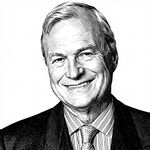
Founder of AXA
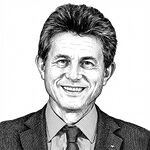
Former Chairman and CEO of AXA
References
- ↑ 1.0 1.1 1.2 1.3 1.4 1.5 13th International Conference: Keynote speech Thomas Buberl. InsuranceEurope. June 2023.
- ↑ 2.0 2.1 2.2 2.3 2.4 2.5 20 minutes avec le PDG d'AXA. Romain Lanéry. July 2025.
- ↑ 3.0 3.1 Thomas Buberl on Climate Leadership. YouTube. 2023.
- ↑ 4.0 4.1 4.2 4.3 Thomas Buberl on Systemic Risk. YouTube. 2021.
- ↑ 5.0 5.1 5.2 5.3 Thomas Buberl on Social Cohesion. YouTube. 2024.
- ↑ 6.0 6.1 6.2 6.3 Thomas Buberl on The Energy Transition Paradox. YouTube. 2024.
- ↑ 7.0 7.1 7.2 7.3 Les Matins HEC with Thomas Buberl. HEC Alumni. 2018.
- ↑ 8.0 8.1 8.2 8.3 8.4 8.5 Thomas Buberl on Public-Private Solidarity. YouTube. 2022.
- ↑ 9.0 9.1 9.2 9.3 Seismic generational shifts: Millennials as catalysts of change. Economist Impact. March 2017.
- ↑ 10.0 10.1 10.2 10.3 10.4 10.5 10.6 10.7 10.8 "Thomas Buberl". Wikipedia. Retrieved 2025-11-20.
- ↑ 11.00 11.01 11.02 11.03 11.04 11.05 11.06 11.07 11.08 11.09 11.10 11.11 11.12 11.13 11.14 "Comment Thomas Buberl transforme Axa". Le Journal du Dimanche. Retrieved 2025-11-20.
- ↑ 12.0 12.1 12.2 12.3 12.4 12.5 12.6 12.7 "Thomas Buberl". Blavatnik School of Government, University of Oxford. Retrieved 2025-11-20.
- ↑ 13.0 13.1 "From Lancaster MBA to AXA CEO". Lancaster University. Retrieved 2025-11-20.
- ↑ "Financial statements 2018 Bertelsmann SE & Co. KGaA" (PDF). Bertelsmann. Retrieved 2025-11-20.
- ↑ 15.0 15.1 15.2 15.3 15.4 15.5 15.6 15.7 "Season 2 – Ep. 9 | Trust Your Gut: AXA's Thomas Buberl Talks Transformation and Reinvention". Russell Reynolds Associates. Retrieved 2025-11-20.
- ↑ 16.0 16.1 "Thomas Buberl, l'exception culturelle allemande d'Axa". Le Monde. Retrieved 2025-11-20.
- ↑ 17.0 17.1 "AXA weighs 650 Belgium job cuts in 'transformation' to strengthen unit". Insurance Journal. Retrieved 2025-11-20.
- ↑ 18.0 18.1 "Axa chief executive launches big shake-up to simplify company". Financial Times. Retrieved 2025-11-20.
- ↑ "Increases to CEO compensation might be put on hold for now at AXA SA (EPA:CS)". Webull / Simply Wall St. Retrieved 2025-11-20.
- ↑ "Thomas Buberl set for CEO reappointment at AXA". BoardStewardship. Retrieved 2025-11-20.
- ↑ 21.0 21.1 21.2 "Qui est Thomas Buberl, l'homme pressé d'Axa ?". Trends-Tendances. Retrieved 2025-11-20.
- ↑ "Team members: Thomas Buberl". Redalpine Venture Partners. Retrieved 2025-11-20.